The pain and trauma of 9/11 shaped many of those leading NYC 25 years later
Published in News & Features
NEW YORK — The attacks of Sept 11, 2001, claimed thousands of lives and shattered countless families, but the trauma of that day and the resilience NYC showed in the weeks and years following the destruction of the Twin Towers also helped shape many who would go onto key positions of leadership in the worlds of politics, business and culture.
Here are just a few of their stories:
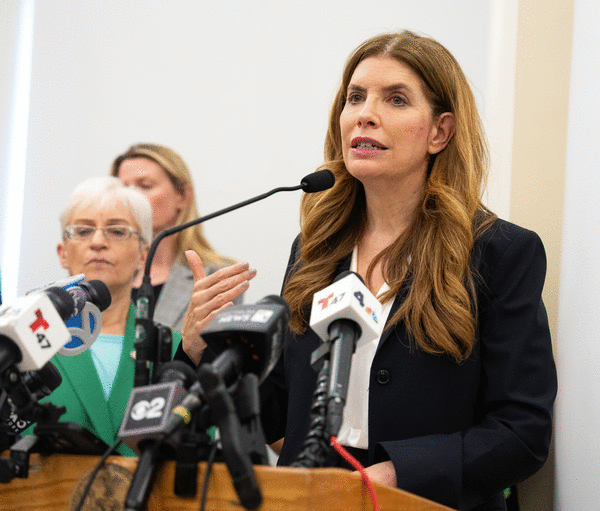
Julie Menin, NYC Council speaker
Julie Menin was living in lower Manhattan and running a small bistro across from the New York Stock Exchange when the terrorists struck, turning her bustling neighborhood into a roiling sea of smoke, debris and death.
Her husband had scheduled a meeting in the World Trade Center, but switched the location at the last moment. She was supposed to be attending a restaurant expo on the concourse of the Twin Towers on Sept. 12.
“Between the two close calls, and what I saw around me, I knew I had to do something,” Menin told the Daily News. “It was an unbelievably harrowing time. Our community was in ruins.”
With her business practically destroyed, Menin founded a non-profit called Wall Street Rising to help spearhead the downtown business recovery. She went on to lead the local community board in Tribeca for three terms as the neighborhood rebuilt, returned to normal and became more desirable than ever in the years following the attack.
“To me, 9/11 was why I got involved in public service,” she said. “I just think it was an obligation. Our city was in crisis. I felt compelled to get involved. What else could I do?”
The fight became even more deeply personal for Menin. Her mother, a Hungarian Holocaust survivor, died of cancer that she blames on her exposure to toxic chemicals in the immediate aftermath of the terror attacks.
Menin eventually moved to the upper East Side and won election as a council member. She was elected City Council speaker this year, where she’s had a sometimes contentious relationship with Mayor Zohran Mamdani, a fellow Democrat. Some predict she could one day run for mayor.
She is still fighting to get the federal government to continue funding its 9/11 health program and for the city to release any records it has about what officials knew at the time about the dangers posed by the toxic fumes.
“It’s unconscionable and infuriating,” she said. “The fact that we have to fight for funding and for the release of these documents. It’s unbelievable we’re in this situation 25 years later.”
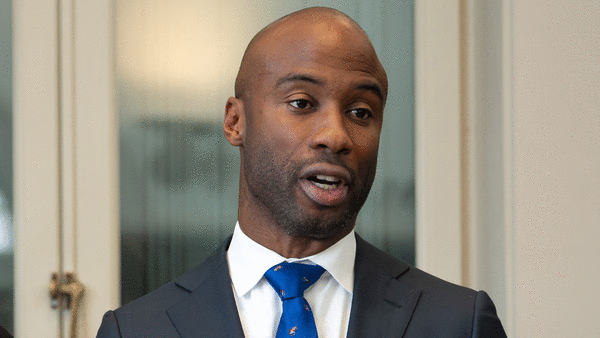
Kamar Samuels, NYC Schools Chancellor
Kamar Samuels started as a classroom teacher at MS 194 on the Gun Hill Road section of the East Bronx while the aftermath of 9/11 was still acutely felt by young New Yorkers.
The future New York City Schools Chancellor spoke at a recent event about how the traumatic fallout from the terror attack forced teachers and students alike to confront their fears and build unity, across the city and the nation.
“When I first started teaching, the current event was 9/11, and the bias was Islamophobia,” said Samuels, who was born and raised in Kingston, Jamaica and began his teaching career in 2003. “Since then, we’ve seen all kinds of bias arise at different moments. And we need to meet these moments.”
Samuels said surviving and thriving during crises like the terror attacks can teach school communities old-fashioned but crucial lessons.
“We have to help our young people navigate across difference, so that they can build empathy,” Samuels said at the event for NYC teaching fellows. That’s truly what’s not, what I call, AI-able. They have to be able to connect across difference.”
Lillian Bonsignore, FDNY Commissioner
New York City Fire Commissioner Lillian Bonsignore was an instructor at the EMS Academy at Fort Totten in Queens when two highjacked commercial jetliners obliterated the World Trade Center’s Twin Towers on Sept. 11, 2001. Everyone at the academy that day scooped up their gear, marshaled ambulances, commandeered city buses from a nearby hub and formed a convoy headed south.
They set off to rescue critically injured patients, “but there weren’t any,” Bonsignore said. They functioned instead as a “forward morgue,” moving remains and trying to match them with items that could identify the dead.
The horor and pain of that day helped shape her approach. Bonsignore said she’d always been motivated “to help our younger generation prepare for anything that they were going to see,” and the World Trade Center attacks strengthened that resolve.
“I felt personally responsible to help prepare the next generation for anything that was going to come their way,” Bonsignore said. “That included leadership.”
Bonsignore became an EMS lieutenant in 2005 and a paramedic in 2007. In 2016 she was appointed chief of the EMS Academy in Fort Totten and then chief of the city’s EMS Operations three years later.
Throughout her career, Bonsignore maintains “never forget” as not just a slogan but also a living practice. Of today’s 17,000 FDNY members, only about 700 remain who were working and responded during 9/11.
“This responsibility of never forget is going to be transferred to the shoulders of people who weren’t there,” Bonsignore noted. “Because at some point the 700 of us will have moved on.”
The FDNY has taken an array of steps as technology has advanced to improve its crisis response capabilities. It adopted the National Incident Command System, which standardizes emergency-response communication across the nation during a mass casualty event; added digital capabilities to make the department’s radio system more reliable, and improved interagency communication. An FDNY counterterrorism unit coordinates with federal officials and agencies to prepare for potential local impacts of world events.
“The fire department is in a whole new place,” Bonsignore said. “We had to build back, and we had to build back stronger and better and more prepared than we ever were. We continue to move forward and as an organization to prepare for anything.”
Steve Fulop, Partnership for New York
Steve Fulop was already sitting at his desk at Goldman Sachs in lower Manhattan after his regular 7:15 am meeting on Sept. 11, 2001.
As the World Trade Center burned a few blocks away, the recent college graduate was evacuated by ferry to his home in New Jersey. He watched the second tower collapse from the middle of the Hudson River.
“That moment had a profound effect on me,” Fulop told the Daily News. “Before then, I was thinking about maximizing what I could make financially. I started thinking more about service, what I could do for the community.”
Within months, the future mayor of Jersey City had decided to quit the dream Wall Street job and enlist in the Marine Corps instead. The terror attacks were the impetus for that transformation.
“I signed up, saying I was willing to do anything for this country,” he said, “because I believe I’m one of the beneficiaries of everything it’s done for me.”
After serving in Iraq, Fulop returned to New Jersey and plunged into public service. At 28, He beat an incumbent to became the third youngest city council member in Jersey City history. Fulop served three terms as Jersey City mayor, and once took a swipe at then-candidate Donald Trump for his false claim that some Muslims in Jersey City celebrated the terror attacks. He lost the 2025 Democratic primary for governor.
This year, he became the new head of the Partnership for New York, a public policy group representing some of the city’s biggest businesses, a post where many expect him to fight against higher taxes proposed by Mayor Mamdani.
Even a quarter century later, Fulop says the horrific events Sept. 11 shape his life on a daily basis.
“The trajectory I was on, on Sept.10 was totally different,” he said. “My priorities and motivations changed. I would still draw a straight line from what happened to who I am today.”
Shahana Hanif, NYC Council member
Ten-year-old Shahan Hanif was walking with friends to the mosque near her Brooklyn home a couple of weeks after 9/11. A car pulled up and the driver yelled: “Terrorists!”
The terrified girls ran. A few days later, the fifth grader got her older cousin to help draft a letter to President George W. Bush, asking him to help protect her and other Muslims as a wave of Islamophobia hit NYC and the nation after the terror attacks.
“One of the first questions we asked each other was, ‘Can the president help us?’” Hanif recalled later.
They never got an answer, but the nascent organizing effort was a first taste of activism for Hanif, the daughter of Bangladeshi immigrants.
“In the aftermath of the attacks, my family and community were not only reeling from this violent destruction like all New Yorkers, but immediately and personally felt an increase in Islamophobia and a lack of safety,” Hanif told the Daily News.
Hanif went on to become the first Muslim woman elected to New York City Council and recently won reelection to a second four-year term representing a multicultural section of Kensington.
“Twenty-five years later, Muslim New Yorkers have built tremendous political power,” she said. “We have made progress not because Islamophobia disappeared, but because Muslim New Yorkers organized in spite of it.”
Howard Lutnick, US Secretary of Commerce
Howard Lutnick, then CEO of Cantor Fitzgerald, should have been sitting at his desk on the 105th floor of the World Trade Center when the first plane hit the building on Sept. 11, 2001.
Instead he was dropping his son off for his first day of kindergarten, where he got delayed.
Lutnick, who is now Commerce Secretary and one of President Trump’s most trusted advisers, cheated death on Sept. 11, but he lost his brother and best friend. His financial firm took one of the heaviest blows. It lost nearly 700 employees, a tally that was the single biggest for any organization after the NYPD and FDNY.
In a tearful interview a few days later In a tearful interview a few days later, Lutnick described frantically racing between emergency rooms hoping to get staffers to find employees who might have survived. “Find somebody on this list,” he told them. “I don’t care who they are.'”
He ordered the firm to set aside 25% of its profits over the next five years to support the survivors and their families.
“No cap, no limit,” Lutnick said. “The more we make, the more successful we can rebuild our company. We share it together.”
----------
©2026 New York Daily News. Visit at nydailynews.com. Distributed by Tribune Content Agency, LLC.


Comments