Aggressive Plaskett fire outgrows Timber fire as California's Big Sur wildfires rage
Published in News & Features
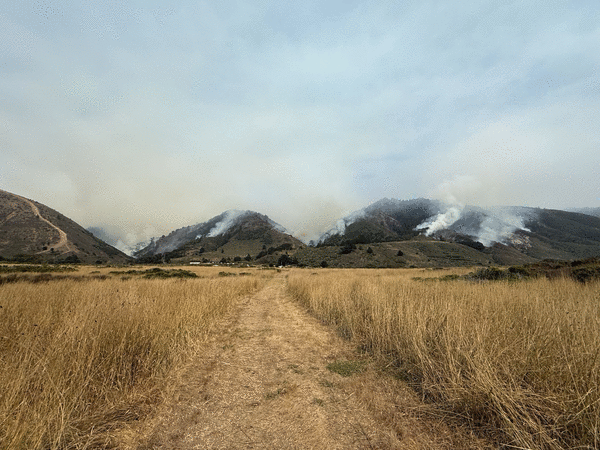
LOS ANGELES — One of two destructive wildfires burning near Big Sur in Monterey County has nearly doubled in size over the last two days. The aggressive Plaskett fire overtook the Timber fire in size, and together they have blackened more than 50,000 acres.
The twin wildfires have led to the closure of 50 miles of Highway 1, as well as popular state parks including Pfeiffer Big Sur and landmark sites such as Nepenthe restaurant, the Big Sur River Inn and the Henry Miller Memorial Library.
Officials, however, said favorable weather in the coming days could help in the battle to control the blazes.
The 29,000-acre Plaskett fire ignited on Aug. 26 and was 1% contained as of Tuesday evening. The blaze was at 15,500 acres as of Monday morning but by around 4:30 p.m had exploded to 26,700 acres — outgrowing the Timber fire to become the state's third-largest fire by acreage, according to the California Department of Forestry and Fire Protection.
Much of that "aggressive growth" Monday was along the Plaskett fire's eastern edge, the U.S. Forest Service said in an update that evening: "Steep terrain and thick fuels remain the primary driver of fire behavior."
The Timber fire, which ignited on Aug. 8 in an area about 30 miles to the north of where the Plaskett blaze would later begin, has burned about 25,200 acres. It was 22% contained as of Tuesday evening as fire crews indicated progress in controlling the blaze had been made.
Nearly 1,100 people have been evacuated as a result of the Timber fire, said Lee Beyer, a spokesperson for the U.S. Forest Service.
Beyer said he could not say how many people had been evacuated as a result of the Plaskett fire. A second incident management team took over the fire on Tuesday and was not immediately available for comment. But Beyer noted that the Plaskett fire is burning in a more remote area than the Timber fire.
On Tuesday, the Timber fire grew about 33 acres, authorities said. A joint statement from multiple agencies including the U.S. Forest Service and Monterey County Sheriff's Office described it as a "minimal change" — the result of "aggressive day and night firefighting as well as favorable weather, moderated fire behavior and better mapping of the fire perimeter."
With the Plaskett fire, "the combination of fuels and topography made [for] a really aggressive fire movement," Beyer said. The fire reached an area that most recently burned in the 1970s, and the dense vegetation, strong winds and sloped terrain all made the fire harder to put out, he said.
The humidity and cooler temperatures forecast for the coming days, Beyer said, are expected to help with firefighting efforts. "It's like starting a campfire with wet wood versus dry wood," he said.
The National Weather Service's Bay Area office said in its Tuesday afternoon forecast that it expected cooler than average temperatures and a deepening marine layer to result in "improved overnight humidity recoveries through Friday."
"Chances for drizzle and light rain linger through Friday," the agency said.
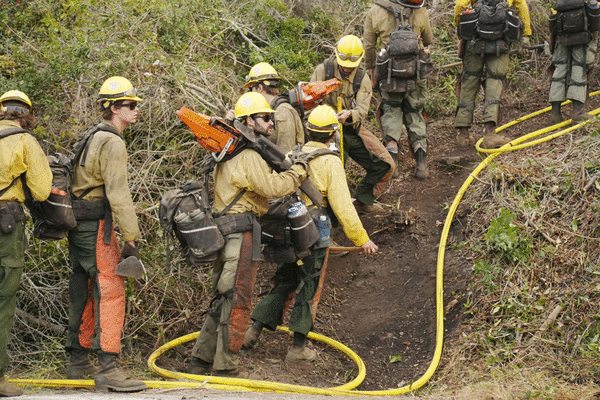
According to Cal Fire, around 3,000 personnel, scores of engines, helicopters, dozers and other equipment are being used to battle the fires, with "numerous" air tankers from throughout the state flying fire suppression missions.
Beyer said there are "absolutely" enough resources to battle the flames as few other major fires are concurrently burning in other parts of the state.
Travelers to the area are having to find alternate routes as a long stretch of Highway 1 remains closed. The northern end of the closure is near Little Sur River, at Mile Marker 56, while the southern end is near the San Luis Obispo County line, at Mile Marker 0.09, according to Cal Fire.
Mandatory evacuation orders, evacuation warnings and shelter-in-place orders have been issued across the region. A map showing current evacuations can be found here. Evacuation shelters for both fires have been opened at the Carmel Mission Inn and Cambria Veterans Memorial Hall.
As the Timber fire continued to burn, firefighting crews over the weekend wrapped a historic cabin in Big Sur built by settler John Pfieiffer in a fire retardant material that looks similar to tin foil, KSBW reported.
Beyer said the material works by reflecting radiant heat and blocking embers from entering the structure.
The cause of both fires remains under investigation.
©2026 Los Angeles Times. Visit at latimes.com. Distributed by Tribune Content Agency, LLC.






Comments