No passport. No flights. No easy way home for Venezuelans who want to leave Chicago
Published in News & Features


CHICAGO — Drawn by the promise of a free flight back to her native Venezuela, Yessica Torres downloaded the U.S. Customs and Border Protection Home app, believing it would cover the plane tickets for Torres and her family.
But after almost a year of waiting for CBP to arrange their travel, Torres now feels stuck in a country that denied her family asylum and whose president has campaigned for their departure. She does not have a passport — the last Venezuelan consulate in the U.S shuttered years ago — and the CBP Home app, which promised to fly her back as part of a program called “Project Homecoming,” has yet to follow through on its proclamation of cost-free travel and a monetary exit bonus.
“There shouldn’t be so much paperwork, so many permits to leave,” said Torres, 34, who is staying in a shared apartment in Chicago with her partner and two young children. “If that’s what they want — that we leave.”
Torres is one of countless Venezuelan immigrants who want to return to their home country, but have been unable to because of the broken diplomatic ties and bureaucratic hurdles between the two countries. Currently, there are no direct flights from the U.S. to Venezuela, and Venezuelan passports and other vital travel documents are nearly impossible to obtain after the countries broke off diplomatic relations with each other in 2019.
Some Venezuelans have found themselves in the position of making the same harrowing trek they endured to get to the U.S. — traveling across multiple countries, sometimes through dangerous territories — to return home.
“They left the country not looking for anything other than stability and peace,” said Illinois Venezuelan Alliance vice president of the board Jose Morales. Now, he said, they are returning back, in part, “because of the persecution by this government.”
To be sure, since the Trump administration’s ouster of then-President Nicolás Maduro in early January, an easier pathway could be on the horizon. Last month, the U.S. formally reopened its embassy in Caracas — though resumption of consular services, where Americans and Venezuelans go for passport and visa services, will take time, according to the State Department. And American Airlines announced this week that flights from Miami to Caracas are expected to resume as soon as April 30 once all government and security checks are approved.
But for Venezuelans who have spent the past year watching federal immigration agents roughly detain their countrymen — active asylum cases or not — a safe way out of the U.S. can’t come soon enough.
“The American Embassy is open in Venezuela but the Venezuelan Embassy is still not open in Washington,” Morales said. “And consulates are not still open specifically in Chicago … that means we are in exactly the same position.”
So until then, Venezuelans in Chicago are trying to make their own way home.
Safe passage
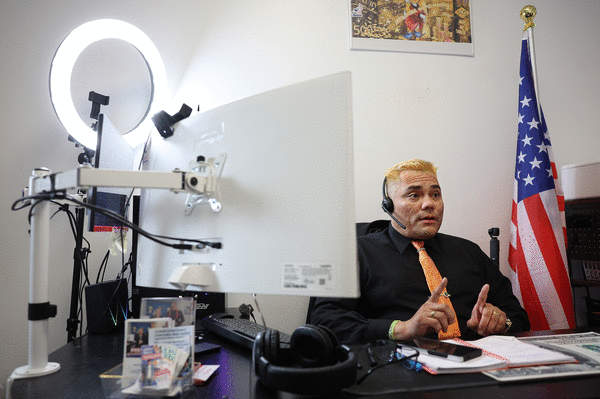
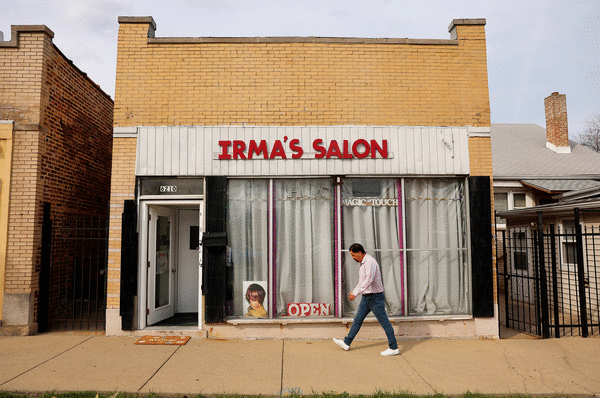
In a small office next to a hair salon on the Northwest Side of Chicago, Danilo Sansonetti, a Venezuelan native, answered phones and welcomed clients in person on a recent Thursday afternoon. A small Venezuelan flag sat on his desk, while a large U.S. flag stood behind him.
Sansonetti, who moved to Chicago in 2022, established a small private agency just a year after arriving to help his compatriots navigate various government and public processes, including obtaining a temporary travel document called “salvoconducto,” or safe passage, required to fly back to Venezuela if they do not have a passport.
“I saw how some of my people had a hard time doing simple things, like paying a toll online or filling out documents,” he said. “I decided to open up this agency with my wife.”
Sansonetti said that in the past year, more than 100 people have asked him for help obtaining the salvoconducto, which essentially functions as a stand-in for a passport. Most Venezuelans lack passports because they are difficult and expensive to obtain, he said. Many cannot afford the roughly $200 fee, so they often only come to the U.S. with a birth certificate or a national ID.
While some agencies charge up to $400 to assist with the process, Sansonetti said he provides the service free of charge.
“If they’re leaving, it’s because they’re desperate to return. They are going through a hard time here that they need to return,” Sansonetti said.
To obtain a salvoconducto, Venezuelans must have an identifying document like an ID, a photo, and a copy of their flight ticket to Venezuela. The document is issued at no cost, but the purchased flight can cost thousands of dollars for families who are often without means.
Sansonetti said the document must also be requested online from within Venezuelan territory, as the application website is not accessible from the United States or Mexico — another hurdle.
In many cases, people turn to someone like Sansonetti when they do not have anyone in Venezuela to help them complete the process. He works with a contact in Venezuela to submit the application on their behalf. Once approved, the document is downloaded and printed for the client.
The process typically takes between one and two weeks. The document must be presented at the airport before boarding a flight.
But the salvoconducto is not a living document. It is only issued for a specific travel date, said Ana Gil, a co-founder of the Illinois Venezuelan Alliance. Which means that a flight delay or cancellation may invalidate it. Another risk: Immigration authorities at the airport might not accept the document for travel, Gil said.
“There is not a standard procedure because those regulations could be subject to immigration officers and that is what is making things more difficult for people,” said Gil.
Torres said that after the family’s planned flight in July back to Venezuela was unsuccessful, she and her family went to the U.S. Immigration and Customs Enforcement office in Chicago to inquire about their supposed flight. They were told to keep waiting.
The issue seemed to be obtaining their travel permits or a salvoconducto, according to an email from CBP representatives shared by Torres, where she was asked to notify them of any updates in getting her travel documents.
“Until now they haven’t given us any answers,” said Torres, who arrived in Chicago with their two young children in 2023 after fleeing the economic collapse in Venezuela. “What a load of trouble it is to leave here.”
In an email to the Tribune, DHS confirmed that Torres and her partner Carlos Bastidas each signed up through the CBP Home app in June of last year but were unable to leave because they do not have travel documents.
“Project Homecoming is continuing to work with (Torres and Bastidas) to get the documents they need to return home,” a DHS spokesperson told the Tribune.
Online tutorials for obtaining temporary travel documents have proliferated with so-called travel agencies explaining the convoluted process on YouTube and offering their travel services. Locally, Gil said the alliance receives multiple calls each week from people who need travel documents to go to Venezuela
“This has been a nightmare for us,” Gil said. “We need to have diplomatic relations back, we need to have a consulate open, an embassy open.”
Bastidas chose to ask a family member in Venezuela to go to the government agency in charge of issuing salvoconductos and inquire about it in person. He heard of salvoconductos that turned out to be fraudulent and prefers to stay on the safer side — contacting national authorities directly, then having the document mailed to him.
“That’s the safest thing you can do,” he said.
He said he was told the salvoconducto cost around $120, another common occurrence among Venezuelans of conflicting information about the process. But what is understood is that to obtain the travel document, the couple need to show an exact travel date, which means they need to purchase their flights in advance. And they cannot afford it yet.
Amid the uncertainty of her return, Torres likes that her 13-year-old daughter is learning English and that her 10-year-old son is getting a good education in school, something they didn’t used to have back in Venezuela.
But because they can’t legally work in the U.S., they’re determined to go back.
CBP Home app — a promise
To encourage immigrants without legal status to leave the country, the Trump administration launched the CBP Home app on March 10, 2025, as part of Trump’s Project Homecoming initiative.
The app includes an “Intent to Depart” feature that assists immigrants who do not have a criminal record in leaving the country, according to DHS.
“There is ZERO excuse for you to stay in the United States if you are an illegal alien. The United States taxpayer is generously offering those in this country illegally $1,000 and a free flight home,” said then-DHS assistant secretary Tricia McLaughlin in July 2025.
On its website, DHS claims the app offers a “historic opportunity” for unlawful immigrants to “receive cost-free travel” and, in January, upped its exit bonus from $1,000 to $2,600 to leave the country. The website states it can assist travelers in obtaining valid travel documents and help with transportation to the airport.
The offer was appealing to Torres and Bastidas, and in June of last year, they decided to give it a go. Torres downloaded it on her phone and entered her personal information, including photos of herself and her family as requested by the app.
She said the app was easy to use and that the process was straightforward at first.
Around June 20 she received an email from CBP Home representatives telling her she would receive a free flight out of the country and the exit bonus on arrival to her destination country. They would also help them obtain valid travel documents if they didn’t have any, the email said.
She was happy to receive a call in Spanish from CBP representatives who asked her about her availability to fly back to Venezuela in July.
“I was excited,” Torres said. “I shipped all my things to Venezuela and said goodbye to my friends.”
But after that call she did not hear back about her flight tickets or her travel documents.
“Then the day came and nothing,” Torres said. “I was left up in the air.”
Jennifer Ibañez Whitlock, senior policy counsel at the National Immigration Law Center, said the group has found the app unreliable in assisting travelers with documents if they do not have a passport, sometimes asking people to contact their country’s consulate for help. She said there is little public data available about the CBP app. Most of the information comes from statements to the media.
Indeed, in an email to the Tribune, a DHS spokesperson wrote that more than 2,000 Venezuelan immigrants were able to self-deport using the app and those who qualified received the stipend, which is delivered via commercial wire service. Nearly 100,000 people have used the CBP Home app as of its one-year anniversary, according to a Jan. 21 DHS release, which also claimed it was a “fast, free, and easy process.”
But on the ground, advocates seem to agree there are mixed results with the app.
Venezuelans may wait in limbo for several months after submitting their departure intent before hearing back from CBP App representatives about travel arrangements, Gil said.
Beth Brown, who launched the Faith Community Initiative in 2023 to help support Venezuelan immigrants, said she is seeing more families wanting to self-deport in the last year partly because their family members were getting detained and deported. But not everyone has been successful in using the app, she said.
“The federal government is making it sound like it’s so easy to self-deport and anyone who wants to can, and it’s absolutely not the truth,” said Brown. “If they want them to leave, why can’t they figure out a way to allow people to leave?”
DHS told the Tribune they try to help immigrants looking to self-deport obtain their travel documents by engaging with foreign governments and providing “case-specific guidance” to immigrants. But sometimes the documents are issued by the destination country and “cannot be compelled” by the U.S.
“Voluntary self-deportation remains subject to commercial carrier requirements and the admission requirements of the destination country,” the DHS spokesperson said in the email. “Individuals can also use Project Homecoming to fly to a different country they have legal status in.”
Sansonetti said many people choose to return by land to avoid obtaining the salvoconducto. They typically travel by bus to San Antonio and cross into Mexico, beginning the sometimes month-long journey back to Venezuela.
“They are just afraid to come across immigration agents. They’re afraid to get detained,” Sansonetti said. “So they avoid the airport.”
Some have traveled by car or bus to Mexico, where entry without valid passports is easier, and from there go to Venezuela. But that comes with its own risks. Some Venezuelans have faced extortion and kidnapping at the border with Mexico, according to the Kino Border Initiative and other advocacy groups that work with migrants.
CBP exit bonus — a ‘gamble’
Asmeryi Pereda saw no choice other than figure out how to return to her native Venezuela after her partner was detained in Chicago and deported last year as part of Trump’s mass deportation campaign.
“I had no money, no job, and no way to return home,” said Pereda, 23, who came to Chicago in 2022 as an asylum seeker.
Pereda, who has two small children ages 4 and 1, worried about her family’s well-being after her partner’s deportation following his detention in September.
Asmeryi Pereda holds her son Lennyel, Sept. 23, 2025, while talking to her husband, Darwin Leal, by phone. (Terrence Antonio James/Chicago Tribune) Pereda chose to self-deport using the CBP Home app, counting on the free tickets and help to obtain valid travel documents that the app claimed to offer. So far, she has received neither.
Pereda and her eldest daughter did not have passports, but a DHS representative told her she was ineligible for a free ticket because she had a U.S.-born child who would require a visa, she said.
Desperate to leave, she learned of an agency that claimed it could help her return to Venezuela by using a salvoconducto.
After raising about $4,000 to cover travel costs including about $400 in agency fees for processing the documents, Pereda and her children left for Venezuela in November, traveling to Miami and Curacao before landing in Caracas.
Still hopeful she would receive the exit bonus, Pereda said she sent CBP the documents to confirm her return: identification, proof of location, the date she left the U.S., and an official document showing her departure.
It has now been four months since her return, and she says she has received no communication from CBP or immigration authorities about the money they promised to send.
“They (CBP) promised that they were going to send me some money for me and my daughter, but I never got it,” Pereda said.
DHS says on its website that the money is delivered to immigrants “after they land in the country of arrival” but offers scant information about how it will be delivered, with methods varying by country.
DHS told the Tribune the stipend is delivered via commercial wire service to those who qualified and used the app successfully, including 2,000 Venezuelans immigrants.
But Gil said while she has heard of some receiving the money via Western Union, not every country has one, and that people are “not informed” about what the delivery process looks like for the exit bonus.
“Most of the immigrants say that despite using the app, they have not received promised financial assistance and the travel arrangements,” said Gil, calling it an “unfulfilled promise.”
Sansonetti is even more skeptical.
“I would say that not a single person I’ve helped return has received any of that money,” Sansonetti said. “Once they leave, they can’t make any claims. They’re already gone.”
Whitlock from the National Immigration Law Center called the exit bonus a “gamble.”
“Some people have been able to use it successfully and have received the wire transfer when they arrive,” said Whitlock. “Others never get an email back.”
Pereda said in her hometown in Venezuela, electricity is unreliable, job opportunities are scarce and access to food is limited.
“Sometimes we eat, sometimes we don’t, but I’m pushing forward for my children,” she said from Venezuela.
A waiting game
On a recent day, Torres’s son was blowing up a birthday balloon for another resident who was turning 7 and was celebrating in the shared living room.
Torres and Bastidas are still saving up for the approximately $4,000 in airfare they need to return, in addition to the $480 for the salvoconductos.
Torres, who keeps her dark red-colored hair tucked neatly in braids, spends most of her mornings cooking traditional Venezuelan food — pabellon, arepas, roasted chicken — that she packs in to-go containers and sells to deliveristas who stop by for a quick meal.
Sometimes as many as 20 people stop by for lunch, she said.
“I have to get up early and cook quickly because I’m not the only one,” she said about the kitchen she shares with three other families.
When she goes back to Venezuela she wants to work in the restaurant business as a cook, which is how her parents — who are both cooks — met each other.
Bastidas used to be a DJ and a mechanic in his home country. The couple plan on turning a section of the house they bought in Venezuela last September for his mechanical business endeavors.
Bastidas, who works as a food deliverista and a construction worker in Chicago, can’t wait to go back to his country to reunite with his family and make memories in his new home.
“Our wish is to, first off, return and see our family,” said Bastidas, 36. “And give some warmth to our little house.”
But leaving the country has been harder than he thought.
“I thought it was harder to come into [this country], than leave it,” Bastidas said. “Now it’s harder to leave than enter it.”
____
©2026 Chicago Tribune. Visit at chicagotribune.com. Distributed by Tribune Content Agency, LLC.





Comments