US, Iran fail to reach deal after marathon talks, Vance says
Published in News & Features
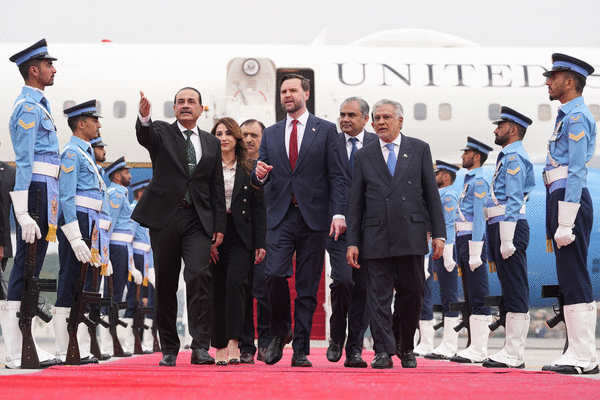
The U.S. and Iran failed to reach an agreement after marathon talks in Pakistan, raising doubts about whether they can find a lasting resolution to a six-week war that has killed thousands and disrupted energy supplies across the globe.
Vice President JD Vance said negotiators will return to the U.S. without a deal after Iran failed to give a commitment it would not seek a nuclear weapon. Iranian media said the U.S. made “excessive” demands, although a spokesman for Iran’s Foreign Ministry appeared to leave the door open for more discussions.
“We’ve made very clear what our red lines are, what things we’re willing to accommodate them on, and what things we’re not willing to accommodate them on,” Vance told reporters early Sunday in Islamabad. “And we’ve made that as clear as we possibly could, and they have chosen not to accept our terms.”
It wasn’t immediately clear what the breakdown in talks meant for the fragile two-week ceasefire clinched last week. U.S. President Donald Trump hasn’t yet commented on the talks since they ended, although he posted a story about a naval blockade on his social media.
Failure to reach a deal after the marathon talks will likely jolt oil and gas markets on Monday, although there were indications of an uptick in traffic through the strait on the weekend. The conflict has roiled the world economy and upended global energy supplies.
“Hope had been cautiously rising last week but this could set us back to levels that we were trading at prior to the ceasefire announcement,” Nick Twidale, chief market analyst at AT Global Markets in Sydney. “I would think we will see oil open higher alongside the dollar.”
Pakistan, which hosted the meetings, said the talks were “constructive” and called on both sides to maintain the ceasefire, saying it would continue to facilitate discussions between the U.S. and Iran in the coming days. Zev Elkin, an Israeli security Cabinet minister, said Sunday that the two-week ceasefire period hadn’t yet ended and “it’s possible that there will be attempts to generate more talks.”
Esmail Baghaei, the spokesman for Iran’s Foreign Ministry, said an understanding was reached on some issues but disagreement remained “on two or three key points.”
“It was natural that one should not have expected to reach an agreement in a single session from the outset,” Baghaei said on Iranian state television after the talks. “Diplomacy never ends” and Iran will “continue to pursue national interests under all circumstances,” he added.
Iran’s virtual closure of the Strait of Hormuz — a crucial waterway for about a fifth of global oil flows — and the continued fighting between Israel and Hezbollah in Lebanon had been two key contentions in the talks.
The U.S. had sought concessions they couldn’t obtain in the war, including around the Strait of Hormuz and the removal of nuclear materials, Iran’s semi-official Tasnim news agency said.
Vance arrived in Islamabad on Saturday and was joined by Jared Kushner and Steve Witkoff to negotiate with a 71-member strong Iranian delegation led by Parliament Speaker Mohammad-Bagher Ghalibaf.
“We need to see an affirmative commitment that they will not seek a nuclear weapon, and they will not seek the tools that would enable them to quickly achieve a nuclear weapon,” Vance said. “That is the core goal of the president of the United States, and that’s what we’ve tried to achieve through these negotiations.”
Michael Kugelman, a resident senior fellow for South Asia at Atlantic Council, said the high profile nature of the talks shows the U.S.’s commitment to the talks.
“The US, for domestic political reasons, wants a deal that enables it to exit the war,” he said in a post on X. “Despite Vance’s comments, this likely isn’t over. More talks could come,” although it’s unclear if that would take place in Pakistan or elsewhere, he said.
Direct talks between the two sides started at 5:30 p.m. on Saturday in Islamabad. A team of technical experts had joined the talks after the first hour, with discussions focused on the Strait of Hormuz, a potential ceasefire extension and phased sanctions relief, according to a US official and a Pakistani official familiar with the matter.
Trump, who has said that curbing Iran’s nuclear ambitions was a reason for the war, downplayed the importance of the talks on Saturday night. As he departed the White House to attend a UFC fight in Miami, he declared: “Whether we make a deal or not makes no difference to me. And the reason is because we’ve won.”
Ghalibaf had been wary of the negotiations before the talks began, saying on his arrival in Islamabad on Saturday that “we have goodwill, but we do not have trust.” Iran had also insisted that a ceasefire in Lebanon should be a pre-condition for talks. Israel, which was not party to the Islamabad negotiations, has continued to strike towns in southern Lebanon.
Trump has alternated between threatening to wipe out “a whole civilization” and saying a U.S.-Iran deal “could be the Golden Age of the Middle East.” Iran has said more than 3,000 people have been killed in U.S.-Israeli airstrikes.
(Rieka Rahadiana, Yi Wei Wong, Aradhana Aravindan, Ben Bartenstein, Ruth Carson, Iris Ouyang, Faseeh Mangi, Bilal Hussain and Dan Williams contributed to this report.)
©2026 Bloomberg L.P. Visit bloomberg.com. Distributed by Tribune Content Agency, LLC.






Comments