US, Iran fail to reach deal after marathon talks, Vance says
Published in News & Features
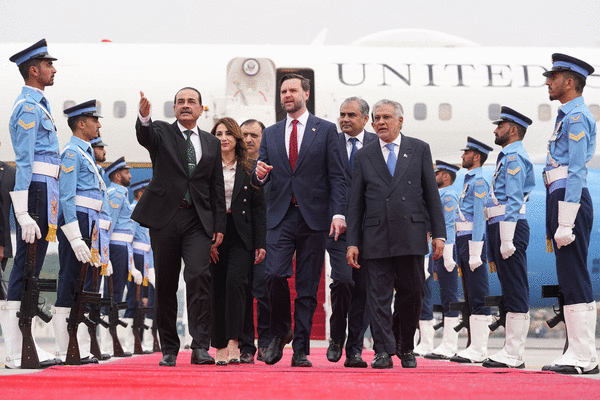
The U.S. and Iran failed to reach an agreement after marathon talks in Pakistan on the weekend, a major setback to finding a lasting resolution to the six-week war in the Middle East.
Vice President JD Vance said negotiators will return to the U.S. without a deal after Iran failed to give a commitment it would not seek a nuclear weapon. Iranian media also confirmed a breakdown of the talks, with the semi-official Fars news agency saying there are no plans for a new round of discussions.
“We’ve made very clear what our red lines are, what things we’re willing to accommodate them on, and what things we’re not willing to accommodate them on,” Vance told reporters early Sunday in Islamabad. “And we’ve made that as clear as we possibly could, and they have chosen not to accept our terms.”
The breakdown in the talks represents a setback for both sides after a fragile two-week ceasefire was clinched last week. Iran’s virtual closure of the Strait of Hormuz — a crucial waterway for about a fifth of global oil flows — and the continued fighting between Israel and Hezbollah in Lebanon had weighed on the talks in Islamabad.
Vance, who was joined by Jared Kushner and Steve Witkoff, had been negotiating with a 71-member strong Iranian delegation led by Parliament Speaker Mohammad-Bagher Ghalibaf.
Iran characterized the U.S.’s demands as “excessive,” according to the semi-official Tasnim news agency. The U.S. had sought concessions they couldn’t obtain in the war, including around the Strait of Hormuz and the removal of nuclear materials, Tasnim said.
“We need to see an affirmative commitment that they will not seek a nuclear weapon, and they will not seek the tools that would enable them to quickly achieve a nuclear weapon,” Vance said. “That is the core goal of the president of the United States, and that’s what we’ve tried to achieve through these negotiations.”
Direct talks between the two sides started at 5:30 p.m. on Saturday in Islamabad. A team of technical experts had joined the talks after the first hour, with discussions focused on the Strait of Hormuz, a potential ceasefire extension and phased sanctions relief, according to a U.S. official and a Pakistani official familiar with the matter.
Failure to reach a deal after the marathon talks will likely jolt oil and gas markets on Monday, although there were indications of an uptick in traffic through the strait on the weekend. The conflict has roiled the world economy and upended global energy supplies.
Ghalibaf had been wary of the negotiations before the talks began, saying on his arrival in Islamabad on Saturday that “we have goodwill, but we do not have trust.” Iran had also insisted that a ceasefire in Lebanon should be a pre-condition for talks. Israel, which was not party to the Islamabad negotiations, has continued to strike towns in southern Lebanon.
Trump has alternated between threatening to wipe out “a whole civilization” and saying a U.S.-Iran deal “could be the Golden Age of the Middle East.” Iran has said more than 3,000 people have been killed in U.S.-Israeli airstrikes.
(Rieka Rahadiana, Yi Wei Wong, Aradhana Aravindan and Ben Bartenstein contributed to this report.)
©2026 Bloomberg L.P. Visit bloomberg.com. Distributed by Tribune Content Agency, LLC.






Comments