Navy interested in expanding shipyard capacity in San Diego to remain battle ready
Published in News & Features
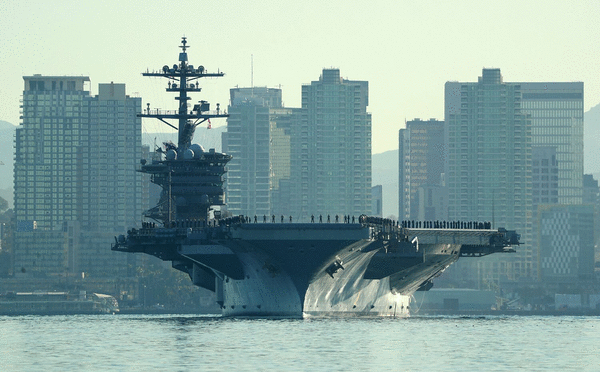
SAN DIEGO — Chief of Naval Operations Adm. Daryl Caudle said this week he wants to explore whether San Diego shipyards can expand their ability to repair and maintain warships to help the fleet remain battle-ready in the sometimes volatile Indo-Pacific and Middle East.
Caudle also said he’s trying to figure out ways to reduce the need to extend the mission of ships on deployment due to the fatigue and hardship it causes for sailors and their families, and the toll it takes on ships.
All three of the Navy’s San Diego-based carriers — the USS Abraham Lincoln, USS Theodore Roosevelt and USS Carl Vinson — have experienced extended deployments in recent years, affecting thousands of sailors.
Caudle made the remarks Tuesday while talking to reporters in San Diego, where he strongly endorsed a long-proposed plan to increase the number of manned ships in the fleet to roughly 381. It currently has fewer than 300 manned and deployable ships, stirring concern.
“The Navy has failed to increase its fleet size over the past 20 years — despite nearly doubling its shipbuilding budget,” according to a Government Accountability Office report issued last year.
Caudle said the Navy plans to greatly supplement manned warships — particularly carriers — with small, unmanned, autonomous vessels that can do everything from conduct surveillance to neutralize mines. They can be scaled to the size of the threat they need to deal with.
The Navy has already placed some unmanned surface vessels at Naval Base San Diego.
The “ghost ships,” as some call them, are not meant to eliminate the Navy’s fabled flattops.
“I love aircraft carriers,” Caudle, 62, told reporters Tuesday. “Nothing delivers combat power like that.”
He expressed special praise for the USS Abraham Lincoln, which is currently operating in the Arabian Sea. It was sent there by President Donald Trump to discourage Iran from attacking U.S. forces in the region and to compel it to renegotiate its nuclear program.
On Feb. 3, a Navy fighter jet shot down an Iranian drone that was headed toward the Lincoln, according to U.S. Central Command.
Carriers are always escorted by warships, particularly destroyers, which require maintenance and repair when they return to port. Four large-to-sizable shipyards do the brunt of that work in San Diego, the largest Navy base on the West Coast.
“I would definitely look to the leadership of the yards that are here — from General Dynamics and BAE and other companies — (and) what can they do to give me more capacity … ” Caudle told the Union-Tribune.
“Those conversations definitely have to be on the table.”
He did not indicate that the Navy had formally contacted the shipyards to discuss the matter.
Caudle was asked how the Navy can reduce the strain caused by continuously cycling local aircraft carriers to places such as the Indo-Pacific and Middle East.
“Where I come down hard as a service chief is conveying to leadership the downsides of extensions on deployments,” said Caudle, who didn’t elaborate.
A reporter also asked for the admiral’s thoughts on the Navy’s plans to spend billions of dollars to increase the size of the fleet.
“The Navy is so essential that I don’t think we can afford not to do it … ” he said. “When we dip down into low numbers (of ships), we see conflict spike up …
“My goal would be to sustain at least 4% of GDP spending here to actually make sure that we got the resources we need to build that type of Navy.”
_____
©2026 The San Diego Union-Tribune. Visit sandiegouniontribune.com. Distributed by Tribune Content Agency, LLC.






Comments