Looming questions for automakers ahead of Trump fuel economy rollback
Published in Business News


WASHINGTON — The Trump administration is expected to finalize dramatically relaxed fuel economy standards for consumer cars and trucks in the coming days, though questions and concerns loom over the new rules.
The rules, which analysts expect to mostly match a proposal from late 2025, would slash light-duty corporate average fuel economy (CAFE) requirements to a fleetwide average of roughly 34.5 miles per gallon through the 2031 model year, down from roughly 50 miles per gallon under Biden-era targets. The change will be the latest in a stream of moves under President Donald Trump to slash environmental requirements for the auto industry.
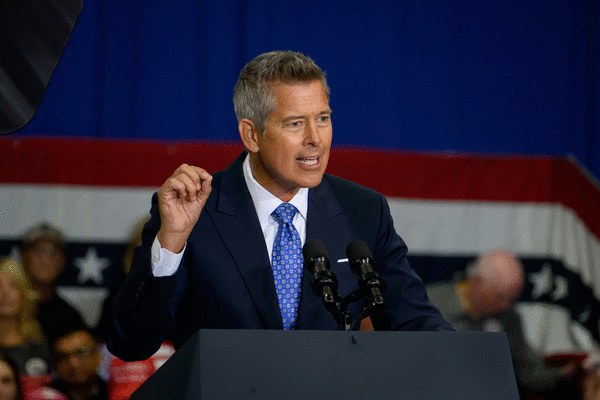
"We are about to announce a common-sense fuel economy standard because we want Detroit to build cars that Americans want to buy. Not cars that Democrats want Washington to build," Transportation Secretary Sean Duffy said during a visit to Sterling Heights on Aug. 31.
Detroit automakers and their competitors have already made major business shifts under Trump, even without new CAFE regulations on the books. Those shifts have involved significant retreats from electric vehicle investments and pivots to more reliably profitable gas-powered vehicles.
The administration has signaled since early in Trump's second term that it would take a wrecking ball to past regulations to give automakers maximum flexibility. However, analysts, critics and even automakers themselves have questioned whether the still-influential CAFE rules could help allay issues of affordability, global competitiveness and stability for an industry that has been on a regulatory rollercoaster over the past decade.
“Whipsawing the industry is not best for anyone. It doesn't help consumers. It doesn't help OEMs. It doesn't help manufacturing. It doesn't help jobs. The back and forth has been a very major drain on the industry and on consumers,” said Stephanie Brinley, associate director of AutoIntelligence for S&P Global Mobility.
She added: “Consistency is what automakers need. They need to know they can follow the rules, but they need to know what the rules are, and they need to know that the rules are going to still be there at the end of the product's life cycle.”
Beyond general stability, Brinley and others pointed to three major questions they are pondering as Trump and his administration's leadership at the National Highway Traffic Safety Administration prepare to unveil their final CAFE rule.
Is a crossover a car or a truck?
Three of the biggest policy changes in the Trump administration's December 2025 CAFE proposal were: a significant reduction in mpg targets from the Biden era, the elimination of EVs as a consideration in setting those targets, and a new definition for what constitutes a car versus a truck.
The first two changes were aimed at eliminating what Republicans often called a "mandate" for electric vehicles during the previous administration. Under the new proposal, automakers would be able to use EV sales to boost fuel economy scores, but NHTSA did not assume adoption of non-gasoline powertrains in its process for setting targets.
Legacy automakers like Detroit-based General Motors Co. mostly celebrated those moves amid a rocky and unprofitable transition to EVs across the industry.
"GM believes that the EV transition must account for market and consumer realities, accounting for customer preferences, affordability, convenience, and fuel availability. Ultimately, the market will determine how quickly the EV transition occurs," David Strickland, GM's VP of global regulatory affairs, said in a public comment.
He added: "The NHTSA proposal appears to go a long way toward aligning the regulations with market trends, balancing its statutorily required standard-setting criteria and ensuring continued efficiency improvements. GM appreciates NHTSA’s clear intent to align the regulation with market realities."
GM and its peers, however, vehemently opposed a draft change to how cars and trucks are classified for regulatory purposes.
NHTSA suggested that many vehicles currently regulated as light trucks, a category that includes most popular SUV offerings, instead be treated as passenger cars to align with how Americans typically use their vehicles.
"Vehicles are very different than they used to be," said Brinley, recalling the country's original CAFE standards from 1977.
"We used trucks differently than we do today. A work truck was a work truck," she added. "The administration, in the first draft of the standards, said, 'Wait, we've got these things that are being called crossover utility vehicles that can't drive over a tall rock.' That's a good question. Is it really a car? Is it really a truck?"
The implications of the proposed changes are significant because NHTSA sets higher fuel economy expectations for cars than trucks. Currently, about 70% of new light-duty vehicles sold in the United States are trucks, while 30% are cars. The new classification method would roughly reverse that balance, GM said in its filing, with more vehicles classified as cars.
If the changes stick, compliance with the Trump administration's fuel economy targets — which are lax at face value — could become markedly more difficult. The required average fuel economy in 2031 under the draft proposal was 37.4 mpg for passenger cars and 28.6 for trucks.
One vehicle at risk of reclassification is the Ford Explorer SUV.
Ford Motor Co. argued for the vehicle's continued designation as a truck in a public comment to NHTSA, writing that many Explorer-based law enforcement vehicles are "utilized to patrol beaches, marshes, intercoastal areas along with rural communities."
Do weak standards really make cars cheaper?
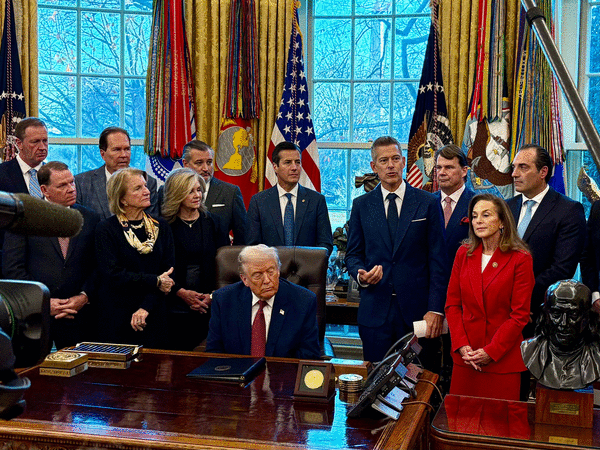
Trump and his allies have framed their rollback of automotive environmental regulations as a boon for vehicle affordability in the United States. The president, flanked by automotive executives standing beside him in the Oval Office, promised in December 2025 that consumers would eventually see savings on new cars of "at least" $1,000 thanks to his loosened CAFE proposal.
Analysts were skeptical of that claim.
Sam Fiorani, vice president of global vehicle forecasting at AutoForecast Solutions, noted that regulations can impact vehicle prices, but mostly by shifting the mix of products automakers offer as they try to comply with federal rules. He suggested that looser CAFE standards could push average prices higher.
"Since it was imposed half a century ago, CAFE has made evolutionary changes over many years," Fiorani said. "Where the market was overwhelmingly filled with gas-guzzling V-8 sedans in 1975, automakers downsized, shifted from carburetors to fuel injection, and improved transmissions, but this took a decade."
He continued: "By the mid-1990s, the shift to SUVs pushed traditional passenger cars aside because fuel economy targets for trucks were easier than they were for sedans. Changes to the fuel economy and emissions regulations during the Obama administration eliminated the need for automakers to make small cars, leading to the Detroit Three, for the most part, abandoning passenger cars," Fiorani said.
"In 1985, the best-selling car, and third best-selling vehicle, in the U.S. was the compact Chevrolet Cavalier with over 420,000 sold. Last year, the top-selling passenger car was the Toyota Camry with less than 320,000 sold, and it was outsold by eight trucks and crossovers."
New vehicle prices by market segment help illustrate the impact of product mix on affordability. The overall average price of a new vehicle, per Automotive News and Catalyst IQ, was $52,304 as of Sept 1.
That number is skewed by automakers' reliance on larger, more premium offerings. The average for a luxury midsize SUV/crossover was just shy of $71,000 on Sept. 1, while the price for a midsize sedan was $31,345.
The watchdog and advocacy group Consumer Reports more directly disputed Trump's claim that relaxed fuel economy rules would save consumers money.
"Efficiency saves consumers money without raising prices," the group wrote in a regulatory filing. "NHTSA’s central justification for this rollback—the contention that higher fuel economy standards drive up vehicle prices—is contradicted by the historical record."
"CR’s analysis of vehicle price trends from 2003 to 2021 reveals that while fuel efficiency improved by 30% (saving consumers an average of $7,000 in lifetime fuel costs), inflation-adjusted vehicle prices did not increase."
Will the US fall behind other countries?
Opponents of the Trump administration's environmental policy rollbacks and even some automakers questioned the wisdom of pulling back too aggressively on fuel economy targets while other countries continue to seek emissions reductions — whether through EV adoption or other technologies.
"Trump is tanking sensible mileage standards at the worst possible time for consumers, who’re getting hit with sky-high prices at the pump,” Dan Becker, a frequent Trump critic and director of the Center for Biological Diversity’s Safe Climate Transport Campaign, said in anticipation of the new CAFE rules. “Consumers will pay the price for these reckless rollbacks while Trump’s Big Oil and Big Auto buddies reap the short-term profits."
The International Council on Clean Transportation warned in a regulatory filing that the Trump administration's December 2025 CAFE proposal would make the United States a "true outlier" in automotive environmental regulations, ranking "behind Australia, Brazil, Canada, Chile, China, the EU, India, Japan, Mexico, New Zealand, South Korea, and the UK, and by a significant margin."
Honda Motor Co., in a public comment on the proposal, expressed concern from a business perspective.
"One concern in this space is that a significant reduction in stringency for future model years may inadvertently signal a retreat from high-efficiency ICE and other powertrain development. While this recalibration is framed by NHTSA as a return to 'steady progress,' targets set too low may fail to provide signals necessary to drive long-term investment in multi-billion-dollar powertrain programs," wrote Jim Kliesch, Honda's director of regulatory affairs.
Kliesch added: "We are concerned that stringency levels set too low would require little technical advancement, missing the fundamental objective of the CAFE program to drive meaningful fuel economy gains.
"Targets set appropriately can support the business case for innovation, justifying the long-term capital outlays necessary to maintain a globally competitive path forward."
©2026 www.detroitnews.com. Visit at detroitnews.com. Distributed by Tribune Content Agency, LLC.










Comments