The post-production tax credit passed the Senate. Now what?
Published in Business News
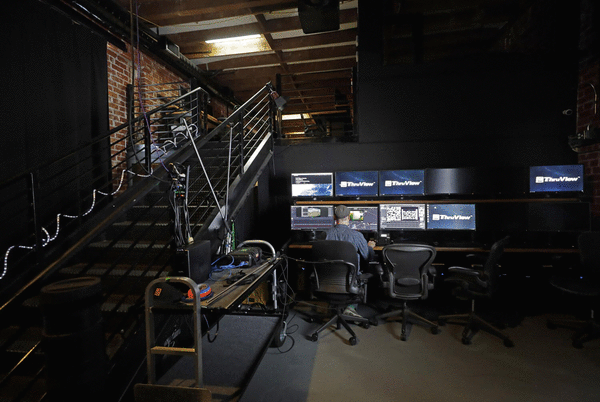
Help is on the way for California's film and TV postproduction workers.
A bill, known as AB 2319 and aimed at supporting the industry's editors, sound mixers, composers and visual effects artists, passed the Senate on Sunday, marking the state's first-ever stand-alone postproduction tax incentive. The bill — which cleared the Assembly by a vote of 72 to 2 and the Senate by 33 to 5 — now awaits Gov. Gavin Newsom's signature.
"We are acknowledging that the industry itself is changing. The pressures on the industry are changing, and we need to modernize and update with it," said Assemblymember Nick Schultz, D-Burbank, who wrote the bill. "We have to do more to compete to keep production in the United States. ... This bill really understands that even when that content is shot elsewhere."
Under its terms, the incentive allows a 35% to 50% credit on qualified expenses relating specifically to postproduction in California. It also doesn't require productions to shoot in the state for the postproduction work to qualify for the incentive.
Initially, the bill's advocates asked for $100 million in funding. But if Newsom signs it, the program would receive modest funding of $10 million per year, set aside from the Department of Finance.
That number is far below what backers had sought, but industry advocates welcomed the measure.
The $10 million is "a beacon of hope," said Marielle Abaunza, president of the California Post Alliance, a group advocating for the bill.
"That $10 million signifies the potential for a true comeback," Abaunza said. "It's this very encouraging wave of reemergence and the belief and understanding that legislators have when it comes to the entertainment industry. They understand that it truly is an economic driving power."
If the governor signs the bill and it receives the necessary funding, then a postproduction tax incentive program would need to be launched. Both Schultz and Abaunza speculate that in the coming years, the program would need to fight for more funding to support each kind of craft. Postproduction covers anything that happens in the final stages of filmmaking, including specialties like sound design and color grading.
This effort is part of a larger lift from California to bolster its film and TV industry, at a time when much of Hollywood is taking its productions and postproduction work elsewhere. The state's share of U.S. postproduction employment has dropped from 53% to 42% between 2005 and 2025, according to CVL Economics, whose founder helped start the trade group sponsoring the bill. The sector employs more than 12,000 workers at over 1,800 firms.
Last year, California expanded its film and TV tax credit program, more than doubling the old $330-million cap to $750 million through June 30, 2030. The current version of the film and TV tax incentive program applies to postproduction, but only if 75% of filming or the overall budget is spent in the state. This bill notably doesn't have those limitations.
A new industry-focused bill was also passed Monday that would allow independent filmmakers to be exempted from the $5-million state corporate tax credit cap that was approved earlier this year as part of Newsom's state budget.
Bobbi Banks, an L.A.-based supervising sound editor who has worked on films such as "The Batman," "Song Sung Blue" and "Selma," said she has worked only five months in almost two years, due to the lack of local jobs. But she's confident this incentive could help.
"It helps to level the playing field as far as postproduction work here," Banks said. "It's just been devastating for people. … A lot of people have retired early, or many people have actually moved out of California because it's financially easier to live [elsewhere] at the moment."
©2026 Los Angeles Times. Visit at latimes.com. Distributed by Tribune Content Agency, LLC.










Comments