Ford has a 'hangover suit' amid anti-DUI push
Published in Business News
DEARBORN, Michigan — New pushes for anti-drunken driving policies have been underway as deadlines to set standards for technologies that monitor for impairment and distraction in future cars and trucks have come and gone. U.S. Rep. Debbie Dingell, D-Michigan, in December introduced a bill that would order car and truck makers to add alcohol detection and driver behavior monitoring systems in thousands of vehicles amid continuing talks for a solution.
But Ford Motor Co. is also drawing attention to impaired driving from the longer-term effects of alcohol on drivers. The Dearborn automaker in 2017 developed the "hangover suit" with the Meyer-Hentschel Institute in Germany to educate drivers on how driving with a hangover can still be impaired driving.
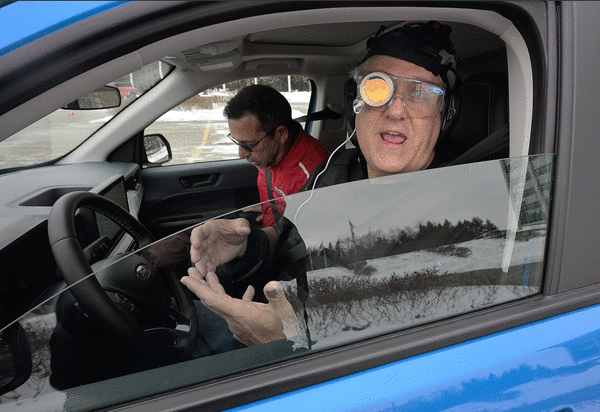
The suit that combines 37 pounds on a vest, wristlets and ankle straps with a head wrap and goggles to simulate a headache and light sensitivity is a part of efforts through the Ford Driving Skills for Life program, a free class supported by Ford Philanthropy and other departments within the automaker that focuses on training new drivers on some of the trickier conditions they might run into on the road.
Mike McNees, who works at Ford in research and advanced engineering for powertrains, recently wore the suit and hopped into a Ford Maverick truck, attempting to navigate it through a driving course with tight turns and variable widths outside the Glass House, Ford's former global headquarters.
McNees, who's being certified as a Tier 3 driver to conduct "at-limit" testing like braking, stability control and chassis maneuvers at speeds up to 125 mph on closed courses, is above-average behind the wheel, but he still struggled to keep the small truck between the cones.
"I felt I was always trying to overcompensate for something," said McNees, 55, of Flat Rock, Michigan. "I felt like I was hitting the cones on the right, but he said, 'Actually, you're not, you're hitting the ones on the left, because you are overcompensating, which is to be expected.' And even though I'm trying to do that, with the weights on my arm, coupled with the blurred vision I have, I can't react quick enough nor good enough to do it."
Ford has also taken it to auto shows and other events to educate drivers on hangover-impaired driving.
An average of 37 people died each day in alcohol-related crashes in early 2025, according to the National Highway Traffic Safety Administration. Hangover impairment levels, according to studies, can be comparable to a blood alcohol content level of 0.05-0.08%. That translates to slowed reaction times, poor concentration and more driving errors, which increases the risk for crashes the morning after drinking.
"The goal here is to educate, to show you that even though you may be legally sober, it does not mean you are not impaired," said Mike Speck, DSFL event manager. "If they feel hungover, they probably shouldn't be driving."
Preaching that message is one thing, Speck added. But showing it makes it more effective.
The DSFL course has existed since 2003 and covers subjects like corner-entry oversteer, understeering and spinout events, space management and hazard recognition. It also covers various behaviors that can distract or impair driving, like texting or taking cold medicine. The class has additionally evolved over time to address the increased presence of advanced driver-assistance systems in vehicles as well as cyclist safety. The program in 2026 continues its "hometown tour" with approximately a dozen programs in cities where Ford has plants.
J.D. McNees, the 17-year-old son of the Ford engineer who wore the hangover suit, participated in DSFL at the Manheim used vehicle auction site in Carleton shortly after getting his license. He admits he originally wasn't excited to participate in the weekend four-hour course that combines a short period in a classroom with mostly behind-the-wheel training in Ford-provided vehicles. But after going through the program, he thought it was worth the time.
"It really increased my confidence on the road," he said. "I am definitely more aware of my driving just in general and my impact on the road and others around me."
Dingell, in a statement, commended Ford for its efforts to educate the public on the dangers of impaired driving. She previously led the HALT Drunk Driving Act in 2021, a part of the Infrastructure Investment and Jobs Acts. It ordered NHTSA to set Federal Motor Vehicle Safety Standards for technologies around performance monitoring, like eye movement and driving patterns, as well as sensors to detect alcohol on a driver's breath or through their skin.
Two deadlines for those requirements, however, have come and gone, prompting Dingell to introduce her bill in December to require major automakers to produce thousands of vehicles annually with the technology.
"Public awareness initiatives like this reinforce the urgent need for strong policy solutions," she said of Ford's hangover suit. "Drunk driving has brought immeasurable pain to families across the country, and I will continue to support every effort to keep impaired drivers off our roads, whether it is legislation or an education awareness campaign."
Automakers increasingly are rolling out anti-drunken driving technologies as well as automated driving systems to improve road safety. Ford's BlueCruise offers Level 2 hands-off-the-road driving on certain highways, and the Blue Oval says it will launch Level 3 eyes-off-the-road technology in 2028. Such systems from many automakers, however, require the driver to take control at times.
"There's lots of research out there that has shown that humans are horrible supervisors, and that's just the plain truth," Greg Brannon, director of automotive engineering and industry relations at AAA Automotive Research, said this week at the Federal Reserve Bank of Chicago's Automotive Insights Symposium in Detroit. "If we're not engaged, we are going to do a secondary task."
Although some critics have raised privacy concerns, driver monitoring systems — or driver attention systems, as David Harkey, president of the Insurance Institute for Highway Safety, calls them — are used for multiple applications in vehicles.
"One of the things we're trying to do is actually change the name: They're not driver monitoring systems. They're intended to keep your attention," Harkey said at the auto symposium. "They're intended to keep you engaged in the driver task. They're driver attention systems. It's really, really important that we got to get the name right, if we're going to sell these systems and get people to use them with the intended purpose."
©2026 www.detroitnews.com. Visit at detroitnews.com. Distributed by Tribune Content Agency, LLC.




Comments