Washington's 'constantly squeezed' dairy farms find cheer in eggnog
Published in Business News
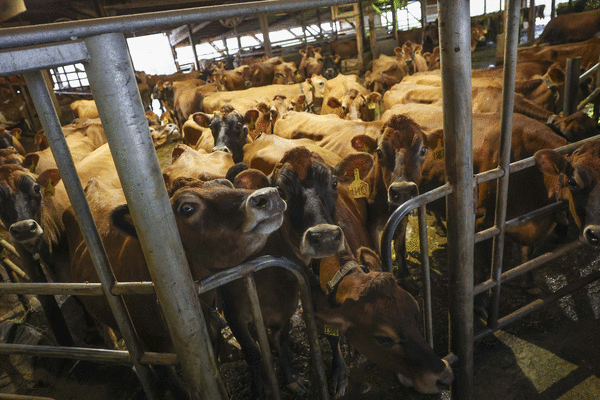
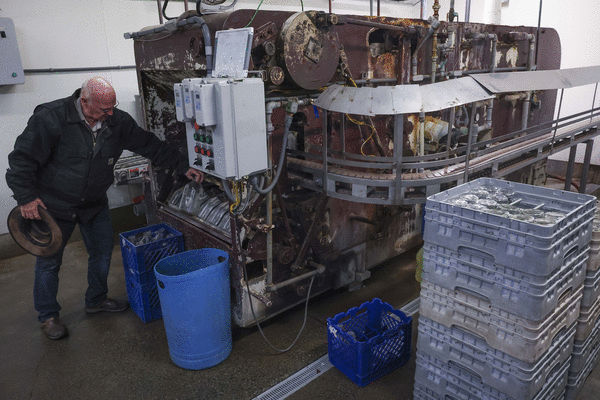
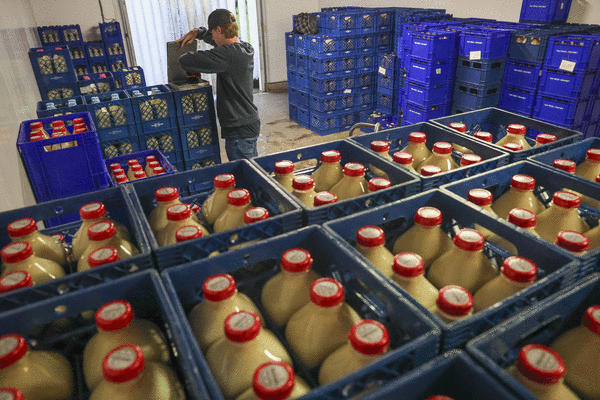
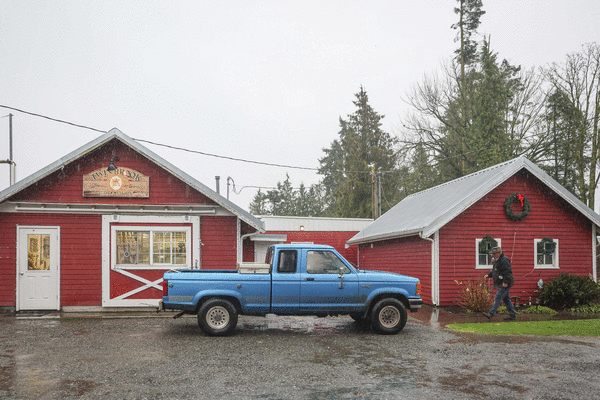
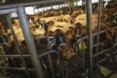
LYNDEN, Whatcom County — More than 200 pairs of eyes turned to Larry Stap when he stepped into his dairy farm, Twin Brook Creamery, to check on the girls." Under the building's tin roof, a herd of curious Jersey cattle sheltered from the pelting rain on a December afternoon, crowding the edges of their pen to sniff newcomers.
It's eggnog season, and "we need every drop of milk we can get," said Stap, 71.
Annual demand for the holiday specialty gives the business a reliable 25% boost from October through December. Some years, that fourth quarter decided for Stap whether his family-owned farm made a profit.
Washington is home to hundreds of dairy farms, but their owners are facing an industry in crisis. The state is struggling with stagnating numbers of dairy cows and milk production, following the COVID-19 pandemic. As more competitors encroach on the global and national markets, local farmers are strangled by high prices for supplies, labor and regulatory costs while they navigate other complexities like processing. With many producers aging out of the profession, the future of the dairy sector hangs in the balance.
Farmers also have to contend with unexpected difficulties, such as this month's devastating floods throughout Western Washington. Reports show that farms in Snohomish, Skagit and King counties have taken on water.
Yet, the industry's bleak landscape is still lightened by holiday cheer. Consumers are flocking to buy eggnog, cheese and other dairy products for their festivities. Producers and their distributors welcome the end-of-year uptick.
"We do see a seasonal sales lift during the holidays as demand increases for baking essentials such as butter, whipping cream, half-and-half, and buttermilk," said Dusty Highland, CEO of Smith Brothers Farms, a Kent-based home delivery service established in 1920 that sources milk from Washington and Oregon farmers. "For Q4, eggnog sales are up 26%, so we're having a great season."
'You're just constantly squeezed'
The rising costs choking Washington's dairy farmers are the product of foreign, national and local issues outside the cow pastures.
"All prices are increasing across the board: supplies, ingredients, labor, energy — so everything," said Virginia Thomas, owner of Clover Mountain Dairy in Chewelah, Stevens County. Though she and her husband, Stacy, are only milking four cows this year, "For a farmer, you're just constantly squeezed."
President Donald Trump's tariffs have affected costs and disrupted the supply chain, she said, so her business has to order some supplies early — and still sometimes suffers delays.
Tariffs have impacted global dairy markets, particularly China, said Shannon Neibergs, extension professor at Washington State University specializing in agricultural economics. However, the Asian powerhouse and the U.S. reached a trade deal last month that provides both parties with some relief.
Milk price is tied to global markets, Neibergs said, with two key factors involved: competition and production.
He pointed to the country's biggest competitors as the European Union, New Zealand and Australia.
Around the world, milk production is increasing, so "milk prices are decreasing," Neibergs said in a phone interview. "They've decreased more at the end of 2025, with a low outlook for the start of 2026."
The U.S. Department of Agriculture puts the latest monthly milk prices received by farmers at $20 per 100 pounds for October. They haven't hit that low since January 2024.
On top of that, on the national playing field, Washington state is losing ground.
"Historically, Washington had the most productive cows in the nation," Neibergs said. He highlighted several of the state's environmental advantages like high-quality water and productive agricultural land.
Eventually, the rest of the country caught up, Neibergs said, and other states are expanding their numbers of dairy cows and milk production.
"Washington is falling behind on that," he said.
Its number of dairy cattle rose steadily through most of the 2010s, reaching a high of 280,000 in 2019 that held through the next year, per the USDA. That figure dipped in 2021 and most recently hovered around 259,000, as of 2024.
The state's milk production also hit a peak of 6.8 billion pounds in 2020 after gradually climbing for over a decade. Since the COVID-19 pandemic, those numbers fell and stagnated, with about 6.2 billion pounds recorded in 2024.
Mounting labor costs, climbing fuel prices and high environmental regulatory costs are cutting into dairy farmers' bottom lines statewide, Neibergs said. "There's certainly challenges that they have to overcome, relative to that lower net farm income."
Consumer spending habits are also shifting. Thomas at Clover Mountain Dairy recognizes that her customers' wallets have tightened during the ongoing economic crunch.
"People have been impacted by the economic situation, and they're choosing carefully what they want to buy and where they want to spend their money," she said.
In spite of those financial restraints, patrons continue to pick her farm for its cheese — Clover Mountain Dairy’s specialty.
At a recent market, "it was flying off the table," Thomas said. "I can't keep cheese in stock."
While consumption of fluid milk has dropped in the U.S., per capita dairy consumption hit highs in 2021 and 2023 not seen since the 1950s — a surge "propelled by record cheese use and gains in butter, cottage cheese and yogurt," according to the National Milk Producers Federation.
Thomas and her husband produce Gouda, feta, cheddar and Monterey Jack, though they plan to try their hands at Gruyere and Parmesan soon.
The couple bought their farmland in 2010. They purchased calves in 2018 and began farming full time around 2020.
Today, their business has 13 cows across 40 acres, and no employees besides the Thomases. Because the farm is in northeastern Washington, it has not been affected by the recent floods.
The couple entered a local agriculture industry in decline: The number of farms in the state plummeted to 31,800 in 2024 from more than 39,000 in 2007, according to the USDA.
Only about 400 farms with milk cows operated in Washington in 2022, per the USDA’s latest census of agriculture, which is released every five years. That number was almost double, at around 800, in 2007.
But at Clover Mountain Dairy, they farm for the love of it.
"There's so many other things you can do in life and make money (other) than farming," Thomas said.
'We almost lost the farm'
To combat industry hurdles, one farmer has raised the price tags on his goods.
At Twin Brook Creamery, Stap decided on a 4% increase starting in January 2024. It helps level out the mounting cost of labor, including minimum wage, which is jumping next year to $17.13 per hour from $16.66 an hour.
Instead, he bought automated milkers, which eliminated one full-time position on his farm.
Stap contested the 2021 Legislature's move to expand overtime pay to all agricultural employees, including dairy workers, following their previous exemption. He said seasonal employees usually want to work 50 or 60 hours per week, but many farms can't afford the overtime rate, so businesses limit them to 40 hours.
Eight employees work alongside family members in the processing plant.
"Farming in the state of Washington is not easy," Stap said.
His objective, however, is to keep the small dairy in his bloodline — where it's stayed for five generations.
On a December afternoon, Stap sat at a wooden table in the kitchen of his house while drizzle pattered on the red barn outside. Invoices and other paperwork were strewn before him, but, for the moment, he focused on another task: sorting through a box of well-loved recipe cards written by various relatives.
Family is a value held close to Stap's heart. A collection of a dozen framed photos of his ancestors and descendants hang in the hallway. A pair of small wooden clogs on display nod at his Dutch roots. And there is the very land underneath his feet.
Stap's great-grandfather, Jacob, bought the Lynden property in 1910. The barn was built a few years later.
Stap grew up on those same grounds, learning how to milk cattle and building forts out of hay. In 1976, he wed Debbie, a local woman also raised on a dairy farm. At the turn of the 21st century, Stap took over the farm.
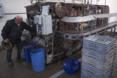
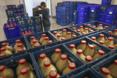
It produces fluid milk products, including milk, half-and-half and heavy cream. Processing takes place on-site, using vat pasteurization.
His daughter and son-in-law, Michelle and Mark Tolsma, joined the team in 2006. The next year, Twin Brook Creamery began bottling its own products. Around 2010, a fateful call from Bellevue-based supermarket chain QFC came: Would Stap supply its grocery stores with milk?
He started with seven locations and expanded the reach of his business over the next couple of years. Yet, turning a profit proved to be a challenge for his farm.
Twin Brook Creamery wouldn't be in the black until 2013.
"We almost lost the farm," Stap said.
Processing woes
In addition to surging costs, another controversy looms over Washington's dairy farmers: processing.
Here, dairy farmers can provide, sell or offer milk for sale to a processing plant, according to the state's Department of Agriculture. Raw milk is then pasteurized at a plant and sometimes turned into other dairy products.
Darigold — a Seattle-based dairy cooperative — is the state's milk processing dynamo.
It announced the opening of a processing plant in Pasco earlier this year. The addition joined six existing Darigold plants in Seattle, Lynden, Issaquah, Spokane, Chehalis and Yakima County's Sunnyside. The Chehalis site is shutting down.
Darigold bills itself as the Northwest Dairy Association's marketing and processing subsidiary, and it's owned by around 250 regional farms. The cooperative called the new plant "the largest dairy processing facility in the Northwest."
Darigold planned to use the new facility to process up to 8 million pounds of milk per day from more than 100 farms to create butter and powdered milk, according to a June news release.
"Our new Pasco facility solidifies the Northwest as a global dairy leader and reflects our farmer-owners’ long-term commitment to good stewardship, high-quality production, and maintaining dairy farming as a way of life," said Allan Huttema, Darigold's then-president and CEO and a third-generation Idaho dairy farmer, in a statement at the time.
The project, approved in 2021, amounted to more than $1 billion invested in the state's dairy industry, per Darigold.
But some farmers take issue with the dairy cooperative's power.
"That's just a whole mess," said Kelsey Killian, 36. She owns Venison Valley Farm & Creamery on Vashon Island, which she operates with her husband, Ben.
"Darigold is really screwing up the dairy industry in our state," Killian said in a phone interview. "They essentially have a monopoly on buying milk for any farm that doesn't process their own milk."
She worries that small farms will suffer as a result.
"If you're a dairy stuck selling to Darigold, it's a horrendous time," she said. "I mean, I don't think that prices have ever been lower for milk."
Chris Arnold, spokesperson for Darigold, said the farms that own the cooperative also supply it — and a "significant majority" of the state's dairy farms are members.
"Our job is to create and sustain markets for the milk that comes from our owners' farms," he said in a statement this month.
Arnold explained that farmers are paid per 100 pounds of milk, and that price is determined by commodities markets, along with membership agreements.
A deduction was applied to farmers' milk checks, or the monthly payments to farmers for milk payments, largely because of the Pasco plant, Arnold said. "That deduction has caused some strain for a number of our member-owners and we are working hard to reduce and ultimately eliminate that deduction."
Venison Valley Farm & Creamery is also feeling strain — but for different reasons.
"Everything is expensive," Killian said.
Since getting her license in 2018, she's run a 7-acre farm. Its inventory includes milk, yogurt, cream, cheese, mango lassi and eggnog, among other products. All fresh products are pasteurized, and Killian does her own processing.
Neighbors let the small herd — four Jersey cows and a Normande cow — graze on their properties. Her area was spared in the recent floods.
Though Killian wants to buy more land, the high prices on Vashon, which has struggled to retain its middle class, make that a distant dream.
She concedes that she has access to the area's wealthier customer base. With its troves of tourists, summer constitutes the farm's busy season, though it picks back up around the holidays.
"We can't keep up, really," Killian said. "I mean, we do have some pretty slow points, but it's usually pretty short periods."
'Save family farming'
The future of Washington's dairy sector remains uncertain.
In the short term, farmers affected by the floods in Western Washington are finding safe places for their herds, said Ivan Chu, senior director of integrated marketing and communications at Dairy Farmers of Washington, a marketing and promotion organization that bolsters dairy farmers.
Even during natural disasters, cows have to be milked, he said.
“It’s a lot of neighbors helping neighbors, honestly,” Chu said in a phone interview Monday. “It’s really an all hands on deck effort to kind of get past this.”
He sees several silver linings for the industry, including the growing popularity of cottage cheese and yogurt. Congress also recently passed the Whole Milk for Healthy Kids Act, which will bring whole milk back to schools.
However, dairy farmers have a long-term dilemma to solve that determines the sector’s survival: As they grow old, who will take the reins?
In Washington, the average age of a farmer is 59 years old, though the age group with the most agriculture producers — about 16,200 — ranges between 65 and 74 years old, per the USDA. Only around 3,000 farmers are between the ages of 25 and 34 years old.
“The average age of farmers continues to grow,” Chu said. “Their children may not be interested in taking over the business as in years past.”
With the running list of challenges, "it's a dying industry in Whatcom County," Stap at Twin Brook Creamery said. "It's very, very, very depressing."
His farm directly dodged one recent problem: the floods. His locale only received a few inches of rain, which dried up within a day.
Instead, Stap is feeling the pinch on the distribution end. “Pete's Milk (Delivery), who is our largest distributor in Kent, is completely flooded out, so we have no home for all of the milk that we have sitting here,” he said.
He predicts an impending shortage of eggnog and milk produced by Twin Brook Creamery in stores.
Earlier this month, with his white Siberian husky, Luna, at his heels, Stap left the cozy comfort of the farmhouse to survey his lands and his legacy: the barn housing a tractor and a truck, the processing facility that once served as a garage and a chicken coop, the dairy with its bovine musk hanging in the air.
Stap is in business — for now. But he's watched how farms like his die: abandoned and overtaken by blackberry thickets and reed canarygrass. Sometimes, he imagines throwing in the towel, too.
Then, Stap remembers his grandchildren.
"We've got a rich heritage in this county, and I want it to continue," he said. "I want to keep this land and this farm in agriculture."
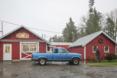
Behind the steering wheel of his blue Ford Ranger pickup, Stap wound his way through miles of country road like he's done for decades. In the corner of his rear window was a lone bumper sticker that read: "Save family farming.
_____
©2025 The Seattle Times. Visit seattletimes.com. Distributed by Tribune Content Agency, LLC.









Comments