6 key disclosures from NASCAR's long legal battle -- and one unresolved issue
Published in Auto Racing
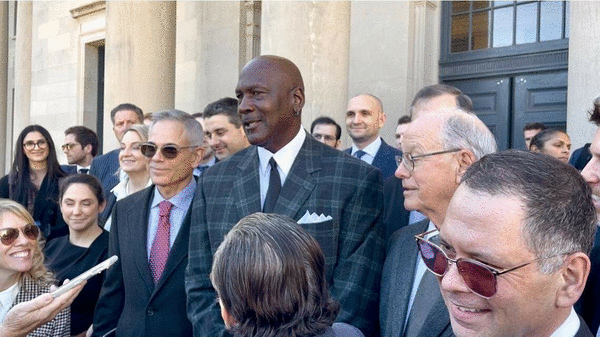
CHARLOTTE, N.C. — NASCAR was not deemed an unlawful monopoly, and the Cup Series teams got the permanent charters they were seeking.
So Thursday’s settlement was a win for all, right?
From 100 feet high, that’s true.
But take a look at the details — at all the financial disclosures that shed light on how NASCAR operated, at all the text messages that revealed NASCAR leadership’s fears and more — and you’ll see that this legal battle will endure for a long time.
Here are six key revelations that will live on long after Thursday’s united show of triumph between NASCAR and its two premier series teams — as well as one issue that still needs resolving.
The unresolved Richard Childress issue
At the conclusion of Thursday’s proceedings — in other words, at the end of the trial — plaintiff attorney Danielle Williams still had business to tend to with District Judge Kenneth Bell.
She needed to ask about the issue involving Richard Childress and figure out how NASCAR found documents that revealed some of his non-NASCAR-related finances — finances that, he claims, were protected by a non-disclosure agreement.
On Tuesday, Childress was asked a line of questioning that blindsided him and left him visibly angry. Attorneys asked Childress about his courting of an investment company to purchase part of his 60% stake in Richard Childress Racing, the company he founded in 1969. He thought such discussions with a group that includes former NASCAR driver Bobby Hillin Jr. — as well as the materials that Hillin had sent to potential investors — were confidential.
“I don’t want to answer that,” Childress said at one point during the line of questioning, before Judge Bell reminded him he was under oath and obliged to answer to the best of his ability.
Childress eventually admitted that he sent Hillin a termination letter — “They don’t have the money,” he said — and that both parties signed NDAs. After the jury departed Tuesday, plaintiffs counsel requested to Judge Bell that the defense turn over the documents they have concerning Childress’ finances and to unveil the source who gave NASCAR those documents.
Bell told lawyers on Wednesday that if the issue wasn’t resolved by Thursday morning he will issue orders — something he said he doesn’t want to do. It appears it had yet to be resolved as of Thursday evening.
Six other key disclosures
Here are six other key disclosures that were tangential to the case but were revealing nonetheless. These are listed in no particular order.
— Salaries. The salaries of several high-profile players in the world of NASCAR were revealed during trial. Among them included people on NASCAR’s side: CEO Jim France ($3.5 million), commissioner Steve Phelps ($2.5 million with another $2.5 million in bonuses), president Steve O’Donnell ($1.2 million) and chief strategy officer Scott Prime ($400,000). Denny Hamlin’s salary as a Cup Series driver was revealed, too; he makes approximately $14 million annually from Joe Gibbs Racing.
— France family’s stake in NASCAR. It was revealed Tuesday that NASCAR, a private company, is owned by two family trusts. The first is the Jim France Family Trust, owning 54.7%. The second is the Lesa France Kennedy Family Trust, owning 45.3%. Both Lesa and Jim serve on the NASCAR board.
— NASCAR revenues and profits. NASCAR made $1.7 billion in overall revenues in 2024. Its net income in 2024 was around $103 million; NASCAR made $537 million in 2023; most of which was made after a large land sale in California, and that money was used to pay off a lot of debt incurred from a previous purchase of International Speedway Corporation (ISC).
— Cup teams revenues and profits. 23XI Racing was one of the few teams that operated with a profit in 2024. That year, the team brought in approximately $40 million in sponsorship money, Hamlin said. Bob Jenkins, conversely, told the jury that his Front Row Motorsports race team had never earned an operating profit in 22 years as an owner in NASCAR. In 2021, the team lost -$2,824,668,69; in 2022, -$7,977,187.20; in 2023, the team lost -$5,685,938.48. The way Jenkins stayed in the sport was by virtue of his fast food empire — and by selling charters, which he wrote off as capital gains that didn’t impact his operating profit year-to-year.
— How much NASCAR spent on the Next Gen car. NASCAR confirmed that it hasn’t made money off the sale of Next Gen car parts that teams are required to purchase from a NASCAR-approved supplier. John Probst, the company’s chief racing development officer, disclosed that the series has spent $14 million developing the car, and that the car is continually being invested in.
— Internal messages that executives wish they could have back. This lawsuit was replete with embarrassing, unflattering and unbecoming messages, all of which were found during the discovery process and revealed to the jury during trial. You saw 23XI Racing executives saying that co-owner Denny Hamlin spends recklessly. You saw NASCAR executives venting about their frustrations with the board.
And while this didn’t make it to trial, you saw Phelps, NASCAR’s commissioner, write in a passionate diatribe to his confidants that he didn’t appreciate Childress’ outspokenness while NASCAR’s television deal was being negotiated. Phelps called Childress a “stupid redneck,” among other things, who “needs to be taken out back and flogged.” Phelps later said that he regretted those messages and that he’s since talked with and apologized to Childress.
In general, such acrimony is what made this trial so tense. It’s also what made Thursday’s settlement so surprising — and necessary for the sport to move on.
“In all honesty, sometimes when you get to the finish line, you have to think not just for yourself but for the sport as a whole,” said Michael Jordan, owner of plaintiff team 23XI Racing. “I think both parties got to that point, we realized we got the opportunity to settle this, we dove in, and we actually did it.”
Added Jim France: “We can get back to focusing on what we really love, which is racing. We’ve spent a lot of time not really focused on that so much. Not as much as we need to be. I feel like we’ve made a very good decision here, together, and we have a big opportunity to continue growing the sport.”
©2025 The Charlotte Observer. Visit charlotteobserver.com. Distributed by Tribune Content Agency, LLC.




Comments