Slotkin ban on Chinese cars stalls amid Xi visit, but could pass soon
Published in Political News
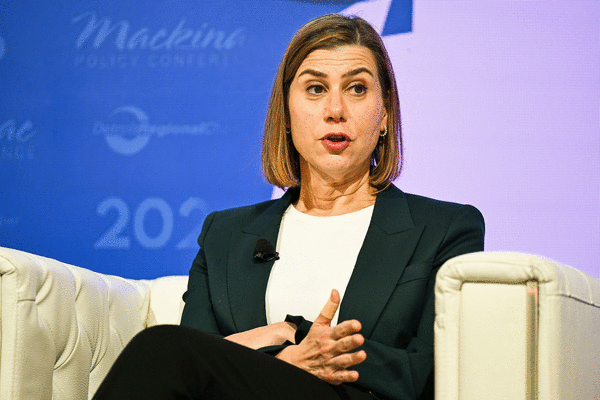
WASHINGTON — A bipartisan duo of senators from Michigan and Ohio fell short of getting unanimous support for a bill banning Chinese vehicles from the United States, but they expressed optimism about passing the legislation in the days ahead.
"We've sent out the bill to all of our colleagues, and by a very, very strong majority, they have come back and said yes. That doesn't happen every single day," Michigan Democratic U.S. Sen. Elissa Slotkin said during a Senate floor speech on Sept. 24.
"We’re gonna work on it over the weekend, and try to get them on board so we can pass it swiftly early next week,” she later told a Detroit News reporter at the U.S. Capitol, referencing the few remaining holdouts.
Slotkin and Ohio Republican Sen. Bernie Moreno introduced a measure in April seeking to prevent China's ascendant auto industry from gaining a foothold in the United States for both national security and economic reasons. Their proposal would ban the import, manufacture and sale of internet-connected vehicles, software and hardware linked to China or other adversaries.
The duo had been working to fast-track passage of their bill ahead of Chinese leader Xi Jinping's visit with President Donald Trump at the White House. The effort fell short after Kentucky Republican Sen. Rand Paul refused to support the measure.
Trump, for his part, has repeatedly expressed enthusiasm about the prospect of Chinese automakers manufacturing vehicles in the United States, a position that is highly unpopular in the industrial Midwest. Many in the U.S. auto sector worried ahead of Xi's trip that Trump would turn that enthusiasm into action as he continues to navigate a complicated relationship between the two global superpowers.
Slotkin said that while she and Moreno "don't agree on everything," they "certainly agree that letting in these cars subsidized by the Chinese Communist Party would be the beginning of the end of the American auto industry."
The first-term senator from Holly, Michigan, also noted that the bill is supported "by our automakers, by organized labor. A broad coalition of individuals and institutions that know that if we threaten our American auto establishment, we threaten our manufacturing base, we threaten our ability to be a powerhouse in manufacturing across the world."
In a floor speech, Moreno warned of China's concerted, state-supported rise in the automotive sector.
"China understands this — I think better than we do, honestly — the importance of building their middle class," he said. "What they've done is, over the last two decades, targeted the auto industry. Not to compete in the auto industry, but to conquest the auto industry, to create what I've dubbed automotive fentanyl."
"General Motors, Ford, Toyota, you name it, they can compete with any car company on earth. (But they) can't compete with a country that's hell-bent on total conquest. They now make almost four times as many cars as we do here in America. They export almost as many cars as we make here in America. While their domestic market is dropping, they're producing ever more cars, and they need to feed that beast. They need to feed that machine."
No Chinese nameplate consumer vehicles are currently made or sold in the United States. Ford Motor Co. and General Motors Co. both manufacture vehicles for the U.S. market in China, though both automakers have committed to phasing out that production.
Paul, the holdout, also delivered a floor speech on China, but he did not discuss the automotive industry or his reason for opposing unanimous passage of the Chinese vehicle ban. The Kentucky senator instead spoke out against a different bipartisan resolution condemning Chinese government efforts to suppress free speech and silence critics around the world.
"I take a back seat to no one in my opposition of socialism, communism, or any other form of collectivism," he said. "But I draw a distinction between articulating the horrors of Chinese authoritarianism and Senate resolutions intended to embarrass Chinese leaders who are visiting our country. The art of diplomacy is the art of pulling punches, avoiding insult, attempting to find common ground."
Paul did not say if diplomacy was also his reason for opposing the passage of the Chinese vehicles bill. He told a reporter for the news outlet Semafor that, "we're going to discuss it over the weekend, and then re-discuss it next week.”
A similar piece of legislation, co-sponsored by Michigan U.S. Reps. Debbie Dingell, D-Ann Arbor, and John Moolenaar, R-Caledonia, is awaiting passage in the House. All differences in the bills would need to be reconciled before a measure could be sent to Trump for final approval.
Moreno, during his Senate floor remarks, said he knows the president "feels the same way I do, which is we're not going to let these cars into our market. We're going to make certain that we defend the U.S. auto industry."
Trump, however, has said he "loves" the notion of Chinese automakers building vehicles in the United States.
"If they want to come in, and build the plant, and hire you and hire your friends and your neighbors, that's great," Trump told the Detroit Economic Club in January 2026. "I love that. Let China come in. Let Japan come in. They are, and they'll be building plants, but they're using our labor."
As crucial midterm elections approach in less than six weeks, Michigan candidates are trying to distance themselves from that position.
"The greatest threat to our automakers here in Michigan: Chinese-manufactured cars. I'm going to go make sure that never happens," Republican U.S. Senate candidate Mike Rogers said in a social media post on Sept. 24. Rogers has Trump's endorsement but has broken with him on several issues.
"We should have a clear stance that says no Chinese vehicles in the United States," Democratic U.S. House candidate Will Lawrence said in a recent interview, reversing his past stance on the issue.
No mention yet of autos at Xi visit with Trump
No public talk on the auto industry emerged in the first several hours of Xi's state visit.
"Our teams have been working to encourage a more balanced trading relationship, including the new market access for American farmers and ranchers," Trump said in an address welcoming his Chinese counterpart to the White House.
"During this visit, we will also discuss pressing issues concerning security, technology, and superintelligence — SI. The decisions we make in these areas today can promote peace and prosperity for decades and decades to come," he added.
Xi gave an address that touched on U.S.-China business relationships — including China's openness to U.S. companies within its borders — but did not directly mention the auto industry.
"China’s door to the outside world remains wide open. We welcome U.S. enterprises to invest and do business in China, and we hope the U.S. side will treat Chinese companies fairly, working together to lengthen the list of cooperative achievements and shorten the list of issues," he said in Chinese-language remarks translated by an interpreter.
"There is no need for China and the United States to shy away from competition; however, such competition should be benign and bounded—a race where we strive to excel alongside one another, rather than a zero-sum gladiatorial contest," Xi added.
©2026 www.detroitnews.com. Visit at detroitnews.com. Distributed by Tribune Content Agency, LLC.





































Comments