Philly's competitive US House race narrows -- but big questions loom
Published in Political News
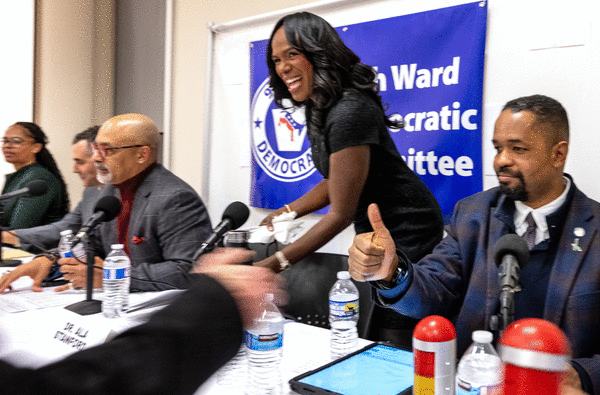
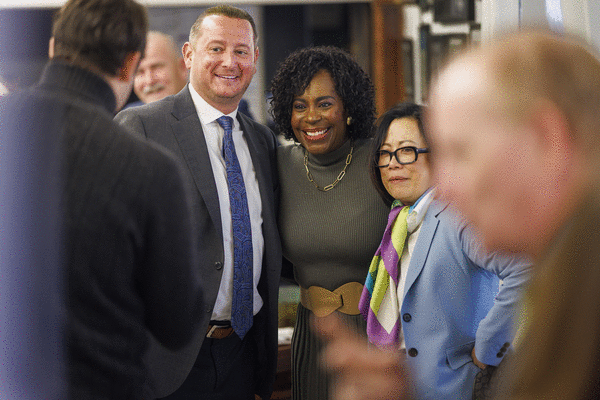
PHILADELPHIA — When this year began, the field of candidates vying to represent Philadelphia’s 3rd Congressional District was sprawling. A dozen contenders spent months campaigning and raised hundreds of thousands of dollars to replace outgoing U.S. Rep. Dwight Evans in what is the most competitive federal race in Philly in recent memory.
Now, with about six weeks until Election Day on May 19, the Democratic primary field has whittled down to five contenders. Three are seen as front-runners: state Rep. Chris Rabb, state Sen. Sharif Street and physician Ala Stanford.
And still, it could be anyone’s race. These are the big open questions that could prove decisive in how the election shapes up.
Can anyone answer the massive pro-Ala Stanford spending?
Money alone doesn’t win races. But it does get a candidate’s message in front of an audience.
For nearly four weeks, Philadelphia voters have seen television ads about only one candidate: Stanford, who has benefited from a massive infusion of spending in her favor by a national super PAC.
Street and Rabb can knock on all the doors and hang all the signs they want, but advertising via TV, streaming, radio, and mail is still seen as the most efficient way to reach the largest number of voters. In that regard, Stanford right now stands alone.
The question is whether Street or Rabb can come anywhere close to countering the huge money imbalance.
Consider this: A super PAC — a group called the 314 Action Fund that backs pro-science candidates and often supports medical professionals running for office — has already spent $2 million to back Stanford in this race. The organization has said it will likely spend at least $2.5 million.
That is five times the amount Street’s campaign had in the bank as of the beginning of the year, the last time candidates had to file public campaign finance paperwork. Rabb had even less cash at the time.
All candidates must file new campaign finance reports by April 15, which will provide a clearer picture of their updated finances.
But no candidate, including Stanford, will come close to raising or being able to spend $2.5 million on their own. That is because candidates must abide by contribution limits — individuals can donate up to $3,500 per election — while super PACs can raise and spend unlimited amounts of cash.
Other super PACs are likely to emerge, but none besides 314 has so far spent money to influence the race.
Will the building trades be the difference-maker for Street?
Street is expected to benefit from his own super PAC. He is endorsed by the Philadelphia Building and Construction Trades Council, an umbrella organization of unions that is considered among the most potent political forces in the state.
The trades, which are led by labor leader Ryan N. Boyer and include the deep-pocketed electricians union, have in the past bankrolled super PACs for their preferred candidates, and they are expected to do so again.
Their endorsement was the difference-maker the last time there was a major competitive primary in Philadelphia. That was the 2023 mayor’s race, when the trades backed now-Mayor Cherelle L. Parker, who otherwise had not kept up in the fundraising battle with two wealthy candidates pouring their own money into their campaigns.
That year, a super PAC funded largely by building trades unions spent hundreds of thousands of dollars on advertising to support Parker and attack her opponents. She won the primary handily.
Whose ground game will reign supreme?
While the money game is Stanford’s to lose, Street and Rabb may both have a leg up when it comes to the large get-out-the-vote operations and field teams behind them.
For Street — the establishment favorite — it is the Democratic City Committee, which endorsed him in February, and its thousands of committee members. Many of them will encourage voters to come out, and they will distribute pro-Street flyers outside the polls. And if history is a guide, a lot of them will be armed with “street money,” the small cash payments used to fund last-minute, get-out-the-vote efforts.
On Rabb’s side is a coalition of national and local progressive organizations. Made up of hundreds of volunteers, the groups are not as established as the Democratic City Committee. But they are organized, and they have deployed field teams to knock on voters’ doors for the better part of a decade.
How will Ala Stanford be defined?
With three front-runners remaining after state Rep. Morgan Cephas bowed out, each campaign is trying to put together a voting coalition to exceed about 30% of the vote. One strategy for the candidates is owning a political lane while attempting to make the other two fight for votes.
Street and Rabb, who have both been in office for nearly a decade, are well defined. Street — the former head of the state Democratic Party — is the insider, the party guy, and the scion of a political family. Rabb is the anti-establishment leftist. Their voters in deep-blue Philadelphia are relatively clear.
But Stanford, who has never before run for political office, is far less ideologically defined. How voters perceive her could be a key factor in how the race shapes up.
For example, Rabb, during candidate forums and on social media, has recently turned his attention to Stanford, and is attacking her more frequently than he is going after Street. If he can successfully brand her as centrist, she and Street could end up fighting for votes.
However, Stanford has tried to portray herself as the true outsider, often touting her apolitical career and criticizing “machine politics.”
Will the race become nationalized?
The 3rd Congressional District is, by some measures, the most Democratic in the country. But the campaign thus far has not generated much attention outside Philadelphia.
That could change if any of the candidates win endorsements from national figures.
Backing from major progressive figures like U.S. Sen. Bernie Sanders, of Vermont, and U.S. Rep. Alexandria Ocasio-Cortez, of New York, could be helpful to Rabb as he tries to keep up in the money race. The pair often lend their endorsements to left-leaning candidates for Congress, and enable them access to a vast networks of small-dollar donors.
Will AIPAC get involved?
For months, there has been speculation about whether the American Israel Public Affairs Committee, better known as AIPAC, will spend money to attempt to influence the outcome of the Philadelphia race.
The prominent group has spent millions of dollars to back pro-Israel candidates for federal office, as well as to oppose those whom it sees as hostile to its causes. The organization has gotten involved in Democratic primaries and specifically targeted members of “the Squad,” the loosely connected left-wing faction in Congress that Rabb has said he would join if he wins.
There is no evidence yet that AIPAC is directly involved in the race, despite Rabb — a staunch critic of Israel — accusing his opponents of taking money from the organization. In a recent memo to reporters, Rabb’s campaign described AIPAC as a “key funder” of the 314 Action Fund backing Stanford.
However, 314 has taken only one contribution from an AIPAC-linked group, according to federal records. In 2024, 314 received a $1 million check from AIPAC’s super PAC, the United Democracy Project. At the time, both organizations were backing the same candidate in an Oregon House race. The money was spent during that cycle.
Since then, 314 and AIPAC have occasionally been at odds. For example, AIPAC earlier this year spent big to oppose Daniel Biss, the Evanston, Illinois, mayor running for the Democratic nomination in Illinois’ 9th Congressional District. Meanwhile, 314 poured money into the race to support Biss, and he won the nomination.
Whom will Mayor Parker endorse?
As the city’s mayor and the leader of the high-turnout 50th Ward in Northwest Philadelphia, Parker could affect a close race with her endorsement. Aren Platt, who runs the mayor’s political operation, said Parker “has taken a lot of time to look into all the candidates.”
It is probably safe to say her choice will be between Street and Stanford.
Parker is very much not of the progressive left. And she and Rabb share a long history that has occasionally been marked by friction. His first seat in the state House was formerly held by Parker, and he won it after challenging the incumbent, state Rep. Tonyelle Cook-Artis. She was a Parker staffer and a close friend who still works for the mayor today.
Between Street and Stanford, Parker’s endorsement could go either way.
In many ways, it would make sense for Parker to back Street. His coalition of establishment-aligned Democrats and building trades unions is the same as the one that lifted Parker to victory in 2023.
However, Parker knows Stanford well. And Stanford has been a key partner to the mayor’s administration at its drug recovery house in Northeast Philly, where her organization leads medical services.
Parker has met with the candidates, but she has yet to make a decision.
Platt said that will come “on her own timeline.”
©2026 The Philadelphia Inquirer. Visit inquirer.com. Distributed by Tribune Content Agency, LLC.


Comments