Hegseth asked US Army chief to step down, Pentagon says
Published in Political News
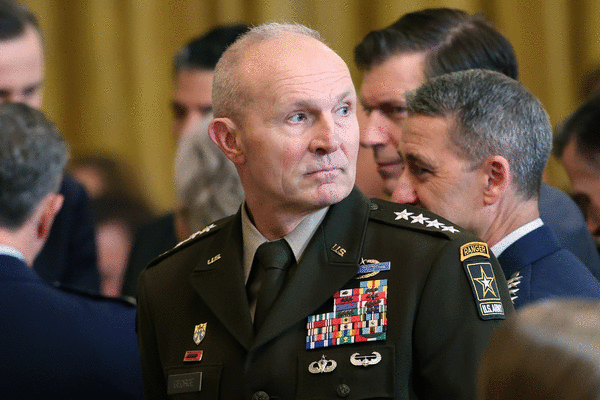
WASHINGTON — Defense Secretary Pete Hegseth has asked Army Chief of Staff Gen. Randy George to step down, according to Pentagon officials, a move that comes after President Donald Trump warned of military escalation against Iran.
The officials, speaking on condition of anonymity, confirmed an earlier report from CBS News, which cited people familiar with the decision.
The Pentagon’s top spokesperson, Sean Parnell, said “George will be retiring from his position as the 41st Chief of Staff of the Army effective immediately,” in a social-media post. “The Department of War is grateful for General George’s decades of service to our nation. We wish him well in his retirement.”
The move comes as the U.S. and Israel continue a war against Iran, a mission that has recently seen the U.S. send thousands of troops — including Marines and paratroopers — into the region for a possible ground operation.
George, a career infantry officer and West Point graduate, took over as Army chief in 2023 after serving as vice chief and as a senior military assistant to then-President Joe Biden’s Defense Secretary Lloyd Austin. The soft spoken and understated officer has not made any public statements about the operations in Iran or the ground troops being sent to the region.
His removal comes amid a wider shake-up of senior military leadership under Hegseth, who has moved assertively to reshape the Pentagon’s top ranks and shift its cultural and strategic direction.
His ouster in the middle of the ongoing war against Iran has echoes of former Defense Secretary Donald Rumsfeld sidelining General Eric Shinseki after disagreements over the number of troops needed for the war in Iraq. Shinseki, a former Army chief of staff, said the U.S. needed to station 200,000 to 300,000 U.S. troops in Iraq to secure the country.
Last fall, Hegseth abruptly removed Army Vice Chief of Staff General James Mingus, replacing him with General Christopher LaNeve.
Admiral Alvin Holsey, who led U.S. Southern Command, also stepped down unexpectedly as Trump ordered a military buildup in the Caribbean to target alleged drug trafficking boats. U.S. forces in the region eventually participated in a special operations mission to seize Venezuelan leader Nicolas Maduro and helped erect a quarantine to better control the country’s oil resources.
George deployed during the Gulf War and later in Iraq and Afghanistan, building a reputation as an operational commander with deep experience across combat theaters.
Before his elevation, George had drawn scrutiny earlier in his career when a vulnerable outpost under his command in Afghanistan was overrun by Taliban fighters. Eight U.S. soldiers and four Afghan army soldiers were killed defending the outpost and George received a formal reprimand. He ultimately rebounded to earn key leadership roles and the confidence of senior civilian leaders.
As chief, George pushed a sweeping transformation agenda aimed at preparing the Army for future conflicts, including restructuring formations, cutting headquarters staff and accelerating the integration of new technologies such as counter-drone systems.
©2026 Bloomberg L.P. Visit bloomberg.com. Distributed by Tribune Content Agency, LLC.





















Comments