House ethics panel rejects Cherfilus-McCormick request to delay hearing into her conduct
Published in Political News
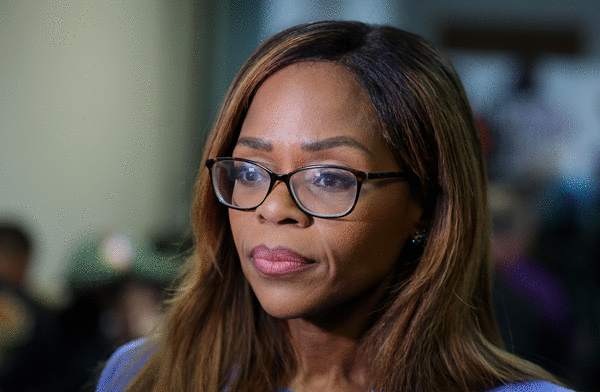
A U.S. House subcommittee created to consider ethics charges against U.S. Rep. Sheila Cherfilus-McCormick has rejected her requests to delay its work until after the conclusion of her criminal trial and to conduct its hearing examining her conduct behind closed doors.
The result: a public hearing of the House Ethics Committee adjudicatory subcommittee will be held, as scheduled, on March 26.
The decision was announced late Wednesday afternoon by the Republican chairman and top Democrat on the House Ethics Committee. In January, they announced the formation of an adjudicatory subcommittee to examine the Cherfilus-McCormick case.
In the latest announcement, U.S. Reps. Michael Guest, R-Miss., and Mark DeSaulnier, D-Calif., said the adjudicatory subcommittee met Tuesday in executive session to hear arguments about her motions to delay the proceedings and to conduct them privately.
“After careful deliberation, the adjudicatory subcommittee voted unanimously to deny both motions,” their statement said.
They added that the Cherfilus-McCormick case had been before the Ethics Committee since September 2023. “Further delay of the matter would not serve the interests of justice. Moreover, holding the entire hearing in executive session at this phase of the proceedings would depart from committee precedent, limit public transparency around these serious allegations and do nothing to safeguard the House’s integrity.”
The adjudicatory subcommittee may be preparing to make a quick decision in the case. The lawmakers said that when the panel meets next week it would consider a motion for summary judgment in the case. They said the proposed motion would be released the day before the subcommittee meets.
The adjudicatory subcommittee had been scheduled to convene on March 5.
Two days before that hearing, the Ethics Committee’s leaders announced that it was postponed for three weeks because Cherfilus-McCormick’s attorney “withdrew from representing her before the adjudicatory subcommittee” and she had asked for a brief delay to retain new legal counsel.
Cherfilus-McCormick, a Broward-Palm Beach county Democrat, was elected in a January 2022 special election to fill the vacancy created by the death of U.S. Rep. Alcee Hastings. In late 2021, she spent heavily on her Democratic primary campaign, ultimately winning by five votes.
She has been under investigation for most of her time in Congress. In January, the Ethics Committee said its investigative subcommittee found “substantial evidence of conduct” described in a criminal indictment against her last year and is bringing multiple charges against her.
Cherfilus-McCormick and other alleged co-conspirators were indicted in November on charges that she stole money that had been overpaid to her family-owned health care company when she was its CEO during the COVID-19 pandemic and laundered the proceeds, with much of the money used to help fund her first successful campaign.
She has been charged with conspiracy to commit theft of government funds, money laundering, making and receiving straw donor contributions and making a false and fraudulent statement on a tax return, according to the indictment.
Cherfilus-McCormick has denied any wrongdoing, and she has entered a not guilty plea to the federal criminal charges.
In the House proceedings, the “statement of alleged violations” from the investigative subcommittee delved into many of the issues in the indictment and other allegations previously raised about Cherfilus-McCormick’s conduct as a candidate and as a member of Congress.
The subcommittee’s work “has revealed substantial evidence of conduct consistent with the allegations in the indictment, as well as more extensive misconduct” including violation of federal laws and regulations and ethical standards.
It found “substantial reason to believe that a violation of the Code of Official Conduct, or of a law, rule, regulation or other standard of conduct applicable to the performance of the official duties or the discharge of official responsibilities … has occurred.”
Her then-attorney filed a motion with the committee in January that said Cherfilus-McCormick “disputes and refutes the allegations and report” of the investigative subcommittee. And citing the “pending criminal matter” she sought to dismiss the proceedings or pause any action until after the conclusion of the criminal proceedings.
Going ahead with the House action, her attorney told the committee in January, “would risk compromising (her) … constitutional rights in the criminal proceedings.”
The investigative subcommittee said its work involved 30 requests for information and that it issued 59 subpoenas, reviewed “over 33,000 documents totaling hundreds of thousands of pages of materials and conducted 28 witness interviews.”
It said Cherfilus-McCormick “initially produced some documents” to the panel. It said she agreed to a voluntary interview, but the day before it was scheduled informed the committee that “she was no longer available.” The committee said it then subpoenaed her for more documents and to testify, and Cherfilus-McCormick invoked her Fifth Amendment right against self-incrimination.
The report detailed 27 counts against the congresswoman.
Among the subcommittee’s allegations:
—“Excessive contributions from multiple individuals and entities, corporate contributions, illegal conduit contributions, and systemic reporting violations.”
—“Failure to file, and knowing and willful filing of inaccurate information on, required Financial Disclosure Statements.”
—Providing “special favors in connection with government appropriations for community project funding requests.”
—“Commingling personal and campaign funds, conduct that does not reflect creditably upon the House, and conduct that does not adhere to the spirit and/or letter of the Rules of the House and federal laws.”
—“Money laundering of government funds improperly retained by Trinity Health Care Services, LLC, and of illegal campaign contributions originating from Petrogaz-Haiti S.A., LLC, and false statements on reports filed with the Federal Election Commission.” Trinity was the family-owned health care company Cherfilus-McCormick ran before she was elected.
The Trinity issue involves an overpayment of $5.8 million to Trinity Health Care by the state, which hired Trinity to administer vaccines and deploy canvassers to sign people up to get vaccinated during the COVID-19 pandemic. It kept the money, and agreed to repay it over time to settle a state lawsuit years later.
The investigative committee said that it examined her unsuccessful 2018 and 2020 campaigns and found she sometimes failed to file required reports and “the reports she did file contain numerous inaccuracies.”
_____
©2026 South Florida Sun-Sentinel. Visit sun-sentinel.com. Distributed by Tribune Content Agency, LLC.

















































Comments