Members split on plan to use reconciliation again to boost defense
Published in Political News
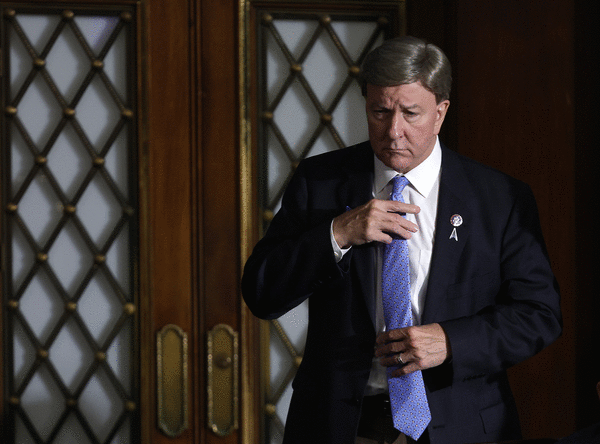
WASHINGTON — As some defense hawks eye a massive influx of defense dollars in a possible forthcoming reconciliation measure, initial reactions from defense appropriators and authorizers have been mixed, foreshadowing what could be a rocky road to achieving President Donald Trump’s stated goal of a $1.5 trillion defense budget in 2027.
In comments to Breaking Defense this week, House Armed Services Chairman Mike D. Rogers, R-Ala., said he and his Senate counterpart, Armed Services Chair Roger Wicker, R-Miss., would like to see Congress enact a second reconciliation package that includes $450 billion for national security to supplement the fiscal 2027 defense budget.
“(Rogers and I) are of the same mind that we need substantial plus ups, some of it may occur in reconciliation, and a good bit of it in the traditional means,” Wicker said Thursday, and indicated that he would support a second reconciliation effort.
But some reluctance, even among top Senate Republicans, materialized almost immediately.
Sen. Shelley Moore Capito, R-W.Va., a Defense appropriator, said reconciliation would be “a heavy lift,” but declined to make any predictions.
“Reconciliation is not the easiest thing to move through,” she said. “I’m assuming this is a reaction to try to figure out a way to help the president get the number he wants. That’s all I know.”
Sen. Mitch McConnell, R-Ky., the chairman of the Defense Appropriations Subcommittee, wants whatever the president requests for defense in fiscal 2027 to come mostly or entirely via a base budget, as opposed to reconciliation.
In a floor speech last week, McConnell said: “Much of the Defense Subcommittee’s most arduous work in recent months has been helping the armed services address real, urgent operational shortfalls that were created when much of Washington decided to pretend that one-time infusions of cash could take the place of consistent annual appropriations.”
Rogers has previously thrown his support behind Trump’s pitch for a $1.5 trillion defense budget for fiscal 2027, and has suggested that previous reconciliation funds should be built into the baseline defense budget when the administration submits its budget request to Congress, which is expected to come next month.
Because a budget reconciliation measure can be passed with a simple majority in the Senate, lawmakers sometimes favor it when their party controls both chambers as a way to supplement their funding priorities without making concessions to the minority. But passing a second measure in 2026 could be a daunting task for congressional Republicans, particularly with a razor-thin margin in the House.
Additionally, some Democrats have voiced concerns that the $150 billion in defense dollars furnished by last year’s reconciliation measure, the so-called One Big Beautiful Bill Act, is thus far largely unaccounted for.
“Frankly, before you ask me for another $450 billion you might explain to me how you’re spending the first $150 billion,” said Sen. Chris Coons, D-Del., the ranking member on the Senate Defense Appropriations Subcommittee.
“More importantly than the topline number, I think, is a clearer and better commitment from this administration to actually work with Congress and to set clear and achievable security goals and to articulate why anything like that amount of money is necessary,” Coons said.
In a letter to Defense Secretary Pete Hegseth sent Tuesday evening, Democrats on the Senate Budget Committee panned the Defense Department for submitting to Congress a fully classified spending plan for $90 billion of the reconciliation funds that the agency received last year.
The classified plan — the first in a series of spending details related to reconciliation funding that the Pentagon owes lawmakers — was transmitted to Congress in October, but received little attention, likely becaue of the 43-day government shutdown that paralyzed Washington at the time.
Defense officials are expected to produce a second spending plan to account for the remaining $60 billion, but it is not yet known when it will be transmitted.
Sen. Jack Reed, D-R.I., the ranking member of the Armed Services Committee and a member of the Defense Appropriations Subcommittee, said it is not clear how Republicans might propose to offset additional spending in a potential follow-up reconciliation measure in 2026.
“You have to start looking at the deficit and also looking five years ahead, when the demand for defense is going to be significant, because our opponents aren’t letting up, but also now you have to come to a reckoning with Medicare, Social Security” spending.
Republicans, he said, should ask, ahead of writing any new reconciliation bill: “How do we pay for it? Do we really need it? Are we spending the money we have now — and that’s quite a bit — wisely?”
Republicans, he suggested, may be eyeing the possibility of losing at least the House if not also the Senate in this year’s midterm elections and so may feel compelled to try to obtain additional defense spending in 2026 via the reconciliation process.
Reed said his GOP colleagues may be thinking: “Hey, this might be our last chance.”
(John M. Donnelly contributed to this report.)
©2026 CQ-Roll Call, Inc., All Rights Reserved. Visit cqrollcall.com. Distributed by Tribune Content Agency, LLC.





















































Comments