Comer wants spending bill to delay intoxicating hemp ban
Published in Political News
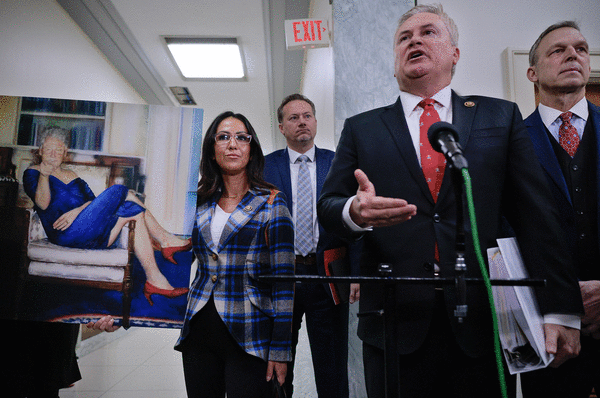
WASHINGTON — Kentucky Rep. James R. Comer said Thursday he is pushing to use a government funding deadline this month to secure a delay in the implementation of an intoxicating hemp ban enacted in November that critics say puts some farmers at financial risk.
Comer, along with House Agriculture Committee ranking member Angie Craig, D-Minn., co-sponsored a bill introduced by Rep. Jim Baird, R-Ind., on Tuesday that would push the effective date for new hemp content restrictions from November 2026 to November 2028.
But the Republican lawmaker said he is working with leadership to include a delay in government funding legislation ahead of a Jan. 30 funding deadline.
“I feel good about it, but it’s not a done deal yet,” Comer said after a joint press conference with two industry groups, Hemp Industry and Farmers of America and U.S. Hemp Roundtable.
“We have to keep the government open. So this is the best option. There are other Plan B’s and Plan C’s, but if Plan A doesn’t work, it’s gonna be pretty detrimental to the industry,” Comer said.
Comer said if the extension isn’t in the upcoming funding bill, the farm bill would be an alternative vehicle. But he warned that if an extension isn’t in place after January, farmers will lose an entire crop year.
“If you’re going to plant a crop, you’ve got to plan several months before you put it in the ground. You got to order the seeds. You got to order the fertilizer,” Comer, himself a farmer, said.
Baird said in a Tuesday statement that farmers need time to plan for the new hemp restrictions before they come online.
“Congress should not have passed such a sweeping policy change that upends a growing industry. Instead, Congress should have given farmers more time, creating a more stable environment for farmers to modify their future planting decisions,” Baird said.
The 2018 farm bill legalized hemp with less than 0.3 percent of delta-9 tetrahydrocannabinol concentration, or THC, a psychoactive compound in marijuana. The change gave a boost to the hemp industry for a variety of end uses, but also led to the proliferation of products including cannabinoids that drew attention for potential health risks.
The continuing resolution that ended a 43-day government shutdown in November included full-year appropriations for the Agriculture Department. It contained a provision that changed the measurement to a total THC threshold rather than only delta-9 THC, which effectively amounted to a ban that starts in November, one year after enactment of the restrictions.
Brian Furnish, the owner of Furnish Farms in Kentucky and a hemp advocate, said that he’s already feeling the impact of the ban.
“Our challenge is, if we don’t get a two-year extension, as a farmer, I can’t sell my current inventory that I harvested legally and planted legally in 2025. As of right now, my farm loans lost over $600,000 in price in the last six weeks,” Furnish said at the press conference.
He said that hemp allowed him to diversify from tobacco and about 70 percent of his income comes from hemp. Furnish said that farmers are losing money to grain crops.
“Our next challenge is if we can’t get an extension and we can’t move our 2025 crop, we will not be planting that 2026 crop. We just can’t afford to,” Furnish said. “We’re sitting on a couple million dollars’ worth of inventory, and that could be detrimental to our farm.”
Uncertain future
The next potential chance to extend the deadline has both uncertain timing and outcome. The House Agriculture Committee is looking at marking up the farm bill in February. Senate Agriculture Committee Chairman John Boozman, R-Ark., said Tuesday that he isn’t sure when that panel plans to mark up the bill.
Rep. Andy Harris, R-Md., and Sen. Mitch McConnell, R-Ky., who spearheaded the initial ban on intoxicating hemp products, are the most likely roadblocks to passage. Neither responded to a request for comment.
Boozman said extending the effective date would be difficult.
“That passed overwhelmingly in the Senate. Certainly, we have members that are very concerned about that,” he said. “The problem is that it is simply totally unregulated so an 8-year-old kid can use these products.”
President Donald Trump in a December executive order directed Congress to work with the White House to “update the statutory definition of final hemp-derived cannabinoid products to allow Americans to benefit from access to appropriate full-spectrum CBD products while preserving the Congress’s intent to restrict the sale of products that pose serious health risks.”
The order also directed Congress to develop a regulatory framework. Rep. Morgan Griffith, R-Va., has for years been trying to pass hemp regulatory legislation and was circulating draft legislation in October. Griffith is a co-sponsor on Baird’s bill.
Comer said extending the effective date two years would give Congress time to enact such legislation, but there’s still more work to be done on such a measure.
“We don’t think hemp should be regulated like a pharmaceutical or like a nutraceutical, but there needs to be some type of regulatory framework. That’s the problem here,” Comer said.
Lawmakers say a third and final fiscal 2026 spending package that would include the Defense, Labor-HHS-Education and Transportation-HUD bills is pending. Sen. Susan Collins, R-Maine, said Wednesday that negotiators are hoping to release the bill text this weekend.
A final Homeland Security spending bill has also been floated for potential inclusion in that package, but the outlook of that legislation was thrown into jeopardy last week after an Immigration and Customs Enforcement officer fatally shot U.S. citizen Renee Good in Minneapolis.
Lawmakers have also floated the prospect of a short-term continuing resolution to buy time to finish out talks, as well as a potential CR running through the rest of fiscal 2026 for any bills that haven’t been completed by the funding deadline.
____
(Jacob Fulton contributed to this report.)
©2026 CQ-Roll Call, Inc., All Rights Reserved. Visit cqrollcall.com. Distributed by Tribune Content Agency, LLC.





















































Comments