Trump's credit card threat casts shadow over Wall Street's profit parade
Published in Political News
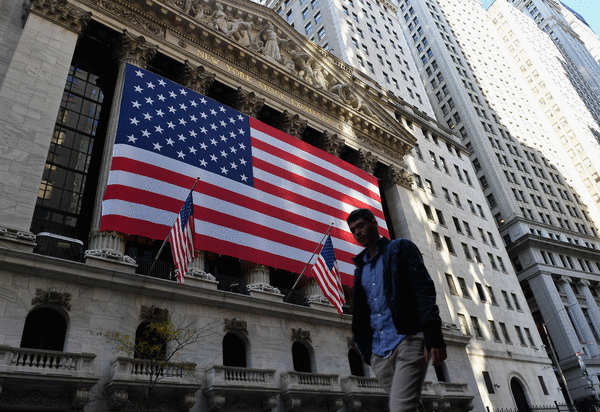
Donald Trump’s return to the White House unleashed a market rally, dealmaking went into overdrive, and bankers embraced all things Trump to rake in the big money.
The new year is offering Wall Street enough reason to worry that the party could be cut short.
The top U.S. banks are trotting out results this week that back up the big run-up in their shares during the past year. But investors are now pivoting to the potential threats ahead, as they worry a populist turn by the president could erode the gains from the aggressive deregulation push the administration has promised to pursue.
“Nobody in banking thinks it’s going to be beer and skittles forever,” said Steve Gannon, a financial-services lawyer at Davis Wright Tremaine. “It’s a messy intersection of politics and banking policy.”
The best way forward, Gannon said, is for executives to hold their tongues, work with trade groups and find a middle ground with Trump.
The most immediate concern is the president’s social-media edict, with unclear real-world authority, that demands banks cap credit-card interest rates at 10%, or roughly half the current average on outstanding balances, for a year. The banks have less than a week left to comply, according to the president.
Citigroup Inc. Chief Financial Officer Mark Mason delivered the starkest warning, saying such a move will likely result “in a significant slowdown in the economy.” While offering to work with the administration, he added, “an interest rate cap is not something that we would, or could, support, frankly.”
On Tuesday, JPMorgan Chase & Co. CFO Jeremy Barnum said the biggest U.S. bank will consider all options to fight back against the proposal, warning it “would be very bad for consumers, very bad for the economy.”
That all comes on the heels of Trump’s vow to prevent big institutional investors from buying more single-family homes and threatening limits on stock buybacks, dividends and executive pay in the defense sector. His promises of government intervention mark a decidedly sharp pivot for a president who has claimed to champion free markets.
It also explains the nervous energy coursing through Wall Street.
Investors are turning their attention away from the prospect of unlimited upside and worrying about expenses instead. Shares of JPMorgan, Citigroup, Bank of America Corp. and Wells Fargo & Co. have all tumbled after the lenders reported fourth-quarter results this week.
Dimon’s vow
JPMorgan Chief Executive Officer Jamie Dimon vowed to spend what’s needed to avoid losing ground to competitors as he sought to fend off increased scrutiny of the bank’s costs. Non-interest expenses have climbed 46% since 2019, and JPMorgan said it expects it to rise again this year to $105 billion. In addition, the investment-banking business posted fourth-quarter fee income that fell short of guidance that the company telegraphed just a few weeks earlier.
Executives at Bank of America, meanwhile, found themselves batting down repeated questions about its own arc of spending to chase revenue growth.
After years of lagging behind its Wall Street peers, Citigroup’s dealmakers are narrowing the gap as CEO Jane Fraser’s turnaround takes hold. But even Citi, the best performing big-bank stock in the U.S. last year, shied away from providing a concrete estimate of how much it plans to spend this year.
Wells Fargo, entering its first full year freed from the Federal Reserve’s asset-cap yoke, struggled to drive the conversation away from the jump in its own expense line, largely tied to fourth-quarter severance costs.
“We have built a strong foundation and have made great progress in improving growth and returns, though we have operated with significant constraints,” CEO Charlie Scharf said in a statement.
Bank of America, which has been focused on guiding investors toward its growing pile of net-interest income — what the bank earns after expenses from interest-bearing assets — also raised questions about its ability to control expenses.
The bank’s guidance suggests that first-quarter expenses “will be worse than we and the market expect,” Piper Sandler Cos. analyst Scott Siefers said in a note to clients. “Better-than-consensus NII expectations are good, but the cost guide could offset and keep expectations more tethered.”
(With assistance from Katherine Doherty, Hannah Levitt, Todd Gillespie and Yizhu Wang.)
©2026 Bloomberg L.P. Visit bloomberg.com. Distributed by Tribune Content Agency, LLC.
















































Comments