Democrats close year emboldened by 2025 electoral successes
Published in Political News
WASHINGTON — Republicans began 2025 on a triumphant note, with full control of Congress and Donald Trump moving into the White House.
They’re closing the year with Trump’s job approval ratings sliding, a redistricting push that hasn’t delivered as expected and Democrats riding high from the off-year election results.
Both parties are now trying to convince voters they are best able to address their economic concerns. As we approach the 2026 midterms, here’s a look back at the big campaign moments of the past year:
Democrats sweep the governors’ races
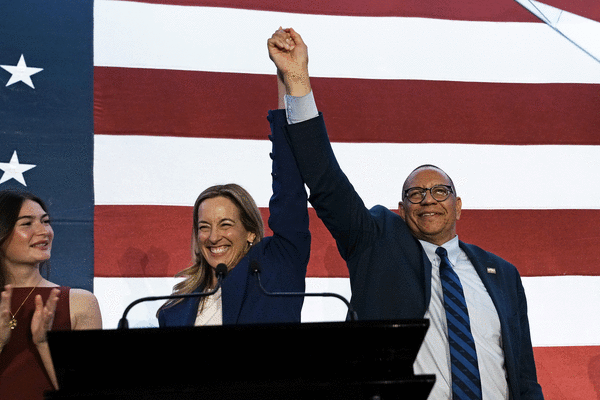
Democrats Abigail Spanberger and Mikie Sherrill, both members of the House class of 2018, scored double-digit victories in gubernatorial races in Virginia and New Jersey, respectively. The elections are often viewed as a harbinger of how voters feel a year out from the midterm elections.
Their focus on high costs — Spanberger on the cost of living and Sherrill on utility costs — has helped center national Democrats’ messaging on affordability as they pivot to the midterms. Their results have also emboldened Democrats on Capitol Hill, who have expanded their House offensive targets for next year and generally feel more bullish about their chances to win back the Senate than they did at the beginning of the year.
“We talked about affordability with everyone,” Sherrill campaign manager Alex Ball told reporters at a briefing last month, adding that they tailored her message to different constituencies.
“We talked about costs to everybody, but the message changed, and I think folks really understood that Mikie was listening to them, and she really understood the issues affecting their communities,” she said.
With her election, Spanberger became the first woman elected governor of Virginia, while Sherrill, who resigned her House seat in November, is the second woman elected to lead the Garden State.
… and Democrats overperform in House specials
In all five House special elections this year, Democratic candidates overperformed the party’s 2024 margins. While special elections aren’t always good predictors of future results, the outcomes further affirmed Democrats’ confidence about their prospects of flipping the House next year.
House Republicans, who are defending a razor-thin majority, crucially didn’t lose any seats in these elections: Randy Fine and Jimmy Patronis won special elections in Florida in April, while Matt Van Epps held a Middle Tennessee seat earlier this month. But the margins of victory in all three districts were much closer than last year.
Democrats easily won a pair of special elections in Virginia and Arizona, but even here, their respective nominees, James R. Walkinshaw and Adelita Grijalva, saw the party’s margin grow from 2024.
The Democratic overperformances were replicated in other down-ballot special elections. The party flipped legislative seats in Iowa, Pennsylvania and Georgia, and a pair of seats on the Peach State’s Public Service Commission.
Empire state of mind
The election of Zohran Mamdani, a self-described democratic socialist, as the next mayor of New York City, has reverberated across the Big Apple and beyond.
Several House Democrats from New York have drawn primary challengers from the left, many of them encouraged by Mamdani’s rise. Among them is New York City Comptroller Brad Lander, who finished third in the Democratic mayoral primary and is challenging Rep. Dan Goldman with support from Mamdani and Sens. Bernie Sanders and Elizabeth Warren.
Reps. Grace Meng, Ritchie Torres and Adriano Espaillat, who represents parts of New York City, have also drawn primary challengers, while the races to succeed retiring Reps. Jerrold Nadler and Nydia M. Velázquez have attracted several progressives.
Mamdani, meanwhile, has emerged as a top bogeyman for Republicans, who are already attempting to tie the mayor-elect to Democrats in battleground seats in New York and other states, including Colorado and Wisconsin.
Redistricting reshapes the battleground
When the year began, it was expected that Ohio would get a new congressional map, as required under state law, and that lawsuits over maps in a handful of other states could prompt new lines.
But when Trump urged Republicans in Texas to redraw their House map to help the GOP pick up as many as five additional seats, it set off a mid-decade redistricting scramble for both parties across the country.
All told, Texas, California, Missouri, North Carolina, Utah and Ohio have adopted new maps, although legal processes are ongoing in Missouri and Utah. Virginia’s Democratic-led legislature and Republican-controlled Florida could also approve new maps before the elections next year.
In a stunning rebuke of Trump, an effort to craft a new map in Republican-controlled Indiana collapsed last week, when the state Senate rejected a proposal aimed at securing an all-GOP House delegation.
Neither party ends the year with a clear advantage in the fight for the House. But legal challenges and the potential for more states to revisit their maps mean we still don’t have a full picture of the 2026 battleground landscape. The Supreme Court is also expected to rule in a Louisiana case that could overturn part of the Voting Rights Act, which could prompt Southern states to reconsider their congressional lines and deliver additional seats for Republicans.
Calling it quits
Retirements are a constant every election cycle, and 2025 was no different.
So far in the House, 10 Democrats and five Republicans are retiring and not seeking another office next year. This doesn’t include Georgia Republican Marjorie Taylor Greene, who has said she will resign on Jan. 5. Several others from both parties are running for Senate, governor or another position.
In the Senate, four Democrats and four Republicans are not running for reelection in 2026, including gubernatorial hopeful Tommy Tuberville, R-Ala.
Tuberville isn’t the only senator seeking to return home. Tennessee Republican Marsha Blackburn and Colorado Democrat Michael Bennet are also running for governor, although neither are up for reelection next year.
Two longtime congressional leaders, former Speaker Nancy Pelosi and former Senate Majority Leader Mitch McConnell, are both entering their final year in Congress after previously stepping back from their leadership roles.
Many of the retiring Democrats have pointed to a need for generational change in government, as discussions about age in politics reached a high point this year. Several more seasoned Democrats face primary challenges from younger rivals who argue their districts need new leadership.
State Supreme Court races draw national attention
Races for Supreme Court seats in states that hold judicial elections have historically been low-key affairs. 2025 confirmed that is changing.
The April election for an open seat on the Wisconsin state Supreme Court, a technically nonpartisan contest, became the most expensive race for a judicial seat in U.S. history, with total spending in the race surpassing $100 million, according to the Brennan Center for Justice.
Elon Musk spent heavily for the conservative candidate in the race, who lost to liberal Susan Crawford, which spelled the beginning of the end of Musk’s White House sojourn. The tech billionaire publicly fell out with Trump later in the spring.
Democrats also won a trio of retention elections in November for the Pennsylvania Supreme Court, maintaining the party’s majority on the bench. A year earlier, Trump had carried the battleground state for the second time as Republicans flipped a Senate seat and two House seats.
While the Pennsylvania races did not garner the same national attention as Wisconsin’s, spending in the races exceeded expenditures the last time there was a retention election for the court, Spotlight PA reported.
©2025 CQ-Roll Call, Inc., All Rights Reserved. Visit cqrollcall.com. Distributed by Tribune Content Agency, LLC.



















































Comments