California on track for lowest Lake Mead use in 75 years
Published in Science & Technology News
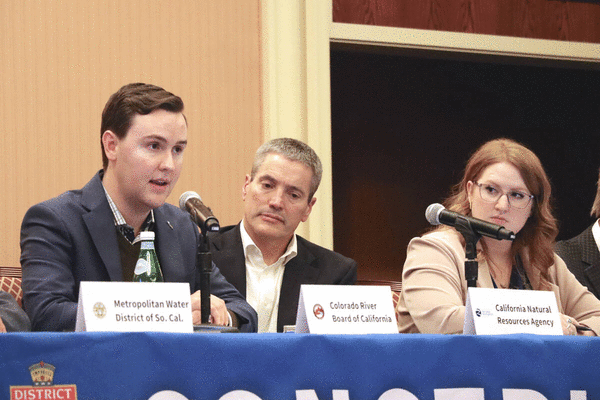
Lake Mead may be facing historic shortages, but officials from the Colorado River state that uses the most water are celebrating unprecedented water savings.
At a briefing for reporters at Tuesday’s Colorado River Water Users Association conference at Caesars Palace, leaders from California’s biggest water districts said the state is on track to use 3.76 million acre-feet this year. That’s about 1.2 trillion gallons — the smallest amount of water from the river since 1949, despite explosive population growth.
“California is here to save the Colorado River, but we can’t do it ourselves,” declared JB Hamby, the state’s lead negotiator on interstate water talks.
Hamby said he believes that conservation is particularly impressive because among the seven states in the Colorado River Basin, California can use the largest share of water and has some of the most protected water rights anywhere in the American West.
The Imperial Irrigation District, for instance, is the single biggest water user in the basin, with its desert farms providing most of the country’s winter vegetables. Gina Dockstader, a fourth-generation Imperial Valley farmer who serves as chair of the district board, pointed to 9.1 million acre-feet of water saved since a key set of agreements that took effect in 2003.
On her farm, Dockstader said, she uses drip irrigation to grow organic lemons and medjool dates.
“Despite having the highest priority rights in the basin, in the Imperial Valley, the Colorado River is our only water supply,” she said. “We also love Mother Nature. We are extremely proud of the role that we have played, and we will continue to sustain the shared resource.”
While it wasn’t discussed at the press conference, in a news release after the gathering, the state’s officials laid out a framework for managing the river after 2026. That complicated negotiation process is looming over the conference.
What happens in the negotiating rooms has big implications for Lake Mead, Southern Nevada’s primary water source, which the federal government has projected will plunge to its lowest level ever in 2027.
In the news release, state officials said they are “willing to set aside many of their legal positions to reach a deal,” mentioning, in broad strokes, flexibility on a release schedule from Lake Powell; the distribution of shortage among the Lower Basin states of California, Arizona and Nevada; and a long-term, 20-year deal with phases.
Beyond the immediate deficit the basin faces of 1.5 million acre-feet, which the Lower Basin has agreed to take on with some potential savings from Mexico, California officials say the Upper Basin states of Colorado, Utah, New Mexico and Wyoming must step up.
California Natural Resources Secretary Wade Crowfoot said the seven states are working hard to meet Interior Secretary Doug Burgum’s Feb. 14 deadline for a final environmental impact statement, which will initiate a public comment period.
“We know we are on borrowed time that we need to deliver a Valentine’s Day present to 40 million Americans that rely on the Colorado River,” Crowfoot said.
In her opening remarks at Tuesday’s Upper Colorado River Commission meeting, the state of Colorado’s commissioner, Becky Mitchell, said the deadline is “pushing the envelope” in terms of how much time is left to strike a deal.
Mitchell said that because of declining water availability, and the fact that the system is built around demands rather than supply, a vast majority of water users in the Upper Basin are already subject to mandatory, uncompensated cuts in their water use.
She called attention to an imbalance in how recent pools of federal funding for conservation are split between the Lower and Upper Basins, with the Upper Basin only receiving about 5 percent, she said.
“We know we are not going to get everything on our wish list,” Mitchell said. “At this point, we have given everything we have towards finding a solution. But we will all need to come together for this to be enough.”
More details are likely to come later in the conference about the timing of the public document release.
On Wednesday morning, leaders from the Bureau of Reclamation — the federal agency tasked with overseeing the negotiations — is set to deliver an update. The principal negotiators from the seven states will speak on a panel on Thursday, the last day of the conference, as well.
_____
©2025 Las Vegas Review-Journal. Visit reviewjournal.com.. Distributed by Tribune Content Agency, LLC.




Comments