California leaders celebrate salmon 'comeback' but climate risks loom
Published in Science & Technology News
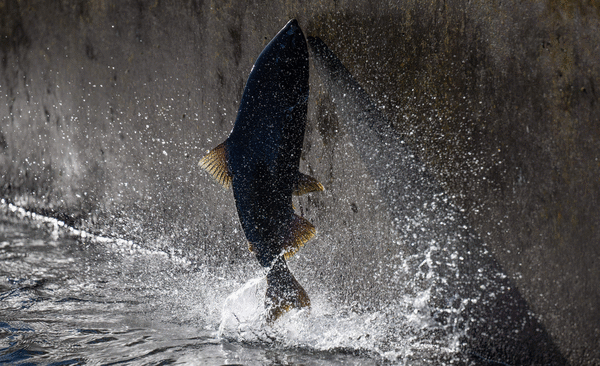
SACRAMENTO, Calif. — On Thursday, Gov. Gavin Newsom touted the “comeback” of coho salmon after state officials spotted juvenile fish in the Russian River’s upper basin — the first such sighting in more than 30 years.
As the state celebrated the news, however, federal fisheries officials announced that they would not designate Chinook salmon as endangered or threatened under the Endangered Species Act, prompting disappointment from conservation groups.
The two salmon species face different challenges and are at different stages of recovery, one salmon expert said. But climate change is increasingly shaping the fate of both.
Different vulnerabilities in a warming world
Carson Jeffres, a senior researcher at UC Davis’ Center for Watershed Sciences, emphasized Chinook and coho are not on the same trajectory, citing their biological differences.
“Threats are very different for different life histories, for the different species ... in how the degradation of the environment affects them,” Jeffres said.
Juvenile coho salmon must survive increasingly hot summer river temperatures as they spend an entire year rearing in freshwater after their eggs are laid in late fall or winter. Meanwhile, Chinook salmon typically migrate to the ocean during their first spring, allowing most juveniles to avoid the hottest summer conditions in rivers, though spring-run Chinook face greater exposure because adults enter rivers in the spring and remain there through the summer before spawning.
While they face different challenges, both species are shaped by the same broader “macro picture” of climate-driven pressures, Jeffres said, warning that a single encouraging season for coho does not signal long-term stability and turnaround.
“We’ve been fortunate. We have had three wet years,” Jeffres said, referring to recent years of above-average precipitation that have temporarily improved river conditions.
“They do a lot better on the wet side of things, but we’re seeing that pendulum swinging back and forth and more extreme than we have in the past,” he continued, pointing to drought conditions from 2012 through 2016, followed by wet years, another extreme drought in 2021 and 2022 and the three wet years California is experiencing now.
Extreme swings between wet and dry conditions are widely recognized as a sign of climate change by scientists at agencies such as the Environmental Protection Agency, which notes that a warming atmosphere intensifies both drought and heavy rainfall.
“Climate change, among various other threats, makes salmon and steelhead recovery a complex and challenging task,” National Oceanic and Atmospheric Administration Fisheries states on its website. NOAA also found that five Chinook salmon groups face very high climate risk and five face high risk, while one coho group is at very high risk and four are at high risk, largely due to warming waters and altered flows.
The federal agency estimated high river temperatures wiped out three-quarters or more of winter-run Chinook salmon eggs in 2021, and produced a mortality rate as high as 86% during the severe drought season in 2014 and 2015. The agency also projects that Snake River spring and summer Chinook salmon populations will face dramatic declines in the coming decades as sea surface temperatures continue to rise.
“We are seeing 10,000 plus Chinook above Iron Gate dam ... this year. But there were hundreds of thousands historically, and that’s not something that we’re going to see happen in a matter of a couple years,” Jeffres said.
“This is a century-long problem ... Thinking it’s going to be fixed in a year is not one of those realistic solutions.”
Policy and protection
The Trump administration has taken multiple actions this year affecting salmon conservation, including withdrawing from a salmon restoration agreement with Pacific Northwest tribes and moving to roll back Endangered Species Act protections.
In November, Secretary of the Interior Doug Burgum said the government is revising the ESA to focus on protecting species in ways that “also respect the livelihoods of Americans who depend on our land and resources.”
The proposed changes would alter how federal agencies decide whether a species qualifies for protection and how critical habitat is designated, focusing more on current population conditions and less on future climate threats.
In press releases, Stephanie Kurose, deputy director of government affairs at the Center for Biological Diversity, said, “if these Trump proposals had been in place in the 1970s, the only place you’d find a bald eagle today is on the back of a dollar bill,” while Joanna Zhang, endangered species advocate with WildEarth Guardians, said the move would “spell disaster” for species like salmon in the Pacific Northwest.
For now, federal law still protects several West Coast salmon populations under the Endangered Species Act. Central California Coast coho salmon and Sacramento River winter-run Chinook are listed as endangered, with Southern Oregon–Northern California Coast coho, Central Valley spring-run Chinook and California Coastal Chinook listed as threatened.
As for the recent denial of protected status for Southern Oregon–Northern California Coast Chinook salmon, conservation groups argued that regulators should have evaluated spring-run and fall-run Chinook separately, saying spring-run Chinook face greater risk and that combining the two runs could mask population declines for spring-run.
Federal fisheries officials, however, concluded that the spring-run fish were not distinct enough to warrant separate protections.
“We’re looking at the Fisheries Service determination and seeing if we can challenge it,” said Jeff Miller, a senior conservation advocate at the Center for Biological Diversity, which petitioned for the Southern Oregon–Northern California Chinook salmon’s listing, following the denial last week.
Miller said the determination was inconsistent with how the agency has treated Chinook populations elsewhere, like in the Central Valley and upper Columbia River.
Jeffres agreed, noting lumping them in one population is “an error” as they have evolved differently over time and have distinct life history strategies. At the same time, he added the coho sighting likely reflects years of local restoration and watershed work, noting that an ESA listing alone does not ensure recovery.
“Having a listing can be a useful tool, but just having a listing doesn’t mean the species is going to return,” Jeffres said.
“It wasn’t ESA that ultimately brought the Klamath dams down,” he said.. “It was decades of protest and highlighting the importance of that resource to all the communities in the Klamath River. It’s the action for the communities that live in those watersheds that really changed the needle.”
_____
©2025 The Sacramento Bee. Visit sacbee.com. Distributed by Tribune Content Agency, LLC.






Comments