Review: 'The Social Reckoning' lacks sharpness, focus of 'The Social Network'
Published in Entertainment News
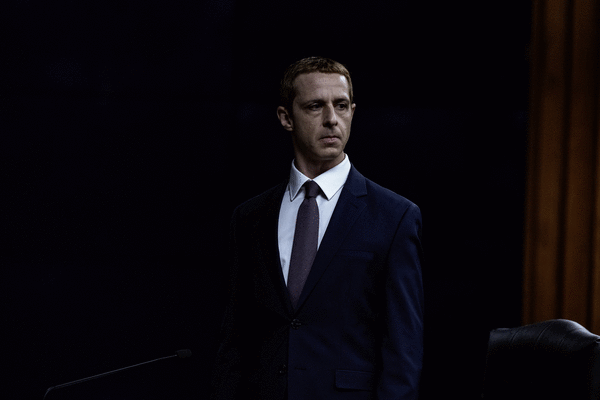


We've come a long way in our relationship with Big Tech and social media since the release of 2010's "The Social Network," which put its finger on the pulse of where we were headed in society as we shifted our relationships with the real world to interactions with screens.
That same foresight and intuition is sorely lacking in "The Social Reckoning," the film's flat follow-up, which, rather than looking forward, looks back at society's fraught relationship with social media. Oh, Facebook tips the scales of what we see on a daily basis? You don't say.
And at a time when AI and a new class of Big Tech giants are threatening to entirely end our existence — and a fresh group of filmmakers has sharpened their eyes on those subjects (see the upcoming Sam Altman biopic "Artificial" or Alex Gibney's Elon Musk documentary) — "The Social Reckoning's" target feels both quaint and dated. It arrives as a period piece of an already lapsed chapter in our lives.
Aside from all that, it's not just very good.
Jeremy Allen White, who, despite marquee roles (he played Springsteen!), has yet to prove his big-screen presence, plays investigative reporter Jeff Horwitz, who lands a job at the Wall Street Journal's San Francisco bureau with the goal of looking into Facebook and its practices.
He finds his source in Frances Haugen (Mikey Madison, in her first role since winning an Oscar for "Anora"), a Facebook data engineer who is concerned about some of the company's internal policies. She believes in Facebook and its mission but cannot find an audience at the company to listen to her pleas for regulation and balance, and she becomes a whistleblower to White's Horwitz.
In another orbit in the film is Jeremy Strong's Mark Zuckerberg, stepping in for Jesse Eisenberg, who played Zuck in "The Social Network." Strong's Zuckerberg is stiff and tightly mannered, the exact cyborg-like replica of a human being we see in news clips of the tech giant, and the actor is devouring the role. It's too bad that writer-director Aaron Sorkin gives him almost nothing to do but sit in a chair.
Sorkin wrote the original "Social Network," but he's missing several key components from that film here, chiefly director David Fincher, who brought his maniacal exactitude to "The Social Network" and helped embody the film's cold core. Also missing is Trent Reznor and Atticus Ross, whose minimalistic score brought a sense of quiet loneliness to the original film; he's replaced by Alexandre Desplat, the double Oscar winner (he won for "The Grand Budapest Hotel" and "The Shape of Water"), who provides a steady if unremarkable backbone to the film.
Where Fincher's focus was Zuckerberg himself, Sorkin's is the world of Facebook, and the world that Facebook has wrought. That allows him to indulge in some of his worst impulses, and "The Social Reckoning's" timeline builds to the COVID-19 pandemic (a character does the thing where they talk about what a big deal it's going to be while they're roundly ignored by those around them) and then builds to a major event that, while not giving spoilers, let's just say it's referred to by the date on which it happened.
When the film arrives there, it plays out as a sanctimonious, eye-rolling gotcha moment — oh, so this is where the film is headed? — as Sorkin frames it like something out of "The Newsroom." And he paints it as the sole responsibility of Facebook, ignoring other social networks, let alone world leaders who fostered that environment beyond the realm of social media.
If the film's conceit is the world that way directly because of Facebook, it's far too broad a target, and the film isn't sharp enough to drive that thesis home. Especially when it spends much of its time with Strong and Madison's characters, and focusing on the minute details of data sharing as it relates to journalistic ethics and practices. The movie has a sharp eye for those specifics, but in a movie that's not necessarily about journalism mechanics and legalities, those points seem wasted and off-topic.
"The Social Reckoning" ends up feeling dramatically inert, unfolding without tension or urgency, and scattered in its narrative approach. Stand-up comedian Bill Burr plays a member of Zuckerberg's legal counsel who keeps hammering Zuckerberg to place regulations on fact-checking political ads, becoming a one-man stand-in for an entire ideology. (Or a one-man stand-in for Sorkin, as it were.)
The director folds in references to Old Hollywood; there are mentions of Frank Capra films and musicals like "Show Boat," because his characters have to exist as 1950s ideals, time-out-of-place angels in a world flipped upside down. There's just no juice in "The Social Reckoning," a movie that's gawking at a car fire while the entire world burns.
———
'THE SOCIAL RECKONING'
Grade: D+
MPA rating: R (for language)
Running time: 1:52
How to watch: In theaters Oct. 9
———
©2026 The Detroit News. Visit detroitnews.com. Distributed by Tribune Content Agency, LLC.








Comments