San Diego Symphony opens season on celebratory note with a triumphant performance
Published in Entertainment News
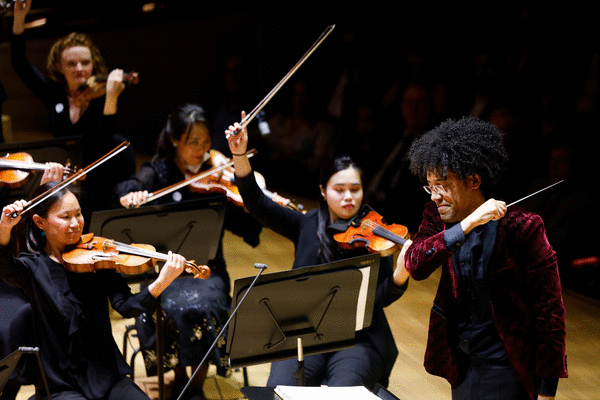
SAN DIEGO — San Diego Symphony Music & Artistic Director Rafael Payare at times seemed on the verge of levitating as he conducted the orchestra Sunday on the opening weekend of its 2026-27 season at downtown’s Jacobs Music Center.
Elevating and — at its peak — electrifying, the performance showcased Payare and the symphony at their highest level. The heady results demonstrated precisely how much the orchestra and its charismatic leader have evolved since he came on board in late 2019.
By turns bold and dramatic, lush and poignant, inviting and provocative, Sunday’s concert saw Payare and the musicians demonstrating the full range of their artistic abilities.
It also gave attentive listeners good reason to wonder: If the San Diego Symphony sounds this strong and assured at the start of its sixth season with Payare at the helm, how much stronger and more assured will it be when the orchestra commences its first-ever European concert tour in late April?
The tour, which will open at Barcelona’s famed Palau de la Música Catalana, was one of several topics symphony CEO Martha Gilmer touched on in her brief, pre-concert opening remarks Sunday.
She reminded the audience that the symphony’s superb new album, “Shostakovich Symphony No. 7” — recorded during two spring 2025 concerts at Jacobs Music Center — is streaming on Apple Music Classical and was released last month in CD form by the Brussels-based record label Delos.
San Diego Symphony’s next album will be released in the spring, Gilmer noted. For those keeping record, an earlier iteration of the orchestra is featured on the recently released 25th anniversary edition of “Magnification,” a 2001 album by the pioneering English progressive-rock band Yes.
Gilmer also promoted two upcoming performances of particular note.
The first, at Jacobs Music Center on Oct. 29, will feature Payare conducting Canada’s Orchestre symphonique de Montréal, which he also leads as music and artistic director. The second, a free concert at The Rady Shell at Jacobs Park on Oct. 30, will feature Payare conducting the San Diego and Montreal orchestras separately and together.
Both concerts are part of San Diego Symphony’s new Beyond Borders: North American Music Initiative, which was announced Sept. 29 and is designed to boost the orchestra’s expanding presence in Mexico, the United States and Canada.
“We believe at this moment it is important to engage with our neighbors to the north and south,” Gilmer said, “underlining all we have in common and not focusing on our differences.”
When the audience applauded, Gilmer said: “I can’t tell you how great the sound of that affirmation is.”
Sunday’s concert included two classics: Mozart’s Piano Concerto No. 24 in C Minor, K 491, which featured Yefim Bronfman as the soloist; and Strauss’s epic tone poem, A Hero’s Life (Ein Heidenleben) Op. 40.
The third selection, which opened the performance, was Fairytale Poem (Poema-Skazka), a 1971 tone poem by the late Russian-Soviet composer Sofia Gubaidulina. The decision to include two very different tone poems, written 73 years apart, was an inspired one.
Gubaidulina specialized in sacred and experimental music. Her work deftly captured joy and despair, shadows and light, with unusual grace and imagination. Based on a Czech children’s story, the 12-minute “Fairytale Poem” is an allegory (for life under the yoke of an oppressive regime) and a metaphor (for how a child’s piece of chalk can unlock the imagination).
Payare and a scaled-down, string-focused lineup of the orchestra nailed both the whimsy and edginess of the piece. They were especially nimble emphasizing the silences between notes, the blurring of tonality and atonality, and the whisper-like hush with which “Fairytale” concluded.
The Mozart Piano Concerto — just one of two minor-key concerts in his vast catalog — was impeccably performed. Together with pianist Bronfman, they dug deep into the music’s alternately tender and dark moments, dramatic surges and finely nuanced filigrees.
Bronfman cleanly articulated even the most charged arpeggios. His decision to play with understated tenderness added contrast to the swirling wind and string passages, and Payare conducted with a winning combination of force and sensitivity.
The highlight of the concert came with the Strauss opus. Clocking in at 44 minutes, it was heroic and then some.
In less-gifted hands, a work this technically demanding and emotionally intense can be the musical equivalent of a whirlpool that challenges performers just to try to stay afloat. Not so, Payare and the orchestra. They brought admirable clarity to even the most complex moments of this monumental work, which tested the mettle of every player on stage.
Their dazzling performance served as a musical master class in the art of aural excellence, textural command, cogent ensemble work, pinpoint dynamic control and how to bring a lightness of touch to potentially bombastic moments without lessening their impact.
Concertmaster Jeff Thayer soloed with admirable sensitivity and expressiveness in the third section of The Hero’s Companion, a violin-fueled portrait of Strauss’ real-life wife. When the music shifted to trumpet fanfares, darting flute lines and pounding percussion, Payare’s nearly airborne conducting was so energetic one wondered if he concluded the concert weighing a few pounds less than when it began.
©2026 The San Diego Union-Tribune. Visit sandiegouniontribune.com. Distributed by Tribune Content Agency, LLC.






Comments