'It Ends' and the rise of Gen Z horror
Published in Entertainment News
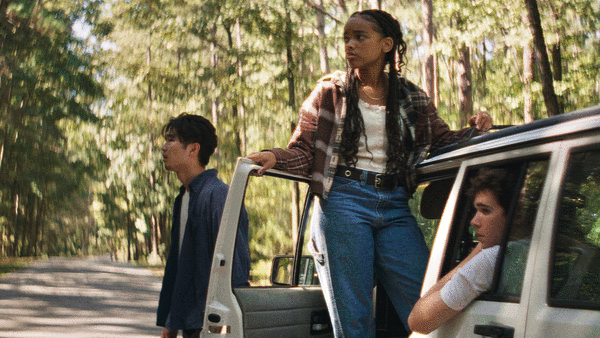
LOS ANGELES — Yet another Gen Z horror movie has arrived in theaters, continuing this season’s buzziest topic: the rise of Hollywood’s new crop of young filmmakers.
This time, it’s 28-year-old Alexander Ullom’s “It Ends,” about a group of friends trapped on a never-ending road trip. Distributed by Neon, the film was reported to have a production budget of only about $80,000.
Since opening on Aug. 21, the indie movie has made about $813,000 after its limited released in 340 screens. Though it’s not the barn-burning box office success of fellow Gen Z horror films such as A24’s “Backrooms” ($394.1 million worldwide) or Focus Features’ “Obsession” ($505.7 million), Ullom’s feature debut indicates that horror by and for young people isn’t a trend that’s ending anytime soon.
For one, Ullom will be back in the driver’s seat to direct his second feature film, “4 X 4: The Event,” a horror movie about a lethal livestreamed competition, which Neon acquired this year for an undisclosed price.
And secondly, these stories are resonating with younger audiences, a demographic Hollywood desperately wants to reach. My colleague, Cerys Davies, has written about the industry’s mad dash to find the next internet stories that can be transformed into box office phenoms. Beyond these YouTube-inspired narratives, horror allows filmmakers to say something about these times.
Films such as “It Ends,” “Backrooms” and “Obsession” get at Gen Z’s specific fears, including pandemic-related isolation, disconnects in romantic relationships or a future with few jobs. And they’re more powerful because they’re coming from filmmakers who intimately understand those crises.
Young people want movies and TV shows that reflect their own lives and relatable issues, rather than more stories in the fantasy genre, according to last year’s annual Teens and Screens report from the Center for Scholars and Storytellers at UCLA. They’re also looking for more content that reflects friendships, versus a focus on romantic relationships.
It’d be smart for Hollywood to pay attention.
For insights, I asked Yalda Uhls, a former studio executive and the founder and chief executive of the Center for Scholars and Storytellers, what the industry should learn from the rise of these Gen Z horror movies.
“Listen to young people,” she told me. “Try to integrate their authentic lived experience into your development process. Think about what they really want, not what you think they want.”
After all, the younger generation is taking notes from this most recent wave of young filmmakers.
Joe Rosenberg, director of industry relations at Chapman University’s Dodge College of Film and Media Arts, told me that many of his students are interested in horror and that they’ve gotten inspiration from the more nontraditional paths of directors such as “Backrooms’” Kane Parsons and “Obsession’s” Curry Barker, who built followings on YouTube before launching feature films.
“They love it, it’s user-generated and they don’t have to wait for someone to write them a check,” Rosenberg said. “When they look at the success of ‘Backrooms’ and ‘Obsession,’ I know what they think is, ‘I think there could be a path for me.’”
Even Ullom had an unconventional path to getting “It Ends” into theaters. The director went from a general meeting on the Universal lot to hopping a nearby fence to join a “Jurassic World” press event. There, he pretended to be an influencer and ended up meeting filmmaker Nicolas Curcio, who has built a following on social media, Ullom recounted in a Reddit Ask Me Anything post last week. Ullom sent “It Ends” to Curcio, who posted about the film online, and after social media buzz and a vote of confidence from Letterboxd, Neon ended up coming on board, he said.
When asked what advice he would give aspiring writers and directors, Ullom hit on two paths — horror’s current moment, as well as the benefit of online audience-building.
“There seems (at least right now) to be institutional support only for genre/horror although if theatrical trends stay high I could see that changing over the next 5 years,” he wrote on Reddit.
He added, “Online audience building is real and also a path to creative financial freedom but also relies on algorithmic support which is tough for long-form narrative features. If your work lines up with something that can be supported online, that’s huge.”
©2026 Los Angeles Times. Visit at latimes.com. Distributed by Tribune Content Agency, LLC.










Comments