How Don Henley and Ted Danson came to PBS's 'Henry David Thoreau'
Published in Entertainment News
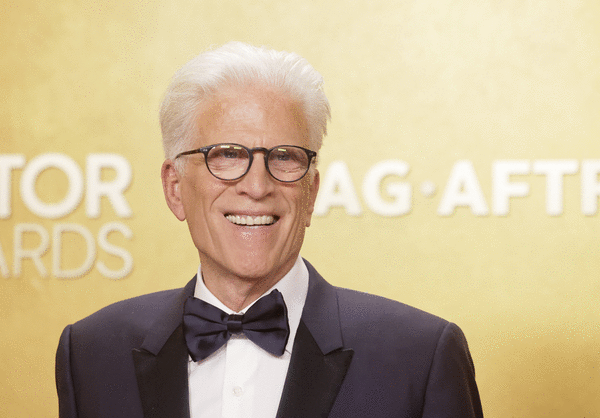
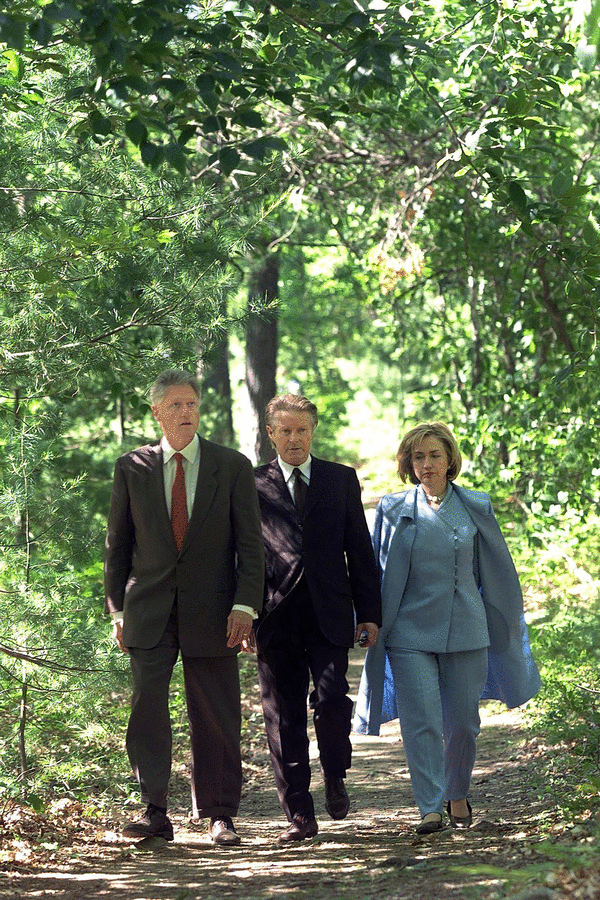
ANAHEIM, Calif. — Don Henley was fixing a bite to eat at his Mulholland Drive home one day in late 1989 when a CNN report on the TV in his kitchen caught his attention.
“I heard the words ‘Walden Woods’ and I heard the words ‘commercial development,’” the singer-songwriter and founding member of the Eagles says on a recent call.
“So I walked over and stood very close to the TV and I saw these guys standing in the woods, talking about this proposed office park,” he says. “I think it was something like 150,000 square feet.”
Henley wrote down the name of one of the activists speaking against the development of the woods by Walden Pond in Concord, Massachusetts, where the writer Henry David Thoreau lived and wrote his 1854 masterpiece “Walden.”
The next day, he called Tom Blanding, the man whose name he’d caught, and told him he wanted to help.
“He said, ‘OK.’ I mean, he didn’t have any idea who I was,” says Henley, who wrote a check and sent it to locals fighting the development.
And then he kept going.
A few months later, he and a few close friends flew from Los Angeles to Massachusetts to meet the local activists.
“It was March 1990, so there was snow on the ground,” Henley says. “Frozen. We were not dressed for the occasion. You know, California dwellers.
“So we crunch through the snow and they showed us Thoreau’s cabin site,” he says. “They showed us the spring where he got his water and they showed us the proposed development.
“I’d never been to Walden Woods,” Henley adds. “It didn’t really occur to me that it still existed.”
That same year, Henley founded the Walden Woods Project to preserve more of the land as it was when Thoreau and Concord friends such as Ralph Waldo Emerson, Louisa May Alcott and Nathaniel Hawthorne walked them.
The organization, which marked its 36th anniversary this month, became Henley’s ongoing priority, preserving more than 200 acres of Walden Wood and celebrating the role of Thoreau and Walden in the environmental movement,
Now comes “Henry David Thoreau,” a new docuseries that premieres PBS on Monday, March 30. Henley and Ken Burns are executive producers. It features actors Jeff Goldblum and Ted Danson and Thoreau and Emerson, with Meryl Streep voicing other characters and George Clooney as narrator.
How did Henley, a rock star living in a big house on Mulholland Drive, find such a kinship with Thoreau, who famously chose a simple, deliberate life amid nature?
For that, lets travel back to East Texas at the end of the ’60s.
Back to the land
“Thoreau’s popularity waxes and wanes,” Henley says. “This past year I’ve seen his name in articles almost monthly, whether it’s The Atlantic or USA Today or whatever.
“Back in 1968, he was having a renaissance, a resurgence,” says Henley, 78. “You know, the boomer generation, the hippies and all were reading him, which was part of the whole back-to-the-land movement.
“Of course, his essay on civil disobedience was an inspiration for a lot of the protests of the Vietnam War, the civil rights protests.”
Henley was an English major then, though he says the works of Thoreau and Emerson weren’t part of his curriculum. Instead, he found them on his own after leaving college to help his mother care for his father, who’d been diagnosed with advanced heart disease.
“I guess they were just part of the zeitgeist,” Henley says of how he discovered the twin stars of the New England Transcendentalist universe. “I read Emerson first. I read his essay called ‘Self-Reliance,’ which helped me. I was trying to become a songwriter, and I wasn’t confident.
“So his essay on self-reliance had a big impact on me. Especially the line that says, ‘To believe in your own thoughts, to believe that what is true for every man.’ I thought, ‘Oh, that’s – I like that.’”
Henley grew up in Linden, Texas, a rural town of about 2,000. “There were woods and forests literally in my backyard,” he says. “There was a small pond down behind my house that I would visit.
“I’d always loved to be out in nature, but in reading Thoreau and Emerson, I gained a new kind of appreciation in terms of the spiritual aspect of the natural world. That helped me cope with my father’s mortality, and by extension, my own mortality, and how to deal with it.
“So that became a guiding principle for me, and was the beginning of my environmental activism,” says Henley, who, in addition to the Walden Woods Project, established the Caddo Lake Institute to preserve an ecologically and culturally significant wetland on the Texas-Louisiana border about 30 miles from Henley’s hometown.
As for that sense of the spiritual he finds in the natural world around him in Texas?
“Well, pot helped,” he says, laughing. “Enabled me to stare at a tree for hours. No, I was pretty much done with pot by 1973.
“I just came to the realization that nature is a gift, a miraculous gift that sustains us and makes our lives possible. What enables us to live on this planet is that we are just the correct distance from the sun. We have a climate that has water and oxygen and what a remarkable, unlikely thing that is.
“And,” he adds, casting a darker eye on the current state of the planet, “we are slowly but surely in the process of destroying all that.”
Reading Thoreau, sorta
Ted Danson, who voices Emerson in “Henry David Thoreau,” was born in San Diego five months after Henley’s arrival on the scene in East Texas.
His own path to the literature and philosophy of Emerson and Thoreau — and to the environmentalism Danson shares with Henley — was different, if no less revelatory.
“I had actually interviewed Ken Burns about a month before this ask from Don Henley came about,” Danson says of how he joined the docuseries. “Don, I’ve known for over 30 years. Pretty much at the time he created his foundation to protect Walden Pond and the woods and stop people from putting up condos in that prime historic area.”
Over the years, they’ve supported each other’s environmental work: Danson attended an early fundraiser for The Walden Woods Project; Henley supported Danson’s American Oceans Campaign around the same time before it merged into Oceana, the largest oceans conservation organization in the world.
“I will go pretty much anywhere that Don asked,” Danson says on a recent video call. “I have so much respect for Don Henley.”
As for the literature that serves as a cornerstone of the modern environmental and social justice movements, that was a tougher sell for Danson, who says he’d long had difficulty reading for retention as a high school and college student.
“When somebody asked me if I read ‘Walden,’ I said yes, but I lied, because I hadn’t, because I wasn’t a good reader,” he says. “It was later in life, probably through Don, that I’m trying to cover my tracks. [He laughs] I came late to it. I’m still learning. I learned from the documentary.”
His childhood and adolescence in Tucson, Arizona, where his father was an anthropologist and archeologist, and later Flagstaff, where his dad was the director of the Museum of Northern Arizona and Research Center, inspired much of his early environmental awareness.
“I was surrounded by my Hopi and Navajo friends because Flagstaff was near the Hopi-Navajo land,” Danson says. “They are, if nothing, the original environmentalists. All of their gods and prayers and dances are aimed to praying for the Earth, giving back to the Earth, praying for rain, praying for good crops.
“My father passed on to me that a lot has come from before us and a lot will come after us,” he says. “This time is not just about you. It’s about your stewardship of what you’ve been given.
“Then later in life, when ‘Cheers’ was taking off and I was making more money than maybe I should have, it made me feel, ‘Oh, dear, what should I do about this?’ That’s when I formed the American Oceans Campaign with a lawyer friend of mine, and we went off to try to preserve our oceans and stop offshore oil drilling.
“That made me go, ‘Oh, I have kind of been trained to recognize Henry David Thoreau and what he was trying to say to the world about the beauty of and the worthwhileness of nature.”
Taking action
Danson admits his teenage environmental activism in Flagstaff wasn’t as high-minded as the ocean advocacy he launched in the late ’80s.
“We fancied ourselves a little like the Monkey Wrench Gang. Do you remember that book?” he says of Edward Abbey’s novel of eco-activism. “This was vandalism, you know. Really terrible.
“A handful of the kids my age, 15, 16 years old, led by this young geologist who worked at the museum and research center, decided that the biggest blight on the landscape was these 40-foot billboards,” Danson says. “You’d turn the corner into this beautiful meadow, and there’d be billboards.
“So we thought, ‘Ah!’ We would jump in his little Volkswagen with our saws and axes at midnight, and we actually did fell a couple of those billboards.”
The midnight raids on the billboards of Flagstaff lasted only until Danson’s father caught wind of it because “we were total idiots,” he says with a rueful grin. “We cut down all the billboards except for a sign for the Museum of Northern Arizona, which kind of pointed the finger close to home.”
The Eagles’ second album, “Desperado,” had just been released in 1973 when Henley says the group played one of its first-ever shows for an environmental cause.
“We did a gig at this funky little place called the Topanga Corral, which is no longer in existence,” he says. “It was just a little dive deep in Topanga Canyon, and it was Neil [Young] and us, and Joni [Mitchell] was there.
“It was for a local Native American tribe called the Chumash tribe, who are the native inhabitants of this area,” Henley says. [The benefit was also organized to fight the development of Topanga Meadows, an important part of the Chumash territory, by Pepperdine University.]
“We did some anti-nuclear shows,” he continues. “We did some political stuff in support of certain candidates. There’s the famous concert for [former U.S. Senator] Alan Cranston, where we broke up the first time. [He laughs]. The Eagles have done concerts for Walden Woods.
“Joe [Walsh] was part of the Channel Islands’ conservancy, and I think we did a concert for that. We’ve done so many now that they all get blurred together.”
Worth fighting for
Both Henley and Danson are realistic about the current state of environmental dangers in the world today.
Caddo Lake is at risk as the Dallas-Fort Worth metropolitan area — and Texas’s data center building boom — looks 150 miles east to its water supplies, Henley says. Oceana continues to work on a list of priorities topped by the threats posed by overfishing global waters, Danson notes.
Yet both maintain there remains wisdom in Thoreau’s writing, even in these tumultuous times for environmental protections and civil rights.
“It goes to paying attention,” Henley says of the inspiration concerned citizens might take from Thoreau, a man who wrote of spending an entire day sitting in the doorway of his Walden Pond cabin, watching the natural world move at its own incremental pace. “It has been said that you are what you pay attention to.
“Thoreau went to Harvard, and he studied Eastern religions there,” he says. “There’s a lot of Buddhism in his work, and I think we simply have to pay attention, as difficult as it might be to watch the evening news or absorb it.
“But I think we have to make changes. People have to vote. It is critically important that people vote in this upcoming midterm election.”
For Danson, climate change is the key issue in almost every environmental threat the world faces today.
“So you need to vote for people who believe that climate change is real,” he says. “And we need to address this, or our children and our children’s children will have an unlivable planet.”
The docuseries helps bring many of these themes home, Danson adds.
“Ken Burns, Don Henley, PBS, thank you so much for putting this out now in a way that people can go, ‘Oh, this was an important man, and people stood up and did that then,’” he says. “It gives people courage. And there’s certain things worth fighting for.”
Simplify, deliberately
There’s a quieter, more contemplative side of Thoreau that the docuseries also explores. In his writing, he urged readers to simplify their lives, to live deliberately, to make contact with the natural world all around.
Thoreau wasn’t impressed by the laying of the transatlantic telegraph cable, Henley notes. You can deduce from that what he might have thought of TikTok, X, or Instagram.
Both Henley and Danson acknowledged that the digital age in which we live is unavoidable. But making time for nature remains as critical as ever, maybe even more so, they say.
“I fall into every trap modern man has created for himself,” Danson says. “I have a phone, I depend on it. ‘Well, aren’t you a hypocrite?’ I’ll just go and clear that up right away: ‘Yes, on some things.’
“But what calms me, what brings me great joy and makes me feel insignificant in that wonderful way – ‘Oh, there’s a universe of which me and my ego is a speck’ – are these trees, these redwoods in our yard here.
“They remind me of that and humble me in a way that brings me peace and a quiet happiness,” he says. “So am I leading the life of Thoreau? No. But it breaks my heart that perhaps my children, or I should say my grandchildren, may not have the opportunity because of how we are relating to our planet.”
For Henley, the red dirt of his Texas roots to the sprawling backyard garden he maintains today are places where one could live simply and deliberately with the land.
“Even back in the early days in the Eagles, we used to go out to Joshua Tree and camp for a day or two. Do some peyote,” he says, and laughs. “Then come back into the Troubadour all tanned.
“My life is hectic, but I’m getting better at making the time,” Henley says. “I have four kids. I have a grandson.
“I’ll be 80 in a little over a year. As you start to near the end of your time horizon, you become acutely aware of the time going by and of the limited time you have left.”
As a boy in Linden, Henley dreaded the hot summer days his dad would call his only child out to the sprawling backyard garden he kept.
“I thought, ‘Oh, man, this is drudgery,’ you know? The hot July sun in Texas,” he says. “But now I’m an avid gardener. I was out last night at dusk planting corn and chili peppers. And that keeps me grounded.”
©2026 MediaNews Group, Inc. Visit ocregister.com. Distributed by Tribune Content Agency, LLC.








Comments