TV Tinsel: Lucy Worsley investigates American Revolution from British perspective
Published in Entertainment News
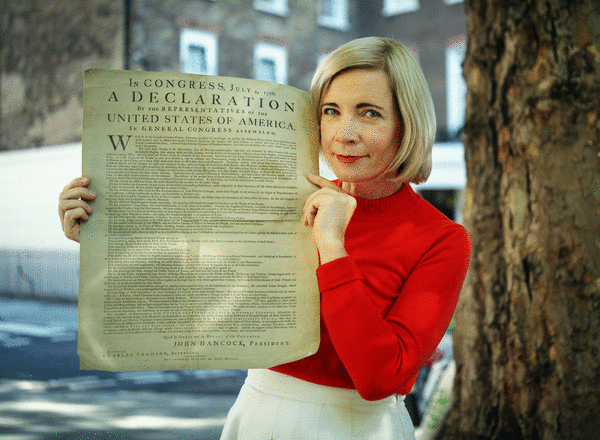
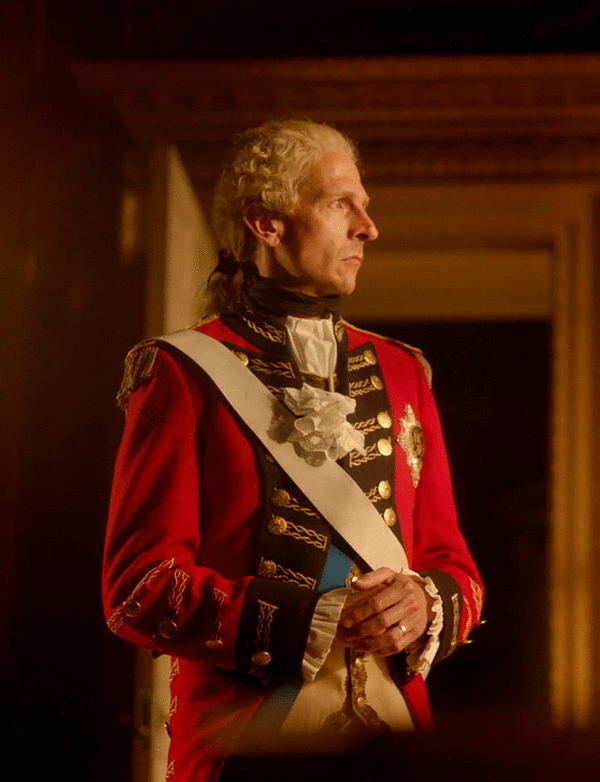
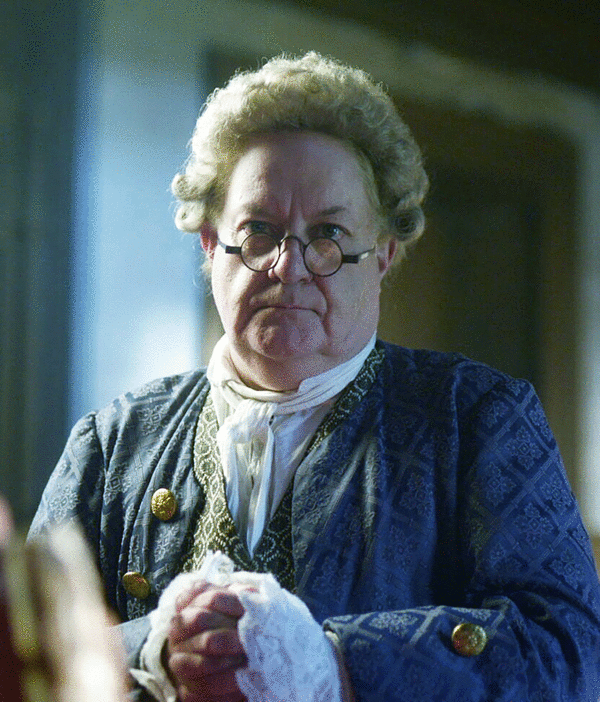
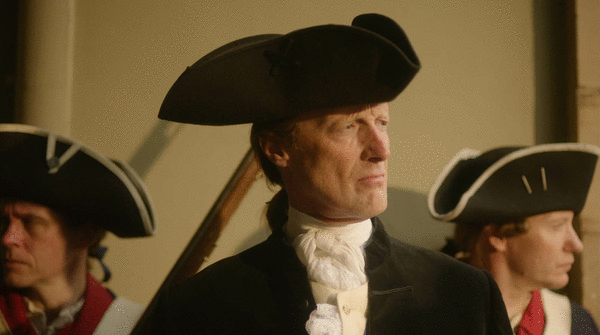


Documentarian Ken Burns has elucidated the story of the America’s fight for independence through his engrossing six-part saga, “The American Revolution.”
But now we hear it from the other side.
Chatty TV historian Lucy Worsley is presenting “Lucy Worsley Investigates: The American Revolution,” premiering on PBS April 7.
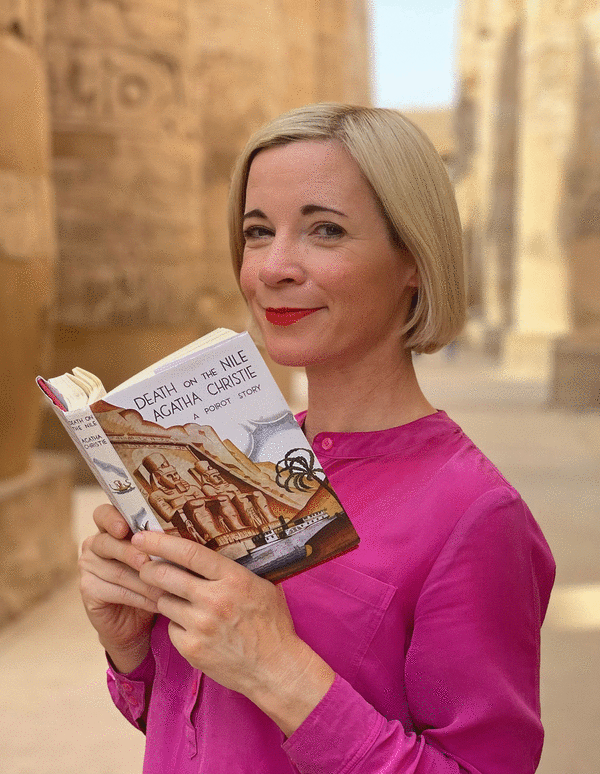
Viewers may know her from her series of titillating explorations into subjects like Sherlock Holmes, the Black Death, Agatha Christie, the royal bedchamber, Jack the Ripper and the six wives of Henry VIII.
She says she was determined, with this two-part series, to reveal some of the events that took place on the English side. “Even British people won't know about what the American Revolution's effect on Britain was,” she says.
“We just don't know enough about the American Revolution in general over here. So it's been lovely to go into this story that deserves to be much better known, I think. And we did quite a lot of traveling, being on both sides and going to some wonderful places and seeing some wonderful things.”
Through her series of historical treatises, Worsley has gained exceptional access to protected artifacts, documents and experts. “It's a delicate negotiation because the people who have these amazing documents, these amazing artifacts, they have to limit access to them for conservation reasons,” she says.
“I mean, it was just amazing to go to the National Archives and actually see the Stamp Act. The thing that causes the American Revolution is this actual act of parliament, but they don't want to get it out of the archives because of the atmospheric conditions ... So they have to think that your project is worth doing.
Most of her projects proved worth doing. “For reasons of time and money, we can't go and see all the documents that we want to in the original,” she says. “So sometimes we do work with a replica of it. So we can feature the information that's in the document, if not the document itself. But of course, it's much better when we go and see the actual thing because there's a real emotional charge to that.”
Worsley says her emotional charge into history really began when she was 9 or 10. “This is one of my treasured possessions,” she says, holding up a small, faded hardcover. “It's a little book, and it's a historical story written for children by an author called Jean Plaidy, and it's called ‘The Young Elizabeth.’
“And it's about Queen Elizabeth I growing up at Hampton Court Palace. And now when I look at this, I feel this was hugely important in my life because I actually ended up working at Hampton Court Palace for 20 years of my life as one of the curators there, hence my interest in things like teapots and the tales of statues, of horses, as well as all the documents that it's such a thrill to handle and to read as a historian.
“So now I think King Arthur had the sword in the stone, and I had my little book about Hampton Court Palace that kind of inspired me.”
The book was a gift from a little girl who lived next door to Worsley. “I have noticed, this is really bad, that she stole it from our school library because that's the ticket of our school library in the back of it,” she smiles.
“I was a very bookish, geeky kid,” she continues. “I sometimes feel like the story of my life is that the bookworm who has no friends gets to go to the ball because I never thought I would be traveling the world and having all of these wonderful experiences doing the thing that I love most, which is learning about history.”
She longs to infect others with her passion. “I hope that enthusiasm’s infectious because I see it as my job, if I can, to coax people into the world in the past. So I think of myself as doing the kind of history that appeals to people who don't think that they like history yet. That's what I want to work on, to maybe suck them in and think that there's something fun and interesting and moving.”
In her research Worsley says she was amazed to find that many Brits sided with the Americans during the Revolutionary War.
“There were all the big battles that we know about. There was Lexington, there was the Battle of Long Island, there was Yorktown, but I don't think people will be aware that there was revolutionary violence happening on OUR side of the Atlantic too,” she says.
“There was terrorism in the Royal Naval Dockyards of Portsmouth. There's bombs set off there. There was the invasion of Jersey, the Island of Jersey, which is only just off the south coast of England. It was so close to home. And then there was rioting in London ... It was fueled. It was in response to the American Revolution, six days of some of the worst rioting that there's ever been in Britain,” she says.
Worsley insists there’s more to her hands-on research than just historical facts. “Something that was once said by the science fiction writer, Isaac Asimov, that I think is really insightful. He said that when you go to the actual place where history happened, so the harbor in Boston or the surrender fields in Yorktown — where these really significant events from history happened — he said that only time and not space separates you from the people of the past. That's as close as you can get to them. So you're in the same spot, and there are centuries between you, but you're as close as you can get. And that's really, it's a very special feeling.”
Thurman turns lethal on Prime
Uma Thurman is co-starring in a new action thriller involving ballerinas, of all things. Called “Pretty Lethal” the film arrives on Prime Video Wednesday, March 25, and features Thurman as the manager of a remote inn and former dancer.
When their bus breaks down, five stranded ballerinas must seek shelter. But they find much more than that when things go badly awry at the inn.
Thurman, famous for films like “Pulp Fiction” the two “Kill Bills” and “Les Misérables,” tells me, “Acting is second nature to me. I’ve done it half my life. I'm not into metaphysical things, but sometimes it’s like channeling.
“It’s like you can express something that comes out of you you didn’t necessarily know was there in the journey toward the character. In those moments, where you're really connected, it’s literally exhilarating. You lose yourself, yet you're expressing. It’s like better than life. It’s like living, but it’s better than life because you're not really responsible. You're free to feel whatever you feel at no cost. It’s like living without any cost.”
The bees share a secret on Nat Geo
You can get up close and personal with the bees when you tune in to “The Secret of the Bees,” premiering March 31 on National Geographic, National Geographic Wild and streaming the next day on Disney+ and Hulu.
Explorer Bertie Gregory is on hand to probe the kingdom of the bees and the essential part they play in the world’s food production. Gregory is unafraid when the bees crawl all over him, but he’s been in worse situations on several of his expeditions.
“We were filming the lion episode in Zambia, and I came back to my room in camp. I had my headtorch on, I walked into my room, and there was a crocodile in my bed. And I can't say that's happened to me before. So I went charging out of the room to go and find one of our guides. I'd love to tell you that I was really brave, but I wasn't. I screamed.”
Travis stars as kidnap victim
Nancy Travis, the ever-patient wife on “Last Man Standing,” is starring in a Lifetime thriller premiering April 4. Part of their “ripped-from-the-headlines” theme, “Rescued by Faith: The Connie and Larry Van Oosten Story,” is the true tale of an Illinois couple who are kidnapped and trapped in an underground bunker with only their trust in God to sustain them. Travis, who plays the wife and grandmother, Connie Van Oosten in the film, tells me why she enjoys acting.
“I think I love being the center of attention; love being the clown making people laugh, affecting people,” she says. “Me at a desk for eight hours a day, I’d go ballistic.[“I love the adventure of it (acting). I did all the plays at school. My mother thought this would be good extra-curricular activity for me. I also loved to play ‘school’ in my basement. And for a long time I thought I’d be a teacher. These two things competed against each other, but they were pleasurable activities. When it came time to pick a career and go to college, I had to think seriously: ‘What do I really enjoy?’ Everything they say about America is true, my generation particularly. You can be president if you want. I said, ‘I want to be an actress.’”
———
©2026 Tribune Content Agency, LLC






Comments