Bob Power, recording engineer for the Roots and A Tribe Called Quest, dies at 73
Published in Entertainment News
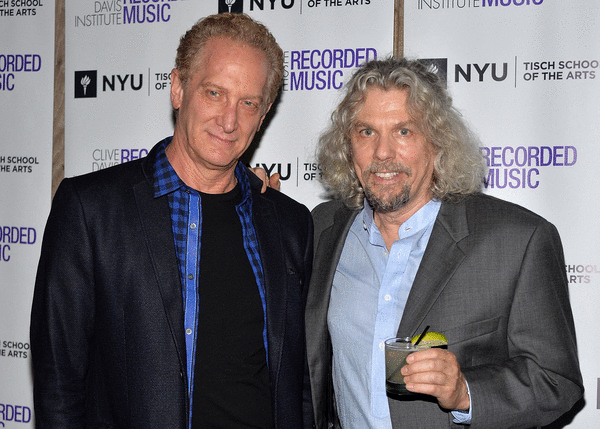
LOS ANGELES — Bob Power, a musician and engineer who worked closely with some of the top hip-hop and R&B acts of the 1990s and 2000s — including De La Soul, A Tribe Called Quest, D'Angelo, Erykah Badu, the Roots and Meshell Ndegeocello — died Sunday. He was 73.
His death was announced by Okayplayer, the music platform founded by the Roots' Ahmir "Questlove" Thompson, which didn't state a cause or say where Power died.
Shouted out by name in the Roots' song "Distortion to Static" — "Coming to New York to mix / It's Bob Power with the snares and kicks to fix," Black Thought rapped — Power was widely admired for the oomph he brought to drums and for how crisply he was able to thread samples into a production. Among the classic records he helped create were "De La Soul Is Dead," Tribe's "The Low End Theory," D'Angelo's "Brown Sugar," Badu's "Baduizm" and Common's "Like Water for Chocolate."
"Bob was the KING of the Low End," the Roots' Questlove wrote Monday on Instagram. Before Power, "Hip Hop was chaotic & muddy," Questlove added. "but man—when Bob entered our sonic sphere? Jesus."
In a post on X, DJ Premier described Power as "one of the iLLest Engineers of all time"; Young Guru, an engineer known for his long relationship with Jay-Z, called Power "an absolute legend" on Instagram and said he was "the man who I patterned my sound after." Power was nominated for two Grammys for his work on Ndegeocello's "Peace Beyond Passion" and India.Arie's "Acoustic Soul," and he was an arts professor at New York University's Clive Davis Institute of Recorded Music.
Robert Power was born in Chicago in 1952 and grew up outside New York City. He started playing guitar as a kid, according to a timeline on his website, after his sister got a guitar to play "Blowin' in the Wind" and he had the "idea to play it louder," the timeline said. He studied music theory and composition at Webster University in St. Louis and joined an R&B band called the New Direction; after college he moved to San Francisco and immersed himself in jazz.
In 1982 he returned to New York, where he took "every gig imaginable," he wrote in the timeline, including jobs scoring commercials, making "bad dance records" and playing "mafia weddings in Bensonhurst for $75." In 1984, the owner of New York's Calliope Studios asked Power to fill in for a vacationing engineer; he ended up working on a record by the group Stetsasonic, which included Prince Paul, who would go on to produce much of De La Soul's music.
"One of my theories about record-making in general is that if the track is rhythmically buoyant, or sort of interesting enough, then you don't have to sell the song so hard," Power said in a 2007 interview with the recording magazine Tape Op. "One of the problems with badly produced music and demos that come in is the time is not compelling. Even if it is somebody playing an acoustic guitar and singing, it's got to have this thing to it."
Power, whose many other recording credits include projects by Ozomatli, Angie Stone, David Byrne and Brockhampton, began teaching at NYU in 2006 and retired last year. Among his survivors is his sister, Robin.
©2026 Los Angeles Times. Visit latimes.com. Distributed by Tribune Content Agency, LLC.









Comments