Commentary: In São Paulo, Bad Bunny welcomed Brazilians into the Latinidad big tent
Published in Entertainment News
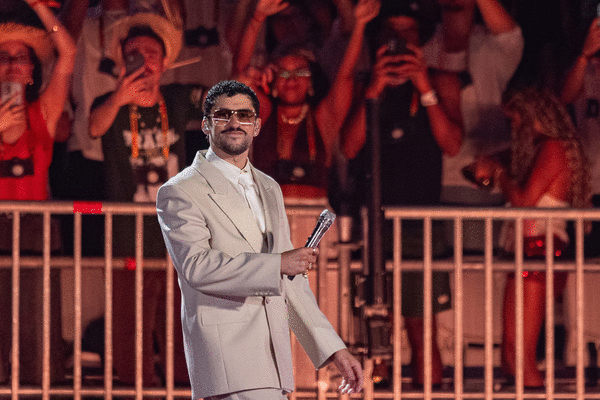
SAO PAULO — Bad Bunny finally answered the internet’s eternal “come to Brazil” pleas with his first-ever concerts in the South American country last weekend.
The Puerto Rican superstar performed two sold-out shows on back-to-back nights at Allianz Parque in São Paulo starting on Feb. 20 as part of the Latin American leg of his “Debí Tirar Más Fotos” world tour, selling out the stadium with a capacity of 55,000 in less than 40 minutes.
I also flew down to Brazil for the concert — albeit with much less fanfare attached to my arrival. The singer famously skipped out on shows in the continental U.S., so my girlfriend and I made the 12-hour journey to the largest city in the Americas to vibe out.
The pair of shows would put to the test Bad Bunny’s push for pan-Latino unity in a country where being described as “Latino” hasn’t always been readily welcomed. Former Times reporter Pedro Moura wrote about the complex relationship some Brazilians have with embracing Latinidad in a 2023 column.
Bad Bunny has evoked the wide-ranging definition of Latinidad for years, perhaps most notably in his 2023 anthem “El Apagón,” which features the line: “Ahora todos quieren ser latinos / Pero les falta sazón.” Recently, he rallied for unity within the Americas with a roll call of nations at the terminus of his Super Bowl halftime performance.
Upon our arrival at the gates of Allianz Parque, Latinidad spilled out of every corner in a cacophonous mix of languages — Portuguese, Spanish, English and even some French — fashion and excited energy.
Flags from just about every Latin American country were visible as we entered the free-for-all seating situation in the very upper deck (these were by no means fancy press tickets, to be clear).
After nabbing seats, I conversed in Spanish with some neighboring concertgoers. Many expressed disbelief that I had traveled from so far away to come to the show. They were even more surprised that someone from the U.S. spoke any language other than English.
The award for the longest voyage went to two lifelong friends from Paraguay who trekked 20 hours by bus for the show because it ended up being cheaper than flying.
The duo have been fans of the “Baile Inolvidable” singer since 2016 and had seen him live twice before, in 2018 and 2022, in their homeland.
One of the pair, Lujan, spoke about how she noted that Bad Bunny’s latest offerings brought about a renewed sense of Latinidad within the continent.
“His music identifies and unifies Latino people,” the 26-year-old Paraguayan said. “Hearing his work makes you proud to say ‘I am Latino!’”
As Bad Bunny kicked off the show with “La Mundanza,” I really felt like I was Latinomaxxing. Honestly, it was one of the few times I’ve sensed myself fully dialed in on what Latindad is.
In that moment I was deeply moved as I realized that there was something so beautifully freeing about not being in the U.S. There was no added societal weight to being Latino; it didn’t feel illegal. I was free of the oppressive thumb of the U.S. empire, if only for the night. English was third in the pecking order of languages.
As the show went on, I danced, cried and took so many pictures. I felt exceedingly thankful to Bad Bunny for allowing me to connect with others and myself in a joyous state of collective Latinidad.
So powerful is the pull of Benito that even some Brazilians are getting warm to a renewed connection with a shared Latino identity.
Brazilian native Lucas Cazula, who has been listening to Bad Bunny for five years, said it was maybe the best concert he’s ever been to. He first heard the “Nuevayol” artist’s music while spending time in Colombia.
Cazula noted that before the release of “Debí Tirar Más Fotos” it was rare to hear Bad Bunny’s music while out and about in Brazil.
But there was something in the specificity of the seminal 2025 album that connected with Brazilians.
“I believe he has helped create a Latin American sentiment in Brazil that wasn’t always so obvious,” the 28-year-old concertgoer said. “More than just through language, we recognize shared experiences amongst Latin Americans.”
He mentioned the album art of “Debí Tirar Más Fotos” and said that to him the image of two plastic chairs thrown on a lawn was a “super Brazilian” image, noting that everyone he knows has a relative with that sort of setup.
“Language was a false barrier because what was more important were these universally shared Latin American experiences,” Cazula said. “Bad Bunny really reminded us that we are Latin American. That is so important because I believe that our unity upsets the powers that be. His message of Latin unity upsets people in power because we are stronger together than apart.”
It upsets me that many U.S. Latinos will be unable to watch Bad Bunny live because of his choice to not play in the continental U.S. I also feel incredibly thankful to the Puerto Rican artist because he forced me and many other Latinos who are lucky enough to move freely across borders to interact with international Latinos, experience their Latinidad in new contexts and to feel unencumbered Latino joy and unity.
———
(Carlos De Loera is a reporter with De Los, the Los Angeles Times vertical that explores Latino culture and identity.)
———
©2026 Los Angeles Times. Visit at latimes.com. Distributed by Tribune Content Agency, LLC.










Comments