Column: 'Heated Rivalry' and manga fans have a lot in common
Published in Entertainment News
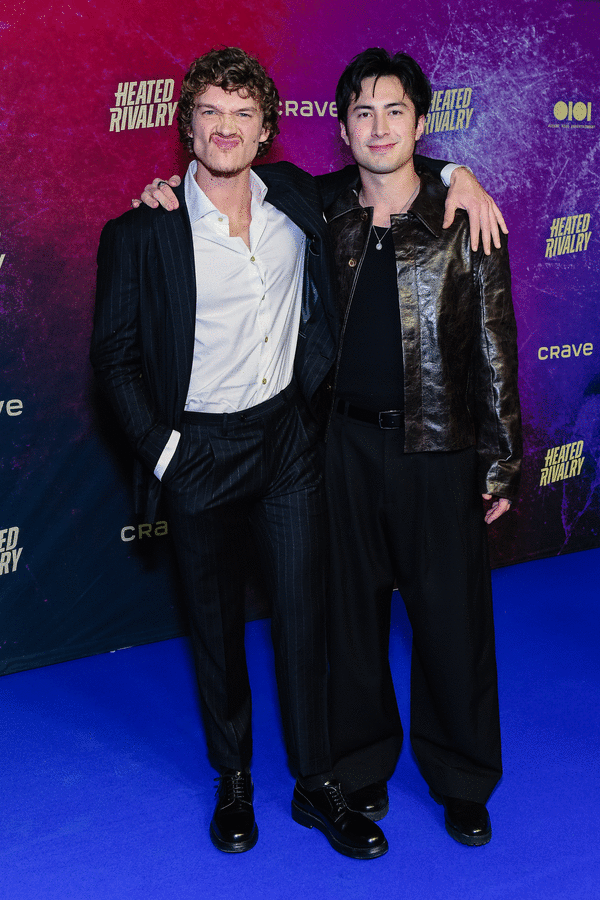
What do a homoerotic hockey melodrama on HBO and a genre of Japanese manga comic books have in common? Die-hard women followers.
The popularity of HBO’s "Heated Rivalry" — a sudsy, sexy, titillatingly explicit melodrama involving closeted professional hockey players — has stunned show business experts. Since its inception on Nov. 28, "Heated Rivalry’s" until-then little known stars — Hudson Williams and Connor Storrie — have become pop-culture sensations, mobbed at public appearances, including the recent Golden Globe awards. Made by the Canadian company Crave (for likely a modest $5 million or less per episode), it’s been picked up for a second season by HBO.
What many find astonishing is that the demographic most fascinated by the show isn’t gay male; instead, it’s mostly watched by women. As the New York Times reported: “On Dec. 22, four days before the finale streamed, 53 percent of the show’s viewers were female, an HBO spokesman said. By the end of last week, roughly two-thirds of the viewers were women.” The New Yorker’s Naomi Fry quotes a woman friend confessing that the show “activates all the fantasies I had and maybe still have about the power of this emotional and physical connection with someone.” She was embarrassed but couldn’t stop tuning in.
Consumers of manga will not be surprised by ardent women fans of male-on-male romance. The path was pioneered and proven popular and profitable in Japan beginning in the 1970s.
Women are the overwhelming audience for boizu rabu genre of manga comics (that is, “boys love,” hence a category designated by the letters BL). Indeed, they are perhaps the most fervent consumers of the entire $4.5 billion industry. Known as fujoshi (a self-deprecating term meaning “rotten girl” 腐女子), BL fangirls dominate comic-book conventions as attendees and, more importantly, as content creators. U.S. publishers were once taken aback by the fan-fiction out of the Japanese market — where idolatrous zealots cast established male superheroes in homoerotic romances. But they’ve slowly come to appreciate this as a form of brand loyalty. There are equivalent genres — substantially inspired by Japan’s example — in China, Taiwan, South Korea and Thailand.
"Heated Rivalry," which is based on a series of short novels by the Canadian writer Rachel Reid, is evidence that fujoshi exist in potentially big numbers in the U.S. and Canada too. The same might be said for Amazon Prime’s huge 2023 hit movie "Red, White & Royal Blue" — a same sex rom-com involving the son of the U.S. president and a British prince. It’s based on a 2019 novel by Casey McQuiston, who uses the pronouns they/them.
The sociological underpinnings of BL manga in Japan are complex — and they’re not much about being gay and a lot about being female. The genre appears to have evolved out of manga marketed to young girls, which — in the 1960s — was created by men and focused on what middle-aged males imagined preteen girlhood should be. Women — who became manga artists and writers in increasing numbers in the 1970s — found those boundaries constraining, but female sexuality and the sentiments around it were too daunting a taboo to break, especially in the shoujo (young girl) market. And even if they were broached, women characters were somehow expected to reflect their second-class status in male-dominated society.
But beautiful boys in love with each other are under no such limitations — the more ethereal and non-Japanese looking the better (or safer, at least). The country has long had the tradition of bishonen, beautiful young men over whom both men and women were infatuated, dating back to at least the 11th-century novel "The Tales of Genji." But a more contemporary contribution emerged in 1971, just as women artists were joining the manga industry. That would be Luchino Visconti’s film version of Thomas Mann’s "Death in Venice" — and the subsequent visits to Japan by Bjorn Andresen, who played Tadzio, the young man with whom the main character (Dirk Bogarde as Gustav von Aschenbach) was obsessed.
Andresen was dubbed “the most beautiful boy in the world” by Japanese media and proved to be a sensation in the country. His features were soon echoed in the faces of attractive manga boys and men (indeed, a type of male beauty that has evolved into the visages of Asian boy bands). Such stylized objects of desire gave women artists even further distance from day-to-day life in Japan — but also liberty. A Swedish actor in a film by an Italian director based on a German novel thus helped provide Japanese women with the freedom to explore love and passion — all under the cover of fantasy.
That market has evolved in different ways in the last half-century. There are BL manga that have a minimum of sex and a lot of the exquisite pain of relationships. but there are also the more explicit yaoi comics. There’s also a parallel subgenre: Manga created by gay men for gay men, called geikomi. But its market share is small compared to BL. It’s also shelved in a different, more adult section of bookstores, away from the comic books meant for girls and women.
The West has its share of women writers who’ve explored homosexual relationships — with a great degree of literary success. These include Marguerite Yourcenar in "Memoirs of Hadrian," Mary Renault’s "Alexander Trilogy" and, more recently, Madeline Miller’s "The Song of Achilles," which has sold perhaps 3 million copies worldwide in 25 languages since it was first published in 2011. Like Japan’s BL creators, these authors deal with desire from a distance, in these cases, through classical history and mythology. The success of "Heated Rivalry," on the other hand, also has BL manga’s pop-culture heat and immediacy. Which — for those of us who have only so much use for sociological subtleties — can be summed up in a headline from the LGBTQ+ website Them: “The Girls Love Gay Hockey Smut… Bonkers Ratings.”
———
This column reflects the personal views of the author and does not necessarily reflect the opinion of the editorial board or Bloomberg LP and its owners.
Howard Chua-Eoan is a columnist for Bloomberg Opinion covering culture and business. He previously served as Bloomberg Opinion's international editor and is a former news director at Time magazine.
©2026 Bloomberg L.P. Visit bloomberg.com/opinion. Distributed by Tribune Content Agency, LLC.









Comments