Review: 'Ponies' elevates a Cold War spy story with emotional depth and female friendship
Published in Entertainment News
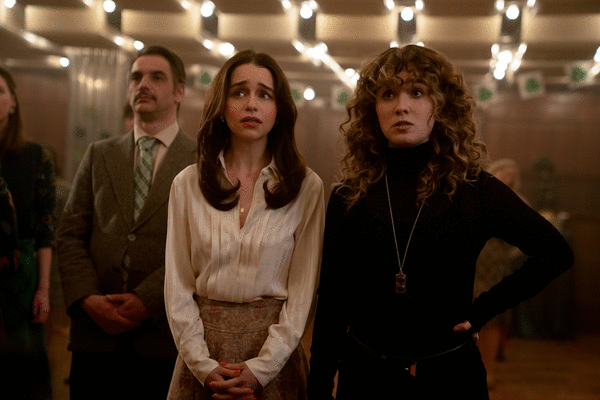
Despite its equestrian-themed title, misfit-spies motif and occasional reference to "Moscow rules," Peacock's new espionage thriller "Ponies" has little in common with Apple TV's "Slow Horses." Set in Cold War Moscow, "Ponies" falls, intriguingly and occasionally uneasily, somewhere between FX's "The Americans" and underappreciated female-empowerment comedy film "The Spy Who Dumped Me."
Which is not surprising since it was created by Susanna Fogel and David Iserson, co-writers of "The Spy Who Dumped Me," which the former directed and the latter executive produced.
Opening with an attempt to extract a CIA asset from the clutches of the KGB, the series centers around Moscow's American Embassy circa 1977 (with a soundtrack and brief glimpses of a young George H.W. Bush and, later, Elton John, to prove it).
As the American operatives engage in the obligatory shoot-'em-up car chase, two women meet in a market. Though they are each less than thrilled with their almost nonexistent lives as wives of envoys to the associate of the U.S. ambassador (i.e., the spies from the opening sequence), their contrasting attitudes and sparky, odd-couple chemistry is immediately, and a bit ham-handedly, established.
Polite, rule-following and Russian-fluent Bea (Emilia Clarke) believes her husband Chris (Louis Boyer) when he lovingly assures her that this posting will be over in a few years and soon she will be putting her unidentified Wellesley degree to better use. (Note to whoever wrote the Peacock press notes: A Wellesley degree does not make a woman "over-educated.")
Tough-talking, streetwise Twila (Haley Lu Richardson) is not so deferential or deluded; she pushes Bea to face down an unscrupulous Russian egg merchant with profanity-laden elan. Unsurprisingly, her marriage to Tom (John Macmillan) is more than a little rocky.
Still, when their husbands die, ostensibly in a plane crash, Bea and Twila are grief-stricken — they have lost not only their husbands but their careers as foreign service wives.
Back in the U.S., Bea is bucked up by her Russian, Holocaust-surviving grandmother (the always welcome Harriet Walter) while Twila realizes she fled her hardscrabble Indiana background for good reason.
Determined to find out what really happened to their husbands, the two return to Moscow and confront station head Dane Walter (Adrian Lester), convincing him that their status as wives — the ultimate Persons of No Interest, or "PONI" in spy parlance — offers the perfect cover.
Ignoring the historical fact that both countries have long had female undercover operatives, Dane decides (and convinces then-outgoing CIA head Bush, played by Patrick Fabian) that Russia would never consider two women (including, you know, one fluent in Russian) a threat and, by the middle of the first episode, we're off.
Reinstalled as secretaries, Bea's mission is to get close to new asset Ray (Nicholas Podany), Twila's to ... be a secretary. She, of course, decides to become more involved, enlisting the aid of Ivanna (Lili Walters), an equally tough market merchant.
Everything gets immediately more complicated, and dangerous, when Bea catches the eye of Andrei (Artjom Gilz), a murderous KGB leader who may be able to lead the CIA to the surveillance facility Chris and Tom were trying to find when they died.
Clarke, returning to TV for her biggest role since her career-making turn as Daenerys Targaryen in "Game of Thrones," is the obvious headliner. And in early episodes she does in fact carry the series, evoking, with as much realism as the relatively light tone of the writing will allow, a woman whose self-knowledge and self-confidence have eroded after she was sidelined into the role of wife.
Richardson, who many will remember as Portia, long-suffering assistant to Tanya (Jennifer Coolidge) in Season 2 of "The White Lotus," is given the opposite task. Twila is, in Hollywood parlance, a "firecracker" — you know, the tough-talking dame who inevitably nurses a wounded heart. While drafting Bea as a spy makes a certain amount of sense, Twila's skill set, as she is told, is being "fearless." Her real talent, however, turns out to be standing up for "ordinary women," including a string of prostitutes, murdered and forgotten.
Since neither woman receives the kind of training even most fictionally drafted civilian-spies get in these kinds of stories, Bea and Twila are forced to rely on their wits, and the yin-yang balance of their good girl/tough girl relationship.
This makes for some great banter and fish-out-of-water moments, but it muddies the tone — are they being taken seriously as spies or not — and requires significant suspension of belief (as does the Moscow setting created by Budapest; everyone keeps talking about how cold it is, but it never seems that cold). Fortunately, compared with their professional counterparts in most espionage dramas, the career agents on both sides appear, at least initially, to be quite limited in their spy craft as well.
An emerging plotline involving sex tapes and blackmail adds all sorts of tensions, as well as historically accuracy, and, as things get rolling, the spies become sharper and the notion of surveillance grows increasingly complicated and tantalizing.
Still, "Ponies" is obviously less interested in the granular ins and outs of gadgets, codes and dead drops than it is in the personal motivations of those involved and the moral morass that is the Cold War. "You came to Moscow to find truth?" an asset scoffs.
The cast is uniformly strong, the performances solid and engaging (Walter's Russian grandma reappears midway through to show everyone how it's done). If "Ponies" takes almost half of its eight-episode season to equal the sum of its parts, Fogel, who also co-wrote "Booksmart," is a master spinner of female friendship, and Clarke and Richardson make it impossible not to instantly recognize, and connect with, Bea and Twila.
Their chemistry, and the absurdity of their situation, propels the story over any early "wait, what?" bumps and confusing tonal shifts into an increasingly propulsive and cohesive spy drama, with plenty of "trust no one" twists and turns, and the kind of period detail that would make "Mad Men" proud. (OK, yes, I am old enough to have tried the shampoo "Gee Your Hair Smells Terrific.")
Fortunately, even as it moves with increasing assurance into "Tinker, Tailor" territory, "Ponies" remains a story of love. Which, as spies know only too well, can only exist when you accept, and share, the real truth about yourself. With a cliff-hanging ending, "Ponies" is betting that Bea and Twila will get another season to find their truths, even in Moscow.
———
'PONIES'
Rating: TV-MA
How to watch: Peacock
———
©2026 Los Angeles Times. Visit latimes.com. Distributed by Tribune Content Agency, LLC.











Comments