Column: Nick Digilio is surviving the movie critic world and has '40 Films' to prove it
Published in Entertainment News


CHICAGO — Before the internet changed the world, it was easy to find a movie critic.
They were in the magazines and newspapers, on TV and radio. You might even sit next to one at a tavern, stumble over one on your way to the bus stop.
In 1990, let’s say, that crowd was dominated by Roger Ebert and Gene Siskel, the critics for the Sun-Times and Tribune, respectively, but looming huge thanks to being the creators and stars of the thumbs-up, thumbs-down syndicated television show “At the Movies” that made them, as I have claimed in print before, the most powerful movie critics in history.
They were part of a local pack that also included Marty Lennartz on WXRT, Sherman Kaplan on WBBM, Jonathan Rosenbaum at the Reader, Dave Kehr at the Tribune and others.
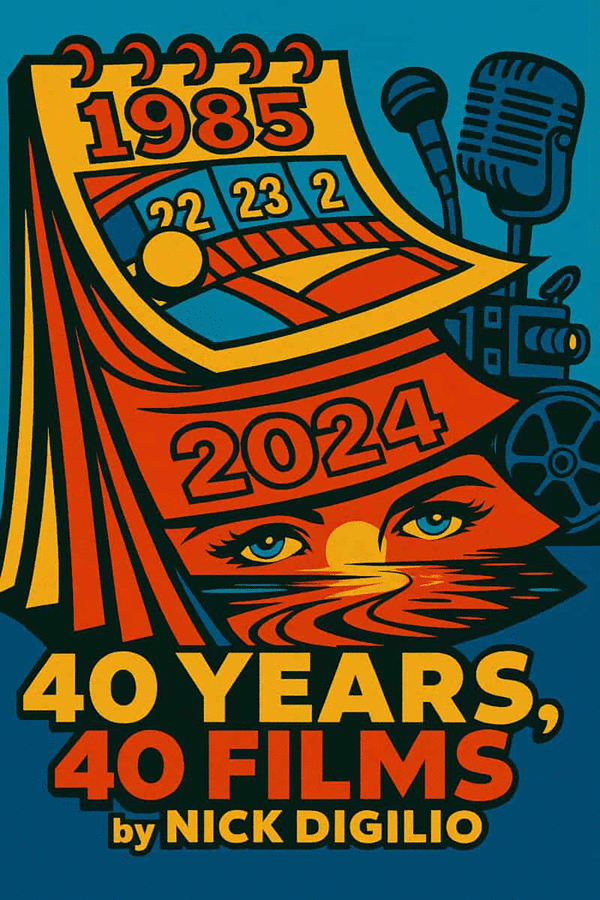
Still standing, and thriving, he will tell you, is Nick Digilio, who has been at this movie critic game for more than four decades, with all its twists and turns, highs and lows. He hosts two podcasts and is a frequent guest on other programs. He hosts movie screenings and other events. And now he's written a book, “40 Years, 40 Films,” published by that increasingly energetic and local-focused company named Eckhartz Press.
“I’ve followed Nick as a film critic for years and always appreciated his unflinching take on movies, even when I disagreed with him,” says author and radio veteran Rick Kaempfer, who founded and runs Eckhartz with Dave Stern. “But the thing that sold me on this book was the way he interwove his own personal story around the film reviews. It’s really a memoir in my mind. A memoir with more than 40 movie recommendations.”
Yes, it is in part memoir. Not exactly the in-depth sort of offering from Patti Smith, but it does make a fine introduction to this son of Nick and Pam Digilio, and why “by the time I was eight or nine,” he writes, “I was a full-on horror obsessive. I studied horror the way other kids studied baseball stats and dinosaurs.”
Born in 1965 and growing up in Lakeview, not far from Wrigley Field, he took the bus downtown to see movies at the tattered palaces that remained, the shabby Roosevelt becoming his “shrine.”
While a student at Luther North High School, he devoured the reviews by newspaper movie critics and “read the movie listings in detail (and) memorized showtimes the way other kids memorized box scores.”
He became a steady caller to Roy Leonard’s radio show on WGN. He was Nick from Lakeview, smart and lively, and soon enough was formally reviewing horror movies on Leonard’s show; his first official review in March 1985 was of “Friday the 13th Part V: A New Beginning.” Gee sorry, missed that, the review and the movie.
This book is “dedicated to Roy,” fittingly because it is impossible to overestimate how influential Leonard was in Digilio’s life and career.
The book gives us Digilio’s short but snappy essays on the best films of the ensuing decades. It is, of course, easy to quibble with some of his judgments but that’s part of the fun with such a subjective journey.
Do you remember “Hope and Glory,” his pick as best film of 1987?
Is “Casualties of War” in 1989 a “masterpiece”?
“Fearless” in 1993, “Chungking Express” in 1994, or “Drive My Car” in 2021. Never heard of them, and that final one he calls “A masterpiece of emotional resonance.”.
He is certainly correct when he writes that “Of all the films I’ve selected over the years as my annual favorite, Kevin Reynolds’ ‘187’ might be the one that elicits the most puzzled responses.”
But his lists of best films makes for enjoyably quick reading and, indeed, has turned me on to films I missed.
Digilio is a smooth and thoughtful writer, enthusiastic too. And he does pepper this movie-heavy section with biographical information, such as his being hired full time at WGN, being fired by WGN, his involvement with local theater companies, changes in management at WGN, instability in his personal life, Roy Leonard’s death and his battles with alcohol (he’s been sober since 2020).
As one of the final acts before his recent and untimely death, Tony Fitzpatrick wrote the introduction to this book. Perhaps some of you have forgotten that among Fitzpatrick’s many creative pursuits (visual artist, poet, actor, playwright, columnist and more) he was a movie critic. He paired with Buzz Kilman, who is still very much alive, and was Jonathon Brandmeier’s newsman and sidekick. They delivered “Drive-In Reviews” on WLUP radio. Kilman once characterized their offerings by saying, “We do have a preference for violence, ‘quality kills’ and terror–psychological and otherwise.”
Of Digilio, Fitzpatrick writes in this book, “My favorite (critic) was always Nick — his love of movies was infectious and generous. … He made a substantive life of it and we are better off for having him. … He is as good as it gets.”
©2025 Chicago Tribune. Visit chicagotribune.com. Distributed by Tribune Content Agency, LLC.




Comments