Does an obscure agency have the power to dismantle the San Diego region's homeless task force?
Published in News & Features
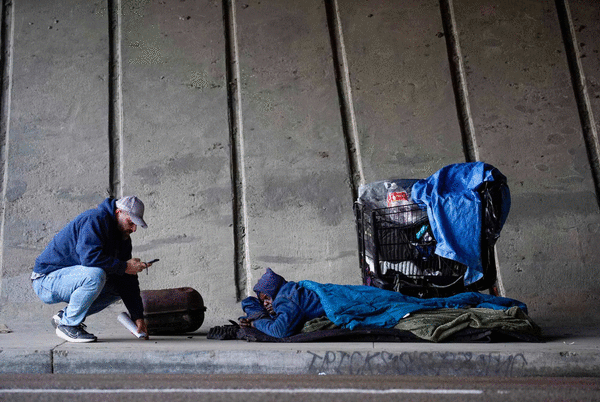
An unexpected push to change who controls San Diego County’s response to homelessness, a move that could potentially dissolve the local nonprofit that now has that responsibility, is being driven by San Diego City Councilmember Stephen Whitburn. But the effort, apparently in the works for more than three years, is not going through City Hall, but rather an obscure county agency created by the Legislature.
Whitburn, whose district includes all of downtown and much of the urban core of San Diego, also serves on the county’s Local Agency Formation Commission (LAFCO). The body typically settles inter-agency quarrels and boundary disputes. Every county in the state has one. Recently, however, San Diego’s has asserted its authority in a way that could test just how much power the agency has.
On Nov. 2, LAFCO’s staff presented the commission with a “white paper” it had been working on for more than a year. The report was specifically critical of the Regional Task Force on Homelessness (RTFH) for not being a government entity subject to public meeting and records laws.
RTFH is a private nonprofit that essentially acts as an administrator for the region’s Continuum of Care (CoC). It conducts the region’s annual point-in-time count, collects data on homelessness and stewards millions in state and federal funds.
The Task Force was established in 1983 under the San Diego mayor’s office, but has gone through several iterations over the years, becoming a nonprofit in 2004.
A CoC organizes an area’s or region’s homelessness funding and programs. It is required in order to receive funding from the U.S. Department of Housing and Urban Development.
In response to the findings in the white paper, LAFCO’s commissioners voted unanimously at the November meeting to have staff explore creating a special district. A special district model could place the functions currently performed by RTFH under “a new unit of local government” that would have “both regional direction and administrative oversight.” This could mean the RTFH would dissolve or restructure.
Whether LAFCO has the authority to do that on its own is unclear. LAFCO Executive Officer Keene Simonds said his staff, at this time, is only working on a scope and feasibility report to be presented early next year. The details are still being worked out, but Simonds said if commissioners want to move forward, they have the power to do so.
“It is possible that, at the end of the day, the commission may feel strongly enough where they could, under existing statutes, create or at least initiate and approve the formation of a special district,” said Simonds.
But some administrative hurdles would come first, Simonds said. While the white paper used the special district in Florida’s Miami-Dade County as an example, Simonds said there are hundreds of different models, but they wouldn’t really work in San Diego County.
“Most likely a special act of the Legislature would be needed to tailor-fit a particular type of special district to meet the likely scope of whatever might be appropriate here,” Simonds said.
Miami-Dade’s special district required a food and beverage tax to fund it. It’s too far into the future to tell if that would be required for a special district in San Diego County, but Simonds said that “anything LAFCO approves, with respect to creating a new governmental entity, is subject to voters.”
“The voters would ultimately have to be asked the question: ‘Up or down, do you support the creation of this district and whatever specific powers are given.’ And I would assume… there would probably be a discussion about funding at the same time,” Simonds said.
When asked if he believed San Diego County voters would support a new government entity to oversee homelessness, even if it came with a new tax, Whitburn said they likely would.
“I think that San Diegans at large understand how important it is to effectively end street homelessness and are willing to get behind that, if they have the confidence that it will be successful,” Whitburn said.
Where the idea came from
Whitburn believes the current system is fragmented and ineffective. This belief, he said, drives his push to change it.
“We need a holistic, comprehensive, focused approach to reducing street homelessness in our region,” Whitburn told The San Diego Union-Tribune. “I believe that if we have an agency that is in charge of that effort and focused on it, then we can accomplish that.”
Around the time Whitburn proposed a camping ban on public property, he and Simonds discussed creating a white paper that looked into how homelessness programs, funds and agencies were structured, the pair said. These discussions were not public.
Those initial discussions led to the white paper being placed on LAFCO’s workplan — an annual, numbered list of priorities the commission aims to tackle — in March 2023. The white paper remained a low priority on the list until it rose to being a top priority two years later, again at the request of Whitburn.
Whitburn said he did this because the number of unsheltered homeless people in downtown San Diego “hit a bottleneck.” While the camping ban got people off the streets, Whitburn said, it also maxed out capacity at local shelters.
According to the white paper, which used point-in-time count data from RTFH, the total number of homeless people in San Diego County over the past decade peaked in 2024 at 10,605 people. The most drastic change in the past 10 years was the nearly 22% increase from 8,427 people in 2022 to 10,264 people in 2023.
An audit earlier this year found the monthly median unsheltered count in downtown San Diego decreased significantly since the camping ban — from 1,721 in the fiscal year that ended June 2023 to 850 in the fiscal year that ended June 2025.
The white paper cited the San Diego Housing Commission’s (SDHC) statistics that, in the city of San Diego, shelters operated between 98% and 99% occupancy between April and June 2026. During Fiscal Year 2025-26, SDHC found that 91% of shelter referrals did not lead to someone being placed in one.
“When it became clear that many of the people living on the sidewalks wanted to come off the streets, but we had nowhere else for them to go and therefore they stayed on the streets, that was evidence to me that the system isn’t working and that we needed to do something more,” Whitburn said.
Caught off-guard
RTFH’s CEO Tamera Kohler defended her organization in a letter sent to LAFCO on Oct. 29 and in person before the commission when the white paper was presented on Nov. 2. The letter was co-signed by San Diego CoC Board Chair Akilah Templeton.
Kohler and Templeton’s letter requested that LAFCO look into “strengthened versions of the current model as fully as the alternatives.”
“The standard for any change should be the additional capacity, resources and measurable improvements it delivers for people experiencing homelessness… an accurate record and a fair assessment of the available options will help the commission and the region make that judgment.”
Even ahead of the Nov. 2 public hearing, the white paper, its critiques, its intentions and its suggestions caught multiple agencies off-guard.
In her letter, Kohler said she first spoke with LAFCO staff about the report on Oct. 12. Although the white paper had been placed on LAFCO’s priority list in March 2023 and gained steam when it rose to the top of that list by March 2025, RTFH spokesperson Gary Warth said Kohler and RTFH staff were not aware of it before Oct. 12 and weren’t provided a copy of it until Oct. 26.
In separate letters, the City of Oceanside and the City of Carlsbad stated they were not aware of the white paper’s details until just before it was presented earlier this month.
Oceanside’s Housing and Neighborhood Services Director Leilani Hines wrote that “Releasing the document on October 26 to local jurisdictions for a public hearing on November 2 does not allow our jurisdiction and others the time required to evaluate the issues raised.”
Mandy Mills, Carlsbad’s director of Housing and Homeless Services, wrote, “This is a complex question that involves many different players, of which were not included in the compilation of the report.”
The agencies affected by a possible shakeup are taking a deeper look into the white paper. RTFH is working with LAFCO on an amended draft of the white paper, but cannot answer specific questions about it until its release, Kolher said in an email. LAFCO staff said Friday they are working independently of the task force on the report exploring a special district.
Meanwhile, the task force is gearing up for the annual Point In Time Count on Jan. 28, an imperfect but key metric for measuring homelessness in the region.
_____
©2026 The San Diego Union-Tribune. Visit sandiegouniontribune.com. Distributed by Tribune Content Agency, LLC.






Comments