Michigan State University officials sued by another trustee over code's impact on speech rights
Published in News & Features
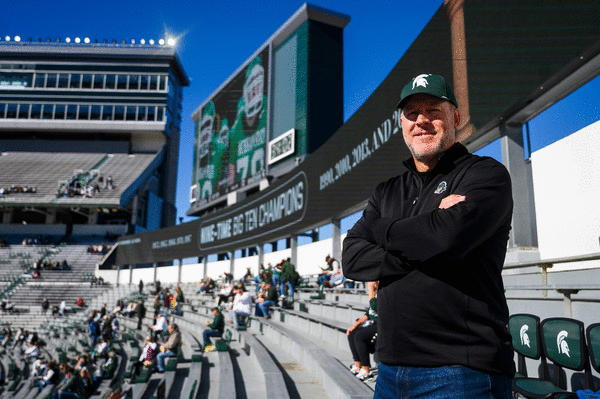
Michigan State University Trustee Mike Balow has filed a federal lawsuit against a fellow board member and the board's secretary for sanctions he received after he refused to sign the revised Board Code of Ethics and Conduct earlier this year.
The lawsuit, filed in the U.S. District Court for the Western District of Michigan, argued that Board Chair Brianna Scott, D-Muskegon, and Board Secretary Stefan Fletcher violated the constitutional rights of free speech and due process for Balow, R-Plymouth. Balow and his attorneys with the national free speech advocacy organization Foundation for Individual Rights and Expression, claimed the board's new code and the sanctions imposed for not signing also harm the public by not allowing them to hear the statewide-elected trustees' "candid views" on the university's governance.
The revised resolution, approved in May, calls for a "duty of loyalty" and asked trustees to raise concerns before the board takes action and protect the integrity of the board's "deliberations and processes." After the board votes, trustees will not "undermine" and will support the majority decision of the board even if they disagree. Trustees were asked to sign onto a "Statement of Acknowledgment" to show they agreed with the code.
In the complaint, Balow said he wasn't able to fulfill his duties as a trustee because of the sanctions put on him for not signing onto the code. He said he's lost tickets to games, access to suites and other university-sponsored spaces and will not be able to attend conferences related to university governance he argued were necessary in his role as a trustee.
"At any of these events, there might be 100 people there, and you might have a conversation with 15 of them that you’ve never met before," Balow said in an interview with The Detroit News. "You can hear about their concerns. ... They can hear your thoughts on what’s going on at MSU. It's one of the purest forms of constituent engagement. It is a core part of our job to be ambassadors for the school."
In a texted statement, Scott indicated she wasn't concerned about the lawsuit.
"Mike Balow lacks credibility and is not a serious person," she said. "Therefore, I cannot take anything he says or does seriously. Hopefully, he takes his ball and goes home."
MSU spokesperson Amber McCann did not immediately respond Oct. 28 to a request for comment. Later, she sent an emailed statement from Scott.
"The Board of Governors at Wayne State University also have a Code of Conduct, which includes provisions similar to the Code of Ethics and Conduct approved by a majority of the MSU Trustees," the statement said. "Furthermore, elected members of the state legislature are expected to follow the rules of the respective House and Senate chambers, as enforced by the Speaker and Majority Leader.
"The purpose of the Code of Ethics and Conduct is to help ensure the Board can effectively govern in service to students, faculty, staff, parents, research partners, taxpayers and the broader public. The code does not limit speech or restrict members of governing boards from raising concerns, providing oversight or questioning decisions; instead, it establishes good and commonsense governance practices."
This is the second lawsuit in as many weeks filed against board members taking issue with the revised code. On Oct. 21, Trustee Rema Vassar filed a lawsuit against Scott, Fletcher, MSU President Kevin Guskiewicz and other members of the board and university administration for discrimination and retaliation. In the complaint, the Detroit Democrat pointed to the revised code as a way to silence her and other trustees who take issue with the board's majority.
When asked about the lawsuit at the Oct. 28 Spartan Bus Tour stop in Ann Arbor, Guskiewicz said he was more concerned with the tour and those he was on it with. Like Vassar's lawsuit, he said he wouldn't let it become a "distraction" from the students, faculty, staff and university he led.
Free speech, due process violations
Balow told The News he was specifically naming Scott in the lawsuit, rather than other trustees or the board as a whole because she was the "embodiment" of the code and the subsequent sanctions.
"She’s the chair, she speaks for the board, she can take action for the board," he said. "She’s the one who has to answer for it in her professional capacity. ... She’s running for the same office this year, I think she needs to answer for why she’s in favor of something so un-American."
Part of the reason the code was revised, as Scott admitted during the board meeting where it was approved, was the opinion pieces Balow and other trustees wrote that appeared in local newspapers. This is a common practice among trustees at various institutions in the state, including the University of Michigan and Wayne State University.
Balow said he didn't want to file the lawsuit, but Scott and the other board members and administration officials weren't meeting with him.
In the complaint, Balow argued the revised code is viewpoint discriminatory because it does not prohibit speech that is in support of the board, only speech that is critical of it. Scott and Fletcher have no "legitimate interest" in upholding viewpoint-discriminatory restrictions on the trustees, and instead, the public has a "strong interest" in hearing the trustees' views.
The code also is "vague" and doesn't provide a clear standard for enforcement, according to the lawsuit. Balow argued that this meant that alleged violations of the code could change depending on the situation and who's involved, and aren't objective.
By asking trustees to sign onto a "Statement of Acknowledgement" or lose their privileges and ability to successfully do their role as a trustee, the lawsuit said Scott and Fletcher were trying to "coerce trustees" into giving up their constitutional rights.
Balow is asking for a jury trial and for the "Trustee-Speech Restrictions" to be found unconstitutional. He's also asking for a injunction to be issued giving him access to the resources, privileges and opportunities he's prohibited from, an injunction that prevents the board from enforcing the revised code and attorney's fees and other costs. He is not asking for a specific amount in damages.
Why the revision was made
On May 17, the MSU Board held a contentious, late-night meeting where it voted to approve changes to the board's Code of Ethics and conduct and created new guidelines around what trustees could do and say.
After about 45 minutes of deliberation, the trustees voted 5-3 to approve the revised Code of Ethics and Conduct. The resolution was co-authored by Scott and MSU General Counsel Brian Quinn.
During the meeting, the trustees disagreed on the resolution's language around when and how dissent with the board's majority should occur. Scott indicated the revision was necessary because of Guskiewicz's frustration with the board.
"A few members of the board have continued to act against our own governance guidance and consultation given to us by national experts, undermining the president, the administration and decisions made by this board, attacking members of the administration and trying to interfere in personnel matters and spreading misinformation to constituent groups outside of and within the university, and that has got to stop," Scott said before the vote.
Ten days later, Guskiewicz announced his intentions to leave the university for Clemson University in a campus-wide email. In the email, he said the university's ability to make "meaningful progress" was hampered by certain trustees, whom he didn't name, going against what the majority of the board and his administration wanted for the university.
But in July, Guskiewicz reversed course and said he would stay as long as the board would have him.
_____
©2026 The Detroit News. Visit detroitnews.com. Distributed by Tribune Content Agency, LLC.




Comments