US Secret Service took down drone in Baltimore at Army-Navy Game, report says
Published in News & Features
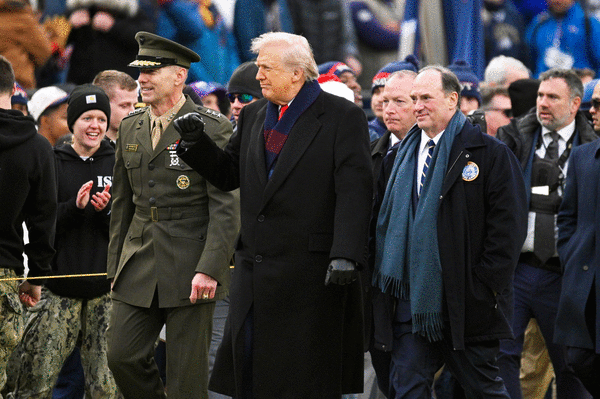
BALTIMORE — The U.S. Secret Service in December took down a drone using electronic jamming equipment at the Army-Navy game in Baltimore, where President Donald Trump, Gov. Wes Moore and other federal and state leaders were present, according to CBS News.
Federal law prohibits drones in designated airspace around certain major sporting events, including those hosted by the NFL, MLB and college football. Ahead of the Dec. 13 Army-Navy game at M&T Bank Stadium, the federal Justice Department announced a temporary flight restriction order for a 2-nautical-mile radius around the stadium and up to 2,000 feet above ground level.
The report follows Maryland lawmakers’ debate over how much authority state and local agencies should have to use drones, and how to regulate their use. Legislation considered in Annapolis has focused largely on government surveillance, not on stopping unauthorized drones at major events.
Maryland House Minority Leader Jason Buckel, a Republican lawmaker who attended the game, said federal law enforcement should be commended for intercepting “potentially dangerous drone usage.” Buckel added that both state and federal law enforcement should share control of blocking potentially harmful drones.
“The Secret Service is the primary agency controlling security when a President is on site, but the need to understand and be able to restrict drone use if it legitimately creates security concerns isn’t limited to federal authorities,” he wrote in a text to The Baltimore Sun.
The Secret Service did not respond to questions about when and where it detected the drone, whether officials considered it a threat, or whether and how state officials were notified. The White House, Moore’s office and the Maryland Stadium Authority, or MSA, also did not respond to requests for comment.
The Army-Navy incident is not the first time a drone was detected near stadium events in Baltimore. In January 2025, a drone flew over the stadium during a Ravens playoff game, forcing a temporary suspension of play and leading to a federal criminal case. The same happened in 2024 and also in 2023, when state officials found that eight drones violated restrictions by flying during Ravens games.
MSA, however, said in September 2025 that it planned to use drones to monitor postgame traffic around Ravens games and coordinate real-time adjustments with Baltimore transportation officials and police.
Maryland has some restrictions on drone use, but the rules vary by location and purpose. A 2015 state law addresses restrictions on unmanned aircraft and directs local governments to work with federal authorities on enforcement. Drone use is also restricted on certain state-owned property in Annapolis without written approval, and Calvert County bans drones in county parks.
Maryland lawmakers have proposed restrictions on government drone use, including Republican Delegate Robin Grammer of Baltimore County, who introduced bills in 2025 and 2026 to limit state and local agencies’ use of drones for surveillance and evidence gathering.
Neither year’s proposals became law. The bills focused on government surveillance and the use of drone-gathered information, not specifically on drones threatening stadiums or on authorities’ power to jam or disable them. Grammer did not respond to requests for comment.
Several law enforcement organizations and public agencies opposed the 2026 bill, House Bill 471, arguing that its restrictions could hinder investigations and emergency response.
The Maryland Chiefs of Police Association and Maryland Sheriffs’ Association warned that the bill could limit established programs, including Montgomery County’s Drone as First Responder initiative, which they said helps officers assess dangerous situations and gather evidence.
“Many emergency calls, though serious, would not meet the restrictive criteria outlined in the bill, preventing the timely deployment of drones for critical situations,” the groups wrote in February.
The Maryland attorney general’s office also opposed the bill, warning that it could hinder investigations into environmental crimes such as illegal dumping and pollution, as well as public safety efforts, including searches for missing people and firefighting. Rhea Harris, who was the office’s deputy director of legislative affairs at the time, said the restrictions could impair investigators’ ability to gather evidence and prove cases.
“Because (the Environmental and Natural Resources Crimes Unit) frequently uses drone surveillance as an essential and valuable investigatory tool in its cases, House Bill 471 would significantly impair our ability to investigate and prove our cases,” Harris said in written testimony, urging further study of the bill.
_____
©2026 Baltimore Sun. Visit baltimoresun.com. Distributed by Tribune Content Agency, LLC.




Comments