How NC's fast-tracked gas tax pause made its way to the governor's desk in hours
Published in News & Features
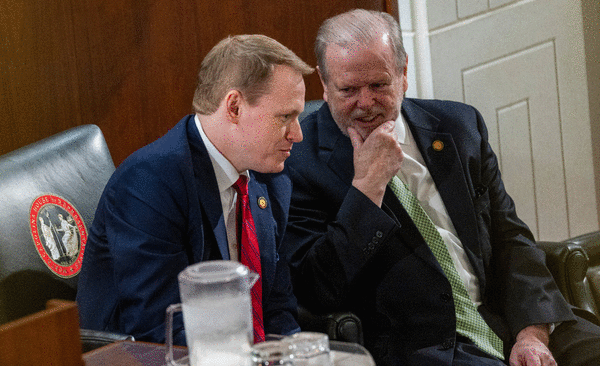
In the span of an afternoon, the North Carolina General Assembly revealed and passed legislation that will pause the state’s gas tax through November, if it becomes law.
Though nearly all Democrats voted for the GOP-written bill, they questioned the election timing as Republicans are facing strong headwinds in the midterm elections, and Democrats were left out of crafting the legislation.
Here’s how the actual timeline played out:
Saturday, Oct. 3
—Republican House Speaker Destin Hall and Republican Senate President Pro Tempore Phil Berger announced they would hold a special session the following week about gas tax relief.
—House and Senate Democratic leaders were not notified directly by their Republican counterparts, instead finding out when the press and public did, they later said.
Monday, Oct. 5
—Throughout the day, Republicans confirmed to multiple media outlets that there would be a voting session on Wednesday with a yet-to-be revealed bill about gas tax relief.
—By the end of the day, Republicans had the required number of signatures to proclaim an extra session would be held. The proclamation was signed by Hall and Democratic Lt. Gov. Rachel Hunt, who is also the president of the Senate.
Tuesday, Oct. 6
—The Legislative Building was quiet, though several lawmakers and legislative staff members were working in the building. The bill, not yet public, was being drafted.
—Democratic Gov. Josh Stein called the idea “a good thing,” though he also criticized the timing and need to offer other relief as well.
—That evening, Democratic leaders met and were able to see a draft of the House bill.
Wednesday, Oct. 7
9:30 a.m.
—Democratic leaders from both chambers — Senate Minority Leader Sydney Batch and House Minority Leader Robert Reives — held a news conference at the Legislative Building. They said they and other Democrats would vote for the bill because it provides relief, but criticized Republicans for the timing of the session and not going further to reduce costs for North Carolinians.
10:30 a.m.
—Berger and other Senate Republicans held a news conference at the Legislative Building, sharing more details about the bill, which Berger said would be public within the hour.
—Republicans dismissed questions about holding the session because of the coming election, saying that the timing is connected to sustained high gas prices and farmers harvesting crops.
—Berger and other Senate Republicans said the reason they can offer a suspension of the gas tax through Nov. 30 is because of their years of fiscal conservatism. Gas taxes normally fund the N.C. Department of Transportation highway projects. Instead, the bill will use inflationary reserve funds, they said, which they have because of limited spending in prior state budgets. They also have a sizable rainy-day fund.
Noon
—By the time the House was scheduled to convene, the bill had been made public. It would become House Bill 3.
12:30 p.m.
—In a Senate session, Sen. Ralph Hise, a Spruce Pine Republican, introduced a resolution that would lay out the rules of the special session, including the scope of what lawmakers could consider, allowing them to pass the legislation in one day.
—Sen. DeAndrea Salvador, a Mecklenburg County Democrat, proposed an amendment to the resolution that would have expanded the session’s reach to include affordability more generally. Senate Majority Leader Michael Lee ruled the amendment out of order since it was not specifically related to fuel.
—The Senate passed the resolution unanimously.
1 p.m.
—The House session began shortly after 1 p.m., an hour past the scheduled time. The House adopted rules for the session, and specifically for the gas tax suspension, including allowing the bill to bypass the usual process of going through a committee first.
—Reives, the minority leader, made multiple attempts to change the rules to allow for more related issues to be discussed, which were denied. Debate on the gas tax bill began with House Majority Leader Brenden Jones explaining the bill, followed by another procedural move that meant the bill would be voted on without much further debate. Reives was able to debate before they voted, but other Democrats were not.
—Jones said the bill offers “direct relief at the pump for the people we represent, not a rebate six months from now, not another government program, not a check someone has to apply for.”
—Reives said that Democrats being kept out of drafting the bill, amending the bill and debating it was “disappointing. We’ve got to be better. I hope we’re going to be better after the election. I hope after the election that we see that people have made a decision that want us to talk. They want us to collaborate.”
—The Senate Finance Committee met to discuss the bill ahead of a vote. Sen. Buck Newton, a Wilson Republican, noted that any change “is not going to be overnight.”
—Mark Bondo, the budget director for the North Carolina Department of Transportation, said at the meeting that since the revenue is coming from the inflationary reserve fund, “we see no problem with this bill.”
1:50 p.m.
—After the House passed the bill 111-1, lawmakers adjourned until November.
•Hall talked to reporters, saying the reasoning behind limiting debate was that “it was really a narrow purpose that we called ourselves back into session. ... I noticed they didn’t want to talk about further tax relief or further property tax relief. They wanted to talk about other things that really went outside the scope of the bill.”
—Hall said that Reives’ motion to suspend the rules was allowed, just as was Jones’ procedural move to limit debate.
2:40 p.m.
—The Senate reconvened and began discussing the bill.
—Newton introduced the bill and said that in addition to the paused gas tax, “this bill also provides targeted relief specifically for our (agricultural) community” by exempting farmers and other agricultural workers from penalties relating to off-road diesel fuel.
—Several Democrats, including Batch, Sen. Val Applewhite and Sen. Sophia Chitlik, questioned why Republican leadership chose to hold the special session right before the election.
—Sen. Jay Chaudhuri, a Wake County Democrat, proposed an amendment that outlined potential enforcement for gas retailers to ensure that consumers are seeing prices decrease.
—Under the resolution, the amendment must concern providing tax relief on fuel, so the amendment was ruled out of order.
—The Senate unanimously voted 41-0 to pass the bill.
3:44 p.m.
•The bill was on its way to Stein’s desk. He is expected to sign it, and has 10 days to take action.
—Berger, the Republican Senate leader, told reporters after the vote that they announced the plan on a Saturday because that was when things came together to gather the signatures needed to hold an extra session. “We tried to make sure that we would be able to enact something that would provide some relief,” he said, “and in order to do that, I mean, the scope of things that you get agreement on in a short time frame is is is pretty limited.”
—On choosing not to notify Senate Democrats directly over the weekend, Berger said that “any initiative that we start out with, we generally get that they’re opposed to it. ... We did not see them as viable partners in getting something done. I appreciate the fact that they voted for it. But they railed against it, too.”
—Batch told reporters after session ended that when Republicans “had the opportunity to be able to suspend the rules, or expand the rules, or expand the special session with regards to what would actually help North Carolinians, they miserably failed in doing so.”
_____
©2026 Raleigh News & Observer. Visit newsobserver.com. Distributed by Tribune Content Agency, LLC.




Comments