German far right wins first top post as it seeks to lead state
Published in News & Features
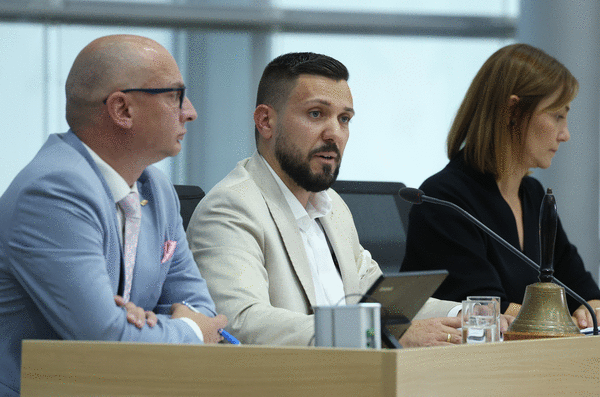
Germany’s far-right party secured a bigger-than-expected majority for the top parliamentary post in the eastern state of Saxony-Anhalt, giving it a firm foothold as it builds support to take power in a regional government.
The Alternative for Germany installed its candidate, Tobias Rausch, with 48 votes in the 83-seat assembly in Magdeburg on Tuesday. The secret ballot gave him four more ballots than had been publicly pledged ahead of the session, fueling speculation that the AfD won some support from the Chancellor Friedrich Merz’s Christian Democrats.
It was a demonstration of the far-right party’s growing clout as it capitalizes on frustration with Germany’s traditional parties and pushes to lead the first far-right state government in the country’s post-World War II history. The party’s candidate, Ulrich Siegmund, said he’ll seek a vote in December to become Saxony-Anhalt’s state premier — and has made overtures to CDU lawmakers who might break ranks.
Thorsten Frei, a Merz ally and the CDU’s parliamentary caucus leader in the national parliament, said the additional votes for the AfD were cause for “grave concern.” But he called accusations that his party offered backing to Rausch “pure speculation.”
“This was a secret ballot and everyone could come into question,” Frei told reporters in Berlin.
Still, the parliamentary math raised questions. The AfD’s 39 lawmakers in Saxony-Anhalt won public backing from the five members of the BSW, a group formed two years ago by former Left party leader Sahra Wagenknecht. The CDU’s group of 15 had said they would abstain, but the result showed that only five withheld their votes.
The Social Democrats, Greens and Left party in Magdeburg each vowed to oppose the AfD candidate with a total of 24 lawmakers. In the end, 29 no-votes were registered. One CDU lawmaker was absent.
The AfD, elements of which are classified as a right-wing threat to Germany’s democratic institutions, took 44% of the vote in Saxony-Anhalt on Sept. 6 on a campaign to deport migrants, oppose military aid for Ukraine and transform the state’s education system.
“Today, we will send a very clear message for Germany, for the new political future of this country,” Siegmund told Deutschlandfunk radio on Tuesday before the vote. “The tide has turned.”
The AfD’s outsize victory was accompanied by a trouncing of the CDU, which has governed the state since 2002. The far-right party went on to score a victory in the eastern state of Mecklenburg-Western Pomerania two weeks later, though has little prospect of governing in the Baltic coast state.
Rausch, 35, is the first AfD member to lead a state parliament. In a break with past practice, in which the parliamentary speaker held a non-partisan role, he’ll remain the state party’s general secretary.
Siegmund’s chances of being elected by parliament as state premier remain uncertain, since the CDU has pledged not to work with the party. The BSW has ruled out a formal coalition with the AfD, but the two parties are discussing a policy package that could underpin looser cooperation. BSW founder Wagenknecht has mainly taken aim at the political establishment, denouncing the political “firewall” erected to isolate the far-right party from power.
“The firewalls should be a thing of the past,” Rausch told lawmakers after he was elected, promising to work for all parties in the assembly.
Siegmund said the at least three votes needed to elect him state premier would come from “members of other parliamentary groups,” adding that the talks were going “very well,” making a majority in the first round of voting foreseeable.
—With assistance from Arne Delfs.
©2026 Bloomberg L.P. Visit bloomberg.com. Distributed by Tribune Content Agency, LLC.





Comments