Judge stays on Sierra LaMar retrial, issues key pretrial rulings
Published in News & Features
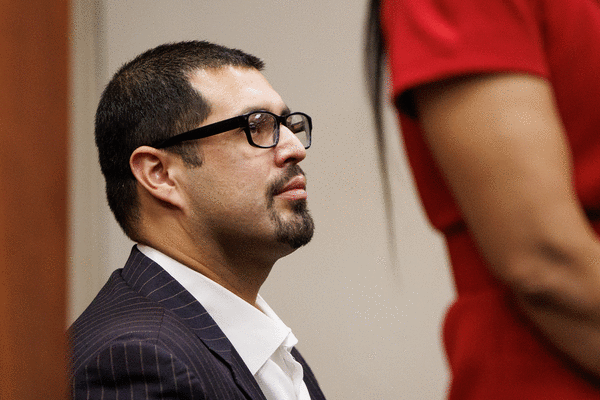
SAN JOSE, Calif. — Santa Clara County Superior Court Judge Brian Buckelew said Friday he will continue presiding over the second murder trial in the 2012 disappearance and presumed death of Sierra LaMar, denying defendant Antolin Garcia Torres’ call for Buckelew to recuse himself over alleged bias.
This means trial hearings will resume as scheduled, with the late stages of jury selection set to take place next week. Once a jury is empaneled, opening statements and testimony will follow. Buckelew previously said he envisioned a trial conclusion by Thanksgiving.
In a reading of his judicial order that lasted more than 30 minutes, Buckelew deemed the disqualification petition by Garcia Torres as untimely and unsubstantiated by fact, relying on the defendant’s interpretation of bias that was “insufficient to support disqualification.”
“The defendant has not met his burden of proof,” Buckelew said. “All statements and actions made in this case were made by me in furtherance of my judicial duties. … I do not believe my recusal would serve the interests of justice.”
Buckelew announced Sept. 21 that he was pausing the case to evaluate a disqualification petition filed by deputy alternate defenders Al Lopez and Mishya Singh, who asserted the judge exhibited bias through unfavorable or delayed rulings on key pretrial motions filed on behalf of Garcia Torres. Buckelew appeared skeptical, telling Lopez that his deliberations on the defense motions were in the interest of protecting his client’s rights, and that he had planned to rule in favor of the defense on multiple issues.
Garcia Torres also claimed bias based on Buckelew’s previous career as a county prosecutor, which the judge firmly rejected, asserting that he had no overlap with the original trial.
Buckelew then proceeded to issue several pretrial rulings that will set the parameters of the trial, chief among them a decision to prohibit the District Attorney’s Office to use the Pennsylvania-based DNA data firm Cybergenetics for consultation, DNA analysis and expert testimony.
Lopez and Singh argued that Cybergenetics’ history of consulting with the Alternate Defender’s Office during the original trial and ahead of the second trial presented a conflict that would have breached the confidentiality of that work if the DA’s Office was also allowed to employ them.
Lead prosecutor O’Bryan Kenney had countered that Cybergenetics was the only firm qualified to perform the probabilistic DNA analysis and genotyping they needed in time for the trial, and accused the defense of trying to hamper the prosecution’s case.
Buckelew sided with Garcia Torres, stating that the robust extent of preexisting and active work that the firm had done for his defense — and the firm’s admission that they could not erect a firewall that would allow them to ethically work for both sides of the case — meant the “prosecution’s asserted need does not outweigh these concerns.”
That leaves the DA’s Office with relying on analysis and work by the county Crime Lab, which the office operates and had sought additional work from Cybergenetics. In a statement Friday, the office said it was “reviewing the ruling and weighing options.”
The judge also decided several other pretrial disputes, including a key ruling in favor of the prosecution that will allow Kenney and co-counsel Sheryl Leung to argue that a sexual motive spurred Garcia Torres’ alleged abduction and killing of Sierra.
Relatedly, the prosecutors will also be allowed to present to the jury how Garcia Torres’ Safeway club card was used to buy a turkey baster and 1.5 gallons of bleach three days before Sierra vanished while walking to a bus stop in unincorporated Morgan Hill the morning of March 16, 2012. Buckelew stated during his ruling that jurors can decide whether the purchase raises suspicion about Garcia Torres’ intent to destroy incriminating evidence for a sexual crime.
Buckelew’s decision also mentioned how Garcia Torres, when asked by sheriff’s detectives about why his DNA might be found in public areas, claimed that he routinely masturbated in his car and threw corresponding tissues out the window, in what prosecutors had previously argued was an unsolicited explanation for any incriminating DNA evidence used to tie him to Sierra’s presumed death.
In another ruling, the judge sided with the defense in allowing jurors to hear testimony from a witness who testified in the first trial that she was commuting in the area of Hale and Palm avenues and saw a gold vehicle driving erratically around the time Sierra was last seen. Lopez and Singh plan to argue that this testimony raises the prospect of a third party who kidnapped and killed her.
Buckelew then said he would allow the prospective prosecution testimony of Dr. Michelle Jorden, the county’s chief medical examiner, to describe how the presence of urine on Sierra’s recovered jeans could have resulted from an involuntary reaction to losing consciousness from being strangled, or being in fear for her life. But the judge was also clear in stating that Jorden will not be allowed to comment on Sierra’s cause of death, since her body has never been recovered.
He also ruled that the prosecution will be barred from introducing evidence about Garcia Torres creating a possible ligature out of items he gathered while in jail, and will also not be allowed to introduce past crimes alleged against him that were either dismissed or uncharged.
Garcia Torres’ retrial was spurred by an appellate court decision earlier this year that overturned murder and kidnapping convictions on the grounds his 2017 trial was improperly consolidated with three prior attempted kidnapping allegations. The error, the appellate justices found, tainted the jury’s guilty verdict in 15-year-old Sierra’s presumed death. The justices also barred a premeditation theory from being argued.
The murder case for the DA’s Office largely parallels the original case that centered on reported findings that Garcia Torres’ DNA was recovered from Sierra’s pants in a field near where she was last seen, and her DNA being found in his car, including a strand of her hair intertwined with a piece of rope in the trunk. The refiled charges also include a new uncharged allegation accusing Garcia Torres of attempting to kidnap a 16-year-old girl in San Jose a week after Sierra disappeared.
The San Jose case joins three attempted kidnapping claims from 2009 that, due to the appellate ruling, will be tried separately from the murder charge. Prosecutors have sought to introduce the newer allegation as evidence under a law that allows uncharged sexual offense claims to be introduced at trial in order to portray a pattern of conduct.
_____
©2026 MediaNews Group, Inc. Visit at mercurynews.com. Distributed by Tribune Content Agency, LLC.




Comments