Hope Florida led disabled people to dead ends as state misused $10 million
Published in News & Features


TAMPA, Fla. — Liz Goodman struggled for years to get support for Logan, her 17-year-old autistic son, through government programs with long waitlists.
She felt optimistic during a gathering for disabled people in Orlando a couple of years ago, where she heard a program called Hope Florida could share vital resources with families in need. Logan has oppositional defiant disorder, making him wary of authority, and he requires extra attention to keep him from taking off in crowds. Sometimes, he sleeps little for days on end.
Goodman thought Hope Florida, a signature initiative of Gov. Ron DeSantis and his wife, Casey, might help her find an aide or a tutor.
She emailed a worker for the program who was supposed to assist those in need. That “hope navigator” sent her names of nonprofits and churches — places she already knew weren’t able to help Logan.
“It’s a list of things I could’ve Googled. It wasted my time,” Goodman, 40, said. “There’s no capacity to help with things in a real way. I think it’s a shell of an organization.”
It was frustrating enough that Hope Florida, working with the state’s Agency for Persons with Disabilities, led her to dead ends. Then she read recent stories about a leaked grand jury report. It found that the Hope Florida Foundation, the nonprofit created to support the program, was part of a “sophisticated scheme” by DeSantis’ administration, one that diverted $10 million in Medicaid settlement funds meant for the public toward political campaigns.
Goodman and nine others from the disability community who spoke with the Tampa Bay Times are outraged. They believe politics were prioritized over their critical needs.
Government programs and nonprofits supporting Florida’s disabled population often run on tight budgets, leaving families waiting years to receive aid — or never getting it at all.
Hope Florida says it empowers disabled people by linking them with essential resources. But all of the families who spoke to the Times said they were let down. An autistic woman approached Hope Florida about getting a job and publishing a book. An email shows a navigator sent a “care plan” with links to Disney’s jobs board and her local library. A man with severe cerebral palsy asked for an aide to help transport his wheelchair that weighs hundreds of pounds. The navigator pointed him to a nonprofit to learn how to better use it on his own and a public transportation option that he says could cost him hundreds of dollars a month.
Goodman started following the Hope Florida scandal last year, when the Tampa Bay Times/Miami Herald unveiled the diversion of settlement money. Reporters found that the $10 million represented a fraction of at least $35 million in taxpayer funds the administration steered toward campaigns it favored. The money was used to fight ballot measures that would have legalized recreational marijuana and overturned a six-week abortion ban.
James Uthmeier, formerly DeSantis’ chief of staff and now Florida’s attorney general, was “in a position of authority” over those who arranged the $10 million settlement that later went to political committees, the grand jury found. U.S. Sen. Ashley Moody, then the state’s attorney general, advised a deputy to sign off on the deal.
“Imagine if those millions had gone to actually making the Hope Florida program effective,” Goodman said. “How many families like mine could’ve been helped?”
The Times sent the Agency for Persons with Disabilities questions about Hope Florida for this story, and the agency responded to none of them. A spokesperson said the department “serves more than 60,000 Floridians” and helps people get services through Medicaid and other programs.
“APD is responsible for serving Floridians with complex and lifelong needs, and we take that responsibility seriously,” the spokesperson wrote. The governor’s and Uthmeier’s offices did not respond to requests for comment. Moody’s spokesperson did not answer questions and referred a reporter to past statements; the senator has said she wasn’t aware of how the $10 million would be spent.
Hope Florida navigators checked in on Goodman a few times in the months after initial contact, emails show, but she grew convinced they couldn’t help. She gave up responding.
Two years after approaching the program, Goodman said she’s found a way to get help for Logan, her “best friend.”
They moved to North Carolina.
Hope Florida’s expansion
The Agency for Persons With Disabilities, created in 2004, praises Hope Florida on its website, saying the program helps people “unlock their God-given potential to thrive.” Casey DeSantis has celebrated the initiative in news releases, saying it puts people on a “path to prosperity and economic independence.” She touted the program as recently as June.
Hope Florida’s mission is to connect residents with help from community partners like churches, volunteers and businesses instead of government services.
It began working with state agencies in 2021 by taking referrals for people in need, according to its website. The project uses taxpayer funds for its navigators, who help people “identify their unique and immediate barriers to prosperity,” according to a promotional pamphlet. Recent job postings for navigators promote salaries of roughly $40,000 to $50,000 a year.
Three years after the program’s launch, the DeSantises said in a 2024 press release that nearly 30,000 people had ended their reliance on government assistance, which would save taxpayers hundreds of millions over the next decade. The first lady announced bonuses for navigators and praised a couple for work with disabled Floridians — including a young resident she said was connected to therapy and an equestrian ranch, and another to a church for food. The administration said in 2025 that Hope Florida was helping in the foster care system and in every sheriff’s office.
But the couple has provided little evidence of the program’s successes. Foster care leaders said the program duplicated existing services. More than a dozen sheriffs told the Times that Hope Florida had not connected them with trained liaisons.
A Florida House committee last year investigated the Hope Florida Foundation and the Medicaid settlement. Tallahassee-area State Attorney Jack Campbell launched a criminal investigation and convened a grand jury to look into the diverted money. The grand jury’s report was sealed, but the leaked findings are plain: Some of the most powerful people in the state misappropriated Medicaid funds for political purposes. A wall of silence from witnesses discouraged the jury from pursuing charges.
‘Misuse of this money is personal’
After Stephanie Johnsen’s autistic son Logan fell out of a classroom window in 2022 and slipped into a coma, she waited at his hospital bedside for eight days.
Family and community support were lifelines, but the experience deepened the despair she carried from navigating the medical system with developmentally disabled children. Logan’s twin, Gavin, is also autistic.
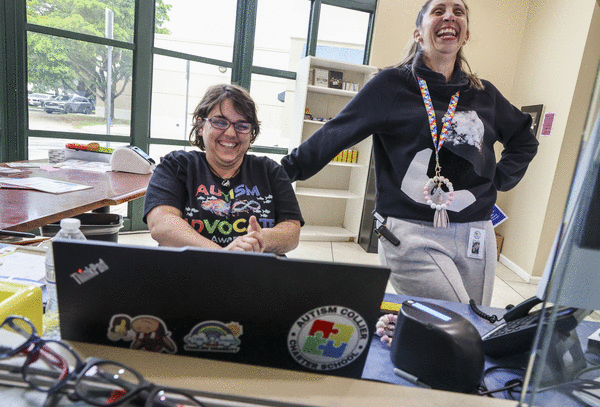
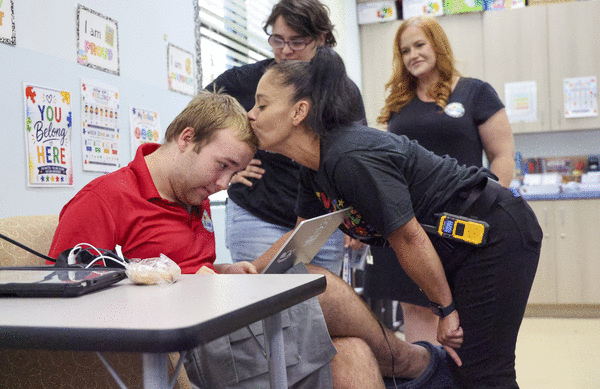
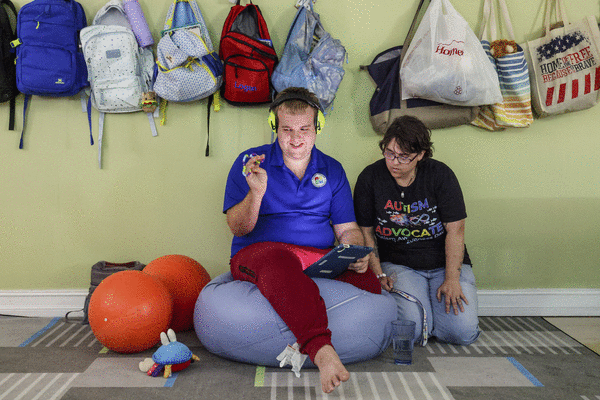
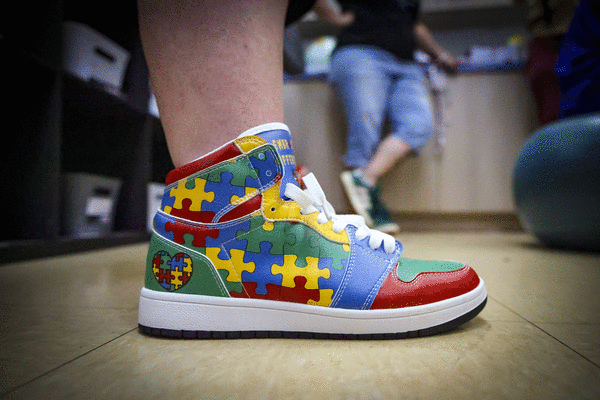
The experience inspired Johnsen to create the Autism Collier Resource Center. The nonprofit guides people through government aid systems, offers support programs for families and connects them with others in the disability community. She also cofounded the Autism Collier Charter School, which provides specialized education.
Johnsen said she offered to make the resource center a community partner for Hope Florida in 2024, when she ran into Taylor Hatch, then-director for the Agency for Persons with Disabilities. She recalls not getting a clear answer on how to get involved. Whenever she encountered anyone at the state level who talked about Hope Florida, she said, she offered again. She’s had no luck.
Families who come to her organization after trying Hope Florida talk about being pushed toward resources that aren’t helpful, Johnsen said. The people she works with need consistent support.
“For families that need help, the misuse of this money is personal,” she said. “Every dollar represents support that could have helped someone.”
Johnsen connected a Times reporter with the mother of a disabled child, who forwarded an email chain from 2023 that shows a hope navigator sending three resources: a vocational rehabilitation center, a technical college and a social services nonprofit. All of them had “no contact person” listed in the email, and the phone numbers provided were general lines. When the mother tried again to get help, emails show, the navigator sent the name of one more nonprofit and said she was about to leave her role with Hope Florida.
Olivia Friese is a longtime friend of Johnsen who works at the Autism Collier Charter School. She talked with a hope navigator in 2023 about getting a job and publishing a book about being an autistic person who is high-functioning in some aspects of life but struggles with testing and traditional schooling. Friese also has what she describes as severe ADHD.
The navigator offered the 35-year-old some community resources and a link to apply for a job at Disney, an email shows. For help with the book, the navigator pointed her to the Lee County library website, according to a “care plan” included in the message.
“That’s not what I needed,” Friese said. “I have trouble advocating for myself. I needed someone to walk through the process with me.”
After her interaction with Hope Florida, she found other groups that helped. Friese worked with Johnsen’s nonprofit and the Employment Network of Southwest Florida, which assisted her through applying and getting hired at the school in July of last year.
She’s finding more connections within the disability community. A friend encouraged her to participate in the Special Olympics. She started deadlifting at around 95 pounds and can now lift up to 250.
Looking back, Friese said she wishes Hope Florida made more of an effort.
“It’s just really frustrating,” she said. “It makes me feel like Florida is not a good state for people with disabilities.”
‘They don’t know what we go through’
Brian Carey attended a subcommittee hearing last year during the House investigation into the Hope Florida Foundation.
He was interested because he’d reached out to Hope Florida for help after Hurricane Ian. The 57-year-old has cerebral palsy, affecting his movement and ability to speak. He received resources that went nowhere, he said.
Carey believes Hope Florida is an example of how disabled people’s welfare is disregarded.
“They don’t know what we go through, day after day,” he said.
Severe cerebral palsy makes it hard for JJ Holmes to control most of his muscles, including his vocal cords, hindering his ability to talk. But together with his mother, Alison, the 22-year-old has found a calling in speaking up for people with disabilities in Tallahassee.
While advocating in 2024, they were optimistic when they heard Hatch, the former Agency for Persons with Disabilities director, sing the praises of Hope Florida. But when Holmes and his mother made contact, a hope navigator sent them to nonprofits and businesses that couldn’t provide the support their family needs.
“It was like dealing with somebody who never met anybody with a disability before and had no clue where to start,” said Alison, 62. “That was devastating. Why would you tell families who already have problems that support is there when it isn’t?”
Holmes wanted a navigator to find him assistance for transporting his heavy electric wheelchair, which he steers using head movements. He wanted an aide to help him get to medical appointments, and to see musicals or maybe get a milkshake once in a while.
When he contacted Hope Florida in 2024, he was using Children’s Medical Services, a Medicaid program, which helped with some medical and rehabilitation care. But he said drivers who were supposed to take him to appointments didn’t show up most of the time.
A navigator told him to make sure his wheelchair was easy to transport on his own, emails show. The navigator pointed him to the Florida Center for the Blind for advice on operating it. But his wheelchair weighs about 350 pounds, and no amount of instruction can replace an aide, he said. The navigator also suggested the Orlando area’s Lynx transportation system, which Holmes said would cost his family money.
He is furious about the misuse of Medicaid funds.
“I feel totally betrayed,” Holmes said in a text he wrote on an iPad using his nose.
He recently wrote an opinion piece in the Orlando Sentinel about why he’s voting for Democrat David Jolly for governor. Jolly has said he would reopen an investigation into Hope Florida if elected.
After being on a waitlist for most of his life, Holmes said he obtained a state Medicaid waiver last year for a government program that helps with transportation and consistent care. It’s a far cry from Hope Florida, he said.
“You can put Hope in the name, call someone a navigator and add a smiley face to every email. But if someone with a disability tells you what’s keeping him trapped at home and your program does absolutely nothing to fix it, that isn’t hope,” Holmes wrote. “It’s hopeless.”
©2026 Tampa Bay Times. Visit at tampabay.com. Distributed by Tribune Content Agency, LLC.






Comments