Helicopter crashes in Yosemite National Park while fighting wildfire, killing 2
Published in News & Features
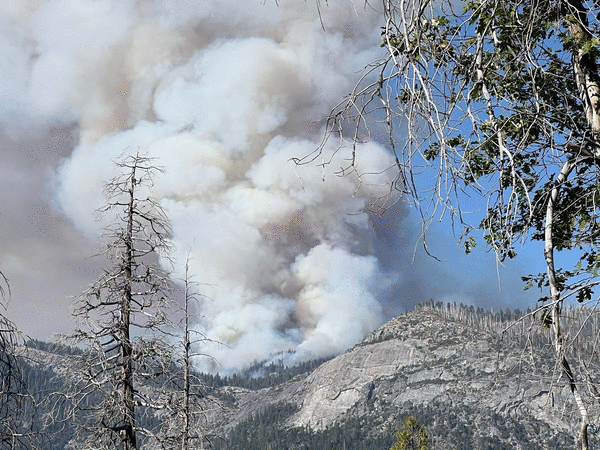
A helicopter battling the Dome fire in Yosemite National Park crashed Sunday in a remote wilderness area of the park, killing its two pilots.
The Eurocopter AS332L1 Super Puma helicopter crashed at 1:58 p.m. Sunday, during firefighting operations while making a water bucket drop, said Ben Cossel, a spokesman for the U.S. Forest Service. The pilots were the only people aboard, and no one was injured on the ground, he said.
Cossel said it was unclear Monday what caused the helicopter to crash. The accident occurred in a remote, federally designated wilderness on the southern half of the park near Ostrander Lake, an area about 7 miles northeast of the Mariposa Grove of giant sequoias, from which helicopters fighting the fire have been scooping water to drop on the flames.
“We don’t have the full picture yet,” he said. “It’s still under investigation.”
Cossel said crews recovered the bodies of the two victims on Monday. Dozens of fire trucks led a memorial procession along Highway 140 and through the town of Mariposa to bring them to the Modesto airport to be returned home.
The crew was from New Meadows, Idaho, he said, under contract with the Forest Service.
Forest Service officials and the helicopter company had not identified the victims by Monday afternoon. The Alaska Division of Forestry & Fire Protection identified one as Greg King, of Wasilla, Alaska.
“King was a cherished member of our wildland fire family, having served on wildland fires in Alaska and extensively alongside the Division of Forestry & Fire Protection,” the agency said. “King’s ties to our agency run deep, with close loved ones currently employed with our division. The identity of the second pilot is being withheld at this time out of respect for family notifications.”
Ostrander Lake, where the helicopter crashed, is located about 10 miles south of Yosemite Valley and 10 miles east of the Badger Pass Ski Area, at an elevation of 8,500 feet. During the winter, the lake and Ostrander Ski Hut, a stone building built in by the Civilian Conservation Corps in 1941, are popular locations for cross-country skiers. It is also the primary source of Bridalveil Creek, which feeds Bridalveil Fall.
The National Transportation Safety Board will lead the investigation into Sunday’s crash. “NTSB investigators will travel to the scene when fire conditions allow,” the agency’s media office said Monday. “A preliminary report will be available in 30 days.”
Late Sunday, Precision, a helicopter company based in McMinnville, Oregon, about 30 miles southwest of Portland, announced the crash on its Instagram page.
“It is with unimaginable sadness and broken hearts that we share the loss of two beloved members of our team,” the company wrote.
“We are devastated by this loss and are struggling to find the words. We ask for privacy and compassion for their families and our team as we grieve this tremendous loss. Please keep their families, loved ones, and our entire team in your thoughts and prayers during this incredibly difficult time.”
A helicopter with the tail number matching the one that the Federal Aviation Administration said had crashed had worked for days, including Sunday afternoon, in Yosemite National Park, according to FlightAware, a website that tracks aircraft.
The Dome fire began in a remote part of Yosemite National Park last Tuesday. The fire has burned 3,047 acres and was 15% contained on Monday.
Firefighters have been using helicopters to deliver supplies and firefighters, and to drop water on the fire, which is burning in steep, roadless forests with granite outcroppings about two miles south of Glacier Point Road. Yosemite National Park remains open with moderate levels of smoke Monday in Yosemite Valley.
Cassel said there were 550 firefighters battling the blaze Monday, and 12 helicopters assigned to it. The helicopters been shuttling in hot shot firefighter crews who stay for several days at a time in the back country to cut hand lines to contain the fire. The helicopters also deliver supplies at drop points to the backcountry crews.
“Those helicopters give us the ability to get to terrain that is so steep, so rugged, and so far off any road system,” he said. “Getting crews in and out is really challenging.”
The fire, he said, is moving at a moderate pace. Winds have been mild, and temperatures have ranged from the 50s to the 70s.
Sunday’s helicopter crash involved a 1994 Super Puma. The four-blade, twin-engine, medium-sized helicopter was developed and initially produced by French aerospace company Aérospatiale. It is used for firefighting, military exercises and work on offshore oil platforms.
The helicopter holds up to 24 people, cruises at 172 mph and can fly up to 17,000 feet high.
Sunday’s crash is not the first fatal accident involving aircraft during a wildfire in Yosemite.
On Oct. 7, 2014, a Cal Fire air tanker was dropping fire retardant on the Dog Rock fire, a 279-acre fire that had broken out just inside the western boundary of Yosemite National Park along Highway 140 near El Portal between Yosemite View Lodge and the park’s Arch Rock entrance station.
While preparing to make his second retardant drop on the fire, the pilot, Geoffrey “Craig” Hunt, struck trees with the plane’s left wing. The tanker rolled and hit the top of a rocky cliff. Hunt was killed and the aircraft was destroyed.
Hunt was a contract fire pilot with DynCorp, flying out of Hollister. He had been flying for Cal Fire for about 13 years.
“Wildland-fire aviation is an unforgiving environment,” said Will Spyrison, a retired US Forest Service division chief who lives in Ventura in a post on his Facebook page Sunday night. “Mountainous terrain, smoke, wind, reduced visibility, changing fire behavior and demanding flight profiles can leave very little margin for error.”
_____
©2026 MediaNews Group, Inc. Visit at mercurynews.com. Distributed by Tribune Content Agency, LLC.






Comments