Merz vows to stay on after worst-ever German state result
Published in News & Features
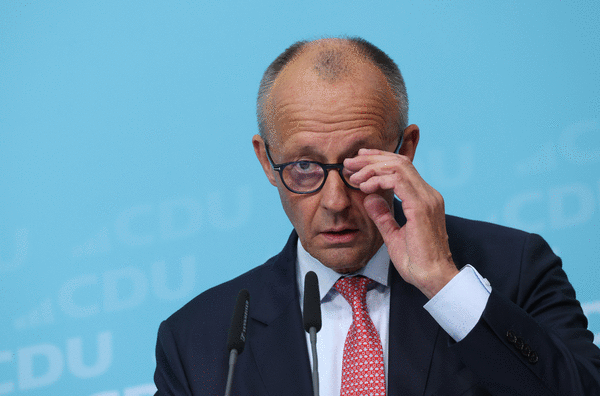
Friedrich Merz said he would stay put as German chancellor and conservative leader even after his party suffered its worst-ever result in a state election, as he moved to counter pressure mounting in his ranks for him to step aside.
The Christian Democratic Union won 5% of the vote in the state of Mecklenburg-Western Pomerania on Sunday, according to a projection from broadcasters ARD and ZDF, just meeting a 5% threshold required to enter the regional assembly. In an election in Berlin, the governing CDU was defeated by the anti-capitalist Left party.
“We can’t sugarcoat it, it was a disaster,” Merz told reporters in Berlin in a statement directly after exit polls were released, breaking with a past practice for chancellors to speak the day after an election. He gathered senior CDU officials to party headquarters, where he sought to gauge their support for his leadership.
Germany’s political establishment was shaken when the CDU suffered a stunning defeat to the anti-immigration Alternative for Germany two weeks ago in Saxony-Anhalt, another eastern state that could lead the first far-right government in the country since World War II. Sunday’s showing could mark the first time the CDU is expelled from a state parliament since the founding of the federal republic in 1949.
The fallout has dealt a blow to Merz’s chancellorship, prompting calls among rank-and-file members to push Merz — who polls show is the least popular postwar German chancellor — out after only 16 months in office.
Eight CDU premiers last week sought to defuse any standoff with a declaration that they stood behind the chancellor, but many party officials are convinced that his stewardship can only do more harm. Whether he remains in power for now, his departure may come sooner rather than later, people within the party have said.
Merz canceled a planned trip to the United Nations General Assembly in New York this week. He’ll meet with more party leaders Monday and with lawmakers in the CDU-led bloc on Tuesday.
Lars Klingbeil, the SPD co-leader and vice chancellor, said the government needs to take stock and ask why voters voiced such uncertainty about policymaking in Berlin, where Merz’s coalition has struggled to sell its plan to overhaul the pension system and take on more debt to boost spending on defense and infrastructure.
“I take this very seriously,” Klingbeil told ARD. “I also believe that we need to look at results like these with humility and ask ourselves: What can we do differently? What can we do better?”
The election in Mecklenburg-Western Pomerania was the latest demonstration of the AfD’s appeal, with the far right more than doubling its support and winning the state for the first time with calls to deport migrants and oppose military support for Ukraine and its attacks on the political establishment.
The party’s national co-leader, Alice Weidel, said Merz was the “wrong chancellor” and doing damage to his party.
“He’s dragging the CDU down with him,” Weidel told ARD. “The CDU must ask itself — especially now — whether it wants to continue with this chancellor and with these left-wing policies. Because it won’t be able to carry on like this.”
But the AfD faced stiff competition from the long-dominant Social Democrats, blunting to some extent the far-right’s upper trajectory. The SPD fell just short of the AfD, which took 37.9%. In Saxony-Anhalt, the party won almost 44% and aims to secure enough votes to install a state premier next month.
Manuela Schwesig, the popular premier of Mecklenburg-Western Pomerania, said she had the backing of a majority of voters in the Baltic coast state who opposed the far right.
“The AfD had planned to win an absolute majority here and form a single-party government,” Schwesig told ARD. “And yes, I was ‘the woman against blue’ to prevent that — and we succeeded,” she added, referring to the color associated with the AfD.
In Berlin, Merz’s party, which has governed the German capital since 2023, trailed the Left party. The Left, which advocates the expropriation of portfolios of large real-estate companies, won 25.3% support, while the CDU secured 19.1%, an ARD projection showed.
Polls had shown the CDU, which took power in the German capital in 2023 for the first time in more than two decades, trailing the Left, which has campaigned on an affordability platform. Its lead candidate, Elif Eralp, the daughter of political refugees, would become the first mayor of Turkish descent.
But it was unclear which party would be able form to form a government, with a potential coalition including the the Greens and SPD.
“Starting today, we will change Berlin together,” Eralp told supporters as initial results were released. She said the polls showed that there was “hope for a better, more affordable Berlin.”
_____
(With assistance from Christoph Rauwald.)
_____
©2026 Bloomberg L.P. Visit bloomberg.com. Distributed by Tribune Content Agency, LLC.




Comments