15 Illinoisans file claims against feds for alleged Operation Midway Blitz misconduct
Published in News & Features
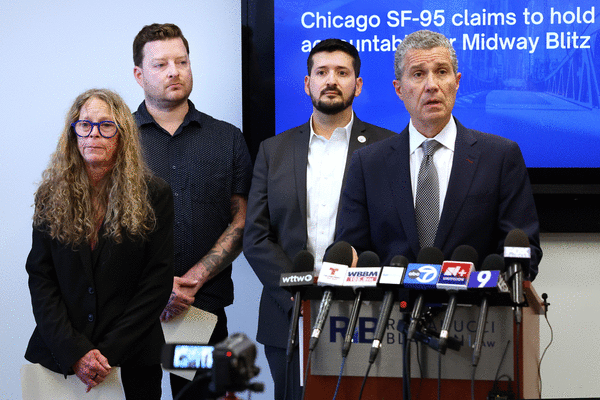
CHICAGO — Juan Muñoz is tired of remembering the events of Oct. 3, 2025.
On that day, at the height of Operation Midway Blitz, Muñoz was among hundreds of people protesting the blitz at the Broadview processing center when dozens of agents confronted the crowd outside the building and began to make arrests.
Muñoz, a trustee of west suburban Oak Park, appeared on video footage being pushed to the ground, He was handcuffed and held for about eight hours.
A year after Midway Blitz launched in Chicago, Muñoz has joined a group of 15 Illinois residents filing claims against the federal government over agents’ alleged misconduct during the massive sweeps through the city and suburbs last year.
“I had the right to stand there peacefully,” he said. “I swore to uphold the Constitution and that day I watched people who had taken the same oath violate the very rights the Constitution guarantees.”
Besides Muñoz, the claimants include an Evanston attorney who was detained while filming a federal arrest on Halloween and a man whose arrest outside Broadview was later used in government social media posts. They’re the latest U.S. citizens to turn to civil remedies in the wake of federal immigration enforcement across the country.
While there have been instances where state prosecutors have sought criminal charges against federal agents accused of misconduct during the raids, most notably in Hennepin County, Minnesota, following “Operation Metro Surge,” similar actions have so far been few and far between in Illinois.
One ICE agent, Adam Saracco, pleaded guilty to misdemeanor battery over throwing a local lawyer and activist to the ground while filming him off-duty earlier this year. And while Illinois State Police have launched an investigation into the shooting death of Mexican immigrant Silverio-Villegas Gonzalez at the hands of immigration agents, Gov. JB Pritzker said Tuesday that that probe would be “near impossible” to complete without additional cooperation from the federal government.
The group of claimants announced Thursday join a growing throng of people who have elected to rely on a law known as the Federal Tort Claims Act, which allows for legal action against the federal government as the employer of agents accused of misconduct.
The American Civil Liberties Union last month announced a group of 54 citizens who were pursuing claims under the FTCA, including a pair of Forest Park Cemetery workers who were detained as bystanders to an immigration arrest that occurred on the banks of the Des Plaines River. And Leo Feler, the Lakeview resident whose home was the site of a federal raid targeting the four construction workers installing siding on his house, recently announced his legal action under the FTCA and the Fourth Amendment.
Antonio Romanucci, the prominent personal injury attorney whose firm is part of the legal coalition representing the claimants, said the federal agents executing Midway Blitz “used our clients as punching bags.”
“We have not forgotten the horrors that were instilled in our city,” he said.
In response for a request for comment on the claims, a representative from the U.S. Department of Homeland Security said in a written statement that federal agents would “no matter how many federal law enforcement officers are assaulted and no matter how many lawsuits are filed against these brave officers who are making American communities safer through this hard work.”
Besides Muñoz, Jennifer Moriarty, the Evanston attorney arrested on Halloween as she taped a confrontation between Border Patrol agents and U.S. citizens, spoke about how she was still disturbed by the sounds of honking horns or helicopters overhead.
Kyle Frankovich, in short sleeves showing the same tattoos up and down his arms that appeared in images of his arrest and later circulated in official DHS social media postings, said his detention left him with a torn muscle, nerve damage and chipped teeth. He said online commenters later tried to identify and stalk him and said Trump administration officials had portrayed him as a “violent activist who assaulted law enforcement officers.”
“I did no such thing, as the government well knows,” he said. “No charges have ever been filed against me.”
Attorney Sarah Raisch said the legal team has filed all 15 claims, each seeking a different amount in damages. The government’s responses have varied, she said.
Federal officials have six months to negotiate over or reject the claims. If a resolution isn’t reached in that timeframe, the claimants can then file civil lawsuits.
Noah Smith-Drelich, a professor of law at IIT-Kent College of Law, said in a recent interview that there are a number of reasons for someone to turn to the civil legal system — including research indicating that much of the federal wrongdoing that could eventually lead to criminal liability doesn’t get prosecuted. There’s also the fact that federal prosecutors ultimately answer to the president.
“If we’re talking about federal prosecutors who do ultimately answer to the federal executive, prosecuting federal officials who also ultimately answer to the federal executive for wrongdoing, I think there’s some reason to wonder how much of this prosecution will actually occur,” he said.
But unlike in the criminal legal system, where the decision to proceed with a case rests with the office prosecuting it, a civil plaintiff has full control over his or her case.
Smith-Drelich added that for many of these plaintiffs, “the act of suing itself can be really powerful.”
People who bring civil rights suits are far from guaranteed to emerge victorious, he said, but even so, “the legal process provides a real expressive avenue for people to lay out everything that happened to them. Even just the suit itself feels like a public, formal expression of wrong.”
While the claims are seeking monetary damages because that’s what is available under the law, Raisch said she was “hopeful” about prospect of greater accountability emerging from the filings.
But she said the outcome of the claims were anyone’s guess.
“It’s impossible to say where the cases will go,” she said. “We’re in very uncharted territory.”
©2026 Chicago Tribune. Visit chicagotribune.com. Distributed by Tribune Content Agency, LLC.






Comments