Trump defends his support for unified Ireland despite UK uproar
Published in News & Features
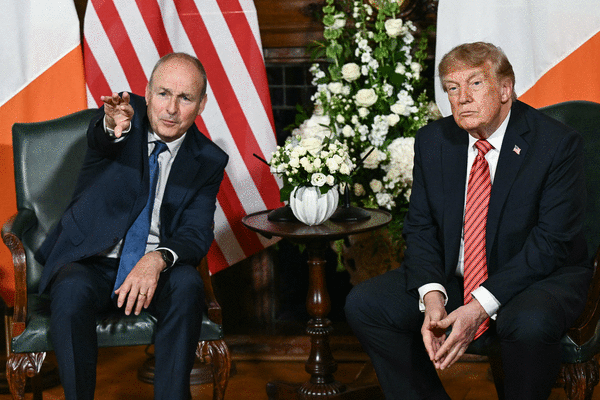
President Donald Trump defended his remarks calling for the unification of Ireland as “fairly routine,” standing by comments that have sparked a controversy in Northern Ireland.
“I’ve always loved the people of Ireland, and it just seems to me that you have Northern Ireland, and you have Ireland, and it would seem to me that one of the naturals of all time is put them together,” Trump told reporters Sunday as he attended the Irish Open in Doonbeg.
“So that’s only my opinion. And by the way, many people agree,” he said. “I made what I consider to be a fairly routine comment. I’ve had so much support on that.”
Trump’s comments Sunday came in response to a question about whether U.K. Prime Minister Andy Burnham should hold a referendum on a united Ireland, though the U.S. president sidestepped that matter.
A day earlier, during a meeting with Irish Prime Minister Micheál Martin in Dublin, Trump said he would like to see Ireland unified.
“I don’t want to cause any problems, but I will tell you, I’d love to see it unified. I have friends on both sides,” Trump said at that time, adding that he thought it would happen eventually.
Martin said some of the response to Trump’s comments “is an overreaction.” “I think if everyone keeps a calm perspective on things you know, we will take it from there. I’m meeting the British Prime Minister next week,” Martin told reporters Sunday.
Martin said he believes in Irish unity but refused to be drawn on any possible timeline. “What I don’t want to do is to go back to the failed sort of approaches historically.”
Trump’s remarks put him at odds with Burnham and other British leaders and have led critics to question whether the U.S. was changing what has been a mostly neutral position on the constitutional future of the Republic of Ireland and Northern Ireland, a region of the UK.
The U.S. played a major role in the brokering of the Good Friday Agreement, the landmark treaty that brought an end to decades of violence in Northern Ireland known as the Troubles.
A spokesperson for Burnham’s office said Saturday that the PM’s position on a border poll, as a vote on unification is known, remains unchanged after Trump’s remarks and that he was “committed to upholding the Good Friday Agreement.” Burnham said last month that a referendum on a united Ireland was “off the table.”
A vote can only be called by the U.K.’s Secretary of State for Northern Ireland when it “appears likely” that a majority of people in the region would support reunification, as stipulated in the Good Friday Agreement.
“Everybody says that and then things happen,” Trump told a reporter Sunday.
The backlash to Trump’s comments crossed party lines in the U.K., with a populist ally — Reform UK’s leader Nigel Farage — also criticizing his statement.
“Northern Ireland is a proud and integral part of the United Kingdom. The people of Northern Ireland neither want a referendum, nor unification. I disagree with President Trump,” Farage said in a post on X.
Former Sinn Fein leader Gerry Adams, who was the party’s chief when the Good Friday Agreement was reached in 1998, said Trump’s remarks only reflected “broad North American sentiment” and said he welcomed the president’s remarks even though they disagreed on many other issues.
_____
(With assistance from Olivia Fletcher and Se Young Lee.)
_____
©2026 Bloomberg L.P. Visit bloomberg.com. Distributed by Tribune Content Agency, LLC.




Comments