ICE pays Minnesota counties millions for detention -- but little for enforcement
Published in News & Features
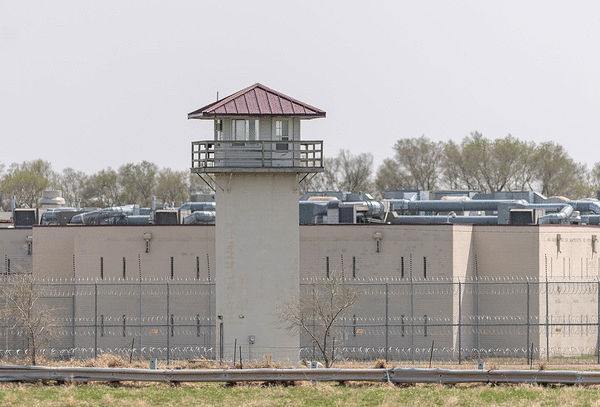
MINNEAPOLIS — Minnesota county jails have been paid $21.5 million to hold detainees caught up in President Donald Trump’s immigration enforcement push, but the future of those payments is in question after the federal government purchased the long-shuttered prison in Appleton, Minn.
The money — roughly $1 million a month since Trump returned to office — primarily went to Freeborn, Kandiyohi and Sherburne counties, according to an analysis of public records data from February 2025 through June 2026. The payments help offset the cost of county jail operations.
But the detention landscape will change after the 1,600-bed penitentiary reopens in November as an immigration detention center. It will dramatically increase ICE’s current holding capacity beyond the state’s county jails.
The U.S. Department of Homeland Security recently bought the Appleton prison from CoreCivic for nearly $500 million. CoreCivic will operate the Appleton facility when it reopens and expects to earn $75 million in annual profit.
ICE has spent $2.2 billion this summer purchasing CoreCivic-owned detention centers as the agency is increasingly reliant on private prison companies to hold immigrants.
ICE has not clarified whether the Appleton prison will replace or supplement detention space at county jails but a DHS spokesperson said last month that the $30 billion budget reconciliation bill gave ICE new funding to expand detention space across the country.
Local officials say they haven’t been notified whether ICE will use less of their jail space after the prison reopens. Sheriffs’ contracts to hold immigrants require 180 days’ notice for changes, but they do not stipulate how many detainees they are expected to hold for ICE.
“Time will tell,” Freeborn County Sheriff Ryan Shea said. “Of course, it seems entirely possible that the Appleton facility will have an effect.”
Freeborn County received nearly $5 million in federal payments for holding ICE detainees since Trump returned to office.
ICE pays local jails up to $140 a day to hold a detainee and covers transportation expenses.
Freeborn, Kandiyohi and Sherburne counties have held ICE detainees in their county jails since before Trump was first elected. Crow Wing County and the Northwest Regional Correction Center in Crookston also hold detainees under different agreements.
Kandiyohi County, in south-central Minnesota, has been the largest beneficiary, collecting $8 million since Trump returned to office.
During Operation Metro Surge, boarding ICE detainees covered roughly half of the county jail’s $2.62 million in operating costs for those three months.
Kandiyohi County Sheriff Eric Tollefson said the contract helped keep costs down. He said it shouldn’t be considered a revenue generator because staffing doesn’t change much when the jail is less full.
“County jails don’t typically make money,” he said. “They’re not really supposed to.”
In 2025, DHS paid Sherburne County $7.5 million for holding ICE detainees, a fraction of what it makes incarcerating federal prisoners awaiting trial.
The county’s $25 million in federal payments covered Sherburne County’s operating costs and provided an additional $2.5 million in revenue. Sheriff Joel Brott did not respond to a request for comment about his office’s federal contracts.
The increase in federal immigration spending comes from the 2025 budget reconciliation bill to reimburse local departments and encourage cooperation.
In contrast to the millions spent on holding detainees, just two Minnesota agencies that signed agreements to help agents serve warrants and arrest immigrants said they received federal payments.
Sheriffs in Crow Wing and Mille Lacs counties said they received initial payments of $160,000 and $175,000 respectively, after having a total of 17 deputies attend 40 hours each of online training.
The small city of Isle trained two deputies but police officials representing the Mille Lacs County community said they had not been reimbursed for the training. The Itasca County Sheriff’s Office did not respond to a records request about federal reimbursement or training.
None of the other agencies that signed an agreement did any training.
More than 2,300 law enforcement agencies nationwide signed up for the federal partnership, but they are much more popular in conservative border states like Florida and Texas.
Several states, including Maryland and New York, forbid local officials from enforcing the agreements. Many cities and counties, including Minneapolis, St. Paul and Hennepin County, have measures preventing law enforcement from asking about immigration status.
The border city of International Falls was the latest Minnesota community to sign a deal to help ICE with enforcement.
International Falls Mayor Drake Dill declined an interview request and told a reporter: “I’m really not interested in that story” when asked about the agreement. International Falls Police Chief Scott Wherley declined to comment.
It doesn’t appear there was much public discussion about the agreement. A review of the International Falls City Council meeting minutes found no mention of the agreement.
Councilor Mike Holden said he didn’t remember talking about it. “Maybe I was gone,” he said.
International Falls did not respond to a public records request for communications between city leaders about the deal.
Two counties opted out of the agreements after initially signing them.
Jackson County withdrew its participation shortly after signing the contract last spring. Cass County also backed out in the wake of Operation Metro Surge.
“We didn’t want anything to do with it,” Cass County Sheriff Bryan Welk said in a brief interview. “That’s not what we signed up for.”
_____
©2026 The Minnesota Star Tribune. Visit startribune.com. Distributed by Tribune Content Agency, LLC






Comments