Businesses, commuters still feel ripple effects of Key Bridge collapse
Published in News & Features
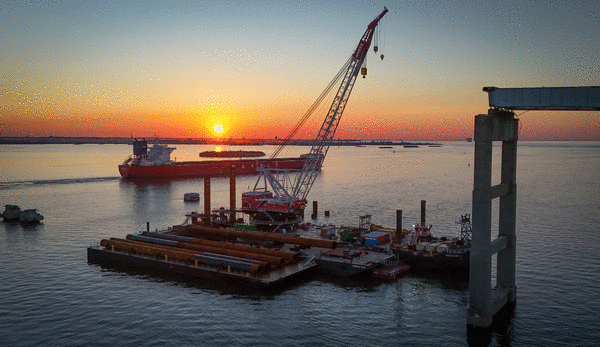
BALTIMORE — Nearly two years after the collapse of the Francis Scott Key Bridge, businesses and communities across the Baltimore region are still dealing with the fallout, as longer commutes and traffic diversions have led to lasting changes with a new bridge still years away from opening.
Since the March 26, 2024, collapse, as many as 33,000 vehicles a day have been diverted onto already congested roadways. Drivers who once circled the city on I-695 must now funnel through the region’s remaining harbor crossings — the I-95 Fort McHenry Tunnel and the I-895 Baltimore Harbor Tunnel — where traffic volumes have surged and delays have worsened as commuter and freight flows are concentrated into fewer routes. The disruption has also rippled through local economies, with some small businesses reporting losses tied to reduced cross-harbor traffic.
In Dundalk, Laura Montana, owner of Little Crystal Bijoux jewelry shop, said the bridge collapse diverted potential customers from her business. Trips that once took 15 to 20 minutes stretched to more than an hour, leading to a roughly 40% drop in business.
“I became an inconvenient place to shop,” she said, adding that reduced foot traffic forced her to rely heavily on online sales and off-site events to stay afloat.
“A lot of my regular guests either work in the city or in Baltimore County, but they live in Anne Arundel or P.G. County, and my shop was on their way home,” Montana said. “I was only maybe 15 minutes away, but with the bridge coming down, I’m no longer on their way home. In fact, I’m out of their way.”
Montana said the impact unfolded gradually, as fewer customers made the longer drive and discretionary spending dipped. While her business has since stabilized, she said in-person shopping has not recovered, and conventions and web sales have become her “lifeline.” Other small businesses, including restaurants in the area that once depended on commuters stopping in on their way home, have faced similar challenges.
Amanda Wolinski, a realtor with Cummings & Co. Realtors who lives in Millers Island, said she’s previously sold homes in the Sparrows Point area to people who would drive to work in Anne Arundel County. But when the Key Bridge fell, what was once a 25-minute drive turned into an hour and a half spent on the road, prompting some to relocate.
“They’re like, ‘Oh my gosh, I’m giving up a mortgage that’s 3% to buy something over in Anne Arundel County and get a mortgage at 7%, but I can’t take the commute anymore,” she said in an interview. “It’s either relocate their business or just buy a different home over there.”
Communities work to rebuild
As recovery continues in the wake of the Francis Scott Key Bridge collapse, officials say rebuilding efforts are extending beyond construction to focus on reconnecting and supporting affected communities.
Melissa Williams, director of planning for the Maryland Transportation Authority, said the Key Bridge rebuild team has prioritized consistent outreach, hosting more than 100 pop-up events and 50 speaking engagements that have resulted in thousands of direct interactions with residents. The agency has also expanded its digital reach through newsletters, social media and community partnerships, while organizing job fairs and supporting local initiatives such as school reading programs, clothing drives and food distribution efforts.
In Turner Station, community leaders say that presence has made a difference. Gloria Nelson, president of the Turner Station Conservation Teams, said the rebuild effort has provided tangible support for residents, including stepping in to assist with strained volunteer efforts during food distributions. She said the collaboration reflects a broader commitment to ensuring recovery efforts strengthen neighborhoods, not just infrastructure.
Nelson said the continued engagement has helped reinforce a sense of connection during a difficult period, as communities work to recover from the economic and social disruptions caused by the bridge collapse. “Rebuilding is not just about restoring what was lost, but about stressing the community every step of the way. And we thank you so very much for that.”
Work deadlines set moving forward
In a call with reporters on Wednesday, Jim Harkness, chief engineer for the Maryland Transportation Authority, said crews have completed key early work on the bridge repair. That included demolition of large portions of the former bridge, which wrapped up in January. Remaining sections of concrete deck and land-based piers have been removed.
The project reached 70% design in November, with a finished plan expected by June after foundation tests confirmed the proposal would work.
Construction is set to intensify in the coming weeks, with pile-driving operations scheduled to begin in April to support the bridge’s main pylons. Officials said final cost estimates and the full construction timeline are still being determined as design and contract negotiations continue, but they are tentatively projecting an opening date of late 2030.
_____
©2026 Baltimore Sun. Visit baltimoresun.com. Distributed by Tribune Content Agency, LLC.






Comments