Defense questions former Haiti first lady's version of events in husband's slaying
Published in News & Features
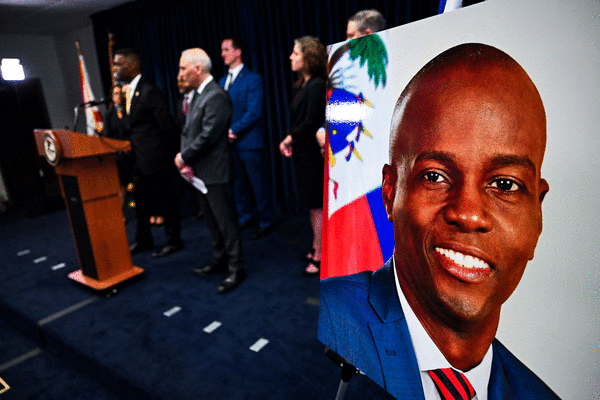
Martine Moïse’s statement to FBI agents in the immediate aftermath of her husband’s assassination inside his Port-au-Prince bedroom has come under scrutiny as defense attorneys raise inconsistencies between her initial comments and her testimony at the federal trial in Miami stemming from his slaying.
After being airlifted to Ryder Trauma Center at Jackson Memorial Hospital hours after she suffered multiple gunshot wounds when her husband, President Jovenel Moïse, was killed in the July 7, 2021, attack, the former first lady told two FBI agents that she had secured her children in a downstairs bathroom and drawn the curtains. She then returned upstairs to where she and her husband then hid under the bed with both of their legs sticking out.
That account differs from what Moïse later testified in the U.S. government’s murder-conspiracy trial of four South Florida men accused of conspiring to kidnap or kill the Haitian leader.
“The children were in the bathroom shower, the bad guys opened the door but didn’t check the shower — the only room in the house not shot up — the only one they decided not to check,” David Howard, a defense lawyer said Tuesday, as he questioned Ryan Bonura, a FBI special agent, about the interview.
Bonura interviewed the former first lady on July 9, two days after the attack. She was at JMH under an alias, had just had surgery on her bandaged arm and her children — both college-age adults — were present. He conducted the interview in English along with another agent, he said. Bonura said he recalled her saying that her Spanish-speaking assailants “checked the bathroom.” He and his colleague, he said, had “no reason to believe that Mrs. Moïse was being anything but truthful.”
“You do know there is no curtain in that bathroom, but a sliding glass door that you can see behind?” Howard asked.
The inconsistencies in Martine Moïse’s statements have raised questions about what exactly took place inside the Moïse home on the night a squad of former Colombian soldiers stormed the couple’s Pélerin 5 neighborhood, accompanied by Haitian police officers and two Haitian Americans.
No one else was shot or killed, including members of the presidential security detail who were supposed to be guarding the family. Martine Moïse said she was awakened at 1 a.m. to the sounds of gunfire. Her husband then turned to her and stated, “Honey, we’re dead.”
The government’s first witness in the Miami federal trial, Martine Moïse testified using a Creole translator, even though she acknowledged earning a university degree as an English translator. During her testimony, she told the jury she crawled down the flights of stairs on her hands and knees to see about the children. She founder her daughter in her son’s bedroom, and they both then went into a windowless bathroom with one of the family’s dogs.
“I thought it was one of the safest places in the house,” she said. “If I didn’t come down, they would have come upstairs. If they had come upstairs, they would have been dead.”
Afterward, she said, she returned upstairs.
“She told you that she and her husband were both partially under the bed, correct, because they couldn’t fit all the way right, and that their legs were sticking out?” Howard asked on Tuesday.
Images of the couple’s home with bullet impacts throughout the house and their crowded, messy master bedroom have also raised questions about her position in the room, a point that defense lawyers have tried to subtly raise by asking her how much she weighs and her exact positioning during the assault.
“They were hiding under the bed,” Bonura said on redirect from the government, explaining that she said the assailants had stepped on her leg and then shined a light in her face in an attempt to see if she was dead.
Under the bed
Martine Moïse testified during the trial’s first two days. Though defense lawyers were reluctant to press hard, they nevertheless questioned her closely after she appeared to change her story and contradicted herself. For example, in the few interviews she gave after the incident she described being under the bed. But in court, she said, she wasn’t all the way under the bed because ”the bed was very low.”
“Even though Joe told me to try to get under the bed, I couldn’t,” she said, referring to her husband.
The questions about Martine Moïse’s recollection of events to the FBI came on a day in which the complexities of trying four defendants at once became increasingly apparent, and as new details emerged about some of the accused having previously worked as confidential informants for U.S. law enforcement agencies.
Prosecutors have insisted that none of the defendants, including six who have already pleaded guilty, were working for the U.S. government at the time of the killing.
On Tuesday, before challenging Martine Moïse’s testimony, Howard sought to show that his client, Arcángel Pretel Ortiz, had been in contact with both the FBI and his handler on the day of the presidential assassination. The Miami Herald has previously reported that Pretel, who ran a company known as Counter Terrorist Unit Federal Academy and helped recruit the Colombian commandos, was an FBI informant.
Bonura was among the agents who interviewed Pretel.
“You are aware that he talked to his handler on the 7th of July 2021,” Howard said, “breaking down, at least his version of what happened?”
Pretel also spoke with his FBI handler on July 8 and 9, he sat for an interview with two special agents with Homeland Security Investigations, Howard said, adding that he even invited them into his home. Pretel later participated in a telephone interview on July 10th, and on July 11 went to the main office of HSI, his lawyer said. He was accompanied by his business partner, Antonio Intriago, who is also a defendant in the federal case. During that visit, Pretel brought documents that were copied.
“I am aware that he met with law enforcement on several occasions,” Bonura said.
The defendants
In addition to Pretel and Intriago, 62, the other defendants on trial are James Solages, 40, a Haitian-American handyman who worked for Intriago’s Doral-based Counter Terrorist Unit, and Walter Veintemilla, 57, an Ecuadorian American prosecutors say helped finance the plan targeting Moïse.
A fifth defendant, Christian Emmanuel Sanon, will be tried separately because of poor health. A Haitian doctor and U.S. citizen, Sanon had positioned himself as possible successor to Moïse and claimed that he was working to bring development and infrastructure projects to Haiti, including solar-powered electricity and clean water.
Among the government’s witnesses are the six defendants who have pleaded guilty. Five of them, including a former senator in the Haitian parliament, face life sentences. The others are John Joel Joseph, also known as “J3” and Joseph Joel John; Germán Alejandro Rivera García, a retired Colombian army officer who served as co-leader of the squad, and Joseph Vincent, a Haitian American.
During cross examination of Bonura by one of Solages’s lawyers, Simon Patrick Dray, the agent was asked whether he knew that “Mr. Vincent was a DEA informant since 2013,” and had also been a Haiti national police officer.
“That sounds familiar,” Bonura said about the DEA ties.
On redirect questioning, prosecutor Jason Wu asked the FBI agent about Vincent’s status with the DEA in 2021. “My understanding is he was inactive,” Bonura said.
Binders of evidence
The government has amassed hundreds of pages of evidence, including a 900-page summary spanning four binders. There are also 20 cellphones, whose data has been extracted by the government. Prosecutors say Moise’s killing was part of a scheme by a group of South Floridians who falsely claimed U.S. governent ties in an effort to gain power and secure lucrative contracts in Haiti.
Defense lawyers, who have sought to highlight the shortcomings of both the Haitian and U.S. investigations, argue that the group intended to serve an arrest warrant on the president because he had overstayed his term, and that by the time the Colombians arrived Moïse had already been killed by his own security forces and officials in his government.
The government has presented a number of digital forensic experts who have extracted text messages from defendants’ cell phones. In court, they’ve asked for the experts to read some of the chats.
“Smoothness and seamlessness is what we want,” Emmanuel Perez, a lawyer for Intriago, said, noting that the volume of the material and the government’s familiarity with its witnesses has at times left the defense “scrambling” to keep up as text messages were being cited.
Both sides were chastised on Monday for the slow pace of the proceedings by U.S. District Judge Jacqueline Becerra. She has expressed concerns about losing the jury’s attention and urged a faster, more efficient presentation of evidence, telling the defense they’ve had the material for some time.
Sean McLaughlin, an assistant U.S. attorney, defended the government’s approach, saying the defense had possessed the material for months and that prosecutors would publish aspects of defendant’s phone messages that they believe is relevant.
“We will try to keep it brief,” he said.
©2026 Miami Herald. Visit at miamiherald.com. Distributed by Tribune Content Agency, LLC.




Comments