How this US Supreme Court case affects WA's vote-by-mail
Published in News & Features
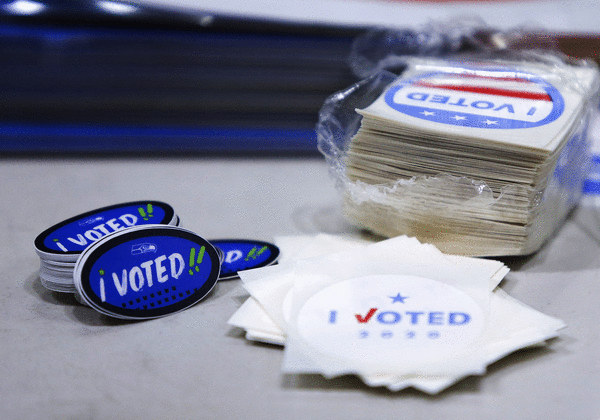
WASHINGTON — The U.S. Supreme Court heard arguments on Monday in a case that could end the practice of counting ballots received after Election Day, which would upend Washington state's and several other states' mail-in voting systems months before this fall's midterm elections.
During a general election in Washington, a ballot postmarked on or before Election Day can be received up to 20 days after the election and still count. At least 17 other states and territories also accept and count a mailed ballot received after Election Day, if postmarked on or before it.
A case before the Supreme Court, brought by the Republican National Committee against the Mississippi secretary of state, challenges whether that grace period should be allowed in Mississippi, a decision that will set a standard for elections across the nation. The court's conservative majority on Monday appeared critical of state laws that allow the counting of late-arriving ballots. If the high court rules against the extra time, Washington will be forced to overhaul its long-standing vote-by-mail practices and voters will be urged, more than ever, to cast their ballots earlier, according to the state's elections officials.
In Washington, much like most states, early voters tend to be older and more conservative. Late ballots tend to break left, meaning that a candidate winning in ballots counted by the end of Election Day will not always be the winning candidate when the election is finalized weeks later.
"Disqualifying these later ballots would create a barrier for no compelling reason," said Stuart Holmes, Washington elections director. Holmes works for Secretary of State Steve Hobbs, a Democrat. "It's also something that's going to confuse the public: what exactly the rules are."
In the 2024 general election, about 127,000 voters in Washington cast ballots that were received after Election Day and postmarked on or before the day, Holmes said.
"We wouldn't even be able to look at these ballots," if the high court rules against such grace periods, Holmes said. "They would be invalid even if the voter did everything right."
The court case marks the Republican Party's broader campaign against mail-in voting, spearheaded by President Donald Trump, who has repeatedly claimed the practice delays results and breeds fraud, despite evidence that voter fraud is uncommon. The Washington State Republican Party, which is pushing to eventually end mail voting altogether in the state, has supported the earlier ballot deadline.
"Ballots received after Election Day should NOT be counted," Chair Jim Walsh said in a Facebook post earlier this year.
The state's Democrats have long defended the vote-by-mail system. U.S. Rep. Marie Gluesenkamp Perez, D-Washougal, said she would see the court forcing Washington to change its rules as preempting the will of residents of the state.
“I’m disappointed any time the Supreme Court entertains attempts to undermine our state’s elections process and force Washingtonians to jump through nonsensical bureaucratic hoops in order to mail in their ballot," Gluesenkamp Perez said in a statement.
There are other hurdles that prohibit accurate results until days after the election, even when ballots are received by Election Day, Holmes said.
The U.S. Postal Service will be overwhelmed during an election, threatening accurate postmarks, Holmes said, and Washington usually receives a mountain of ballots on, or just before, Election Day. Out of Washington's 5 million registered voters, about 4 million vote-by-mail ballots were returned in 2024 — about 1.5 million of these ballots were received beginning two days before the election. Generally, the state sees about half of its cast ballots returned the day before, or the day of, Election Day, Holmes said.
"It's just not possible to process everything on Election Day," Holmes said. "They will be processed in the days to come.
That process includes signature verification by election staff, reviews for potential scanning issues and generally preparing the ballot for official counting. Results, therefore, are often not clear until days later, Holmes said.
Kendall Hodson, chief of staff for King County Elections, said voters in recent years have already been getting their ballots in earlier, due in part to well-publicized concerns with delays in postal deliveries. In 2024, of about 1.2 million ballots in King County, just 26,866 — or 2.3% — were received after Election Day, according to county election data. That's down from about 4% in 2020 and 2022.
“At least for us, the number of voters mailing their ballots late in the cycle has decreased,” Hodson said Monday. “It’s been really trending downwards, is the good news.”
Still, Hodson said, there are thousands of validly postmarked ballots in recent elections arriving after Election Day in King County.
In Seattle, younger voters have tended to wait until the last minute to turn in their ballots, The Seattle Times has previously reported. The median age was significantly lower for Seattle voters whose ballots were received on and after Election Day compared with voters whose ballots arrived earlier. These voters could be particularly impacted if the Supreme Court nixes post-Election Day grace periods for ballots.
In November, Seattle's mayor was chosen by a few thousand votes, flipping from Bruce Harrell, who initially led by about 9 percentage points, to Katie Wilson as ballots were processed for more than a week after Election Day.
Hodson said elections officials intend to aggressively inform voters of a new deadline for their ballots if a Supreme Court decision requires that.
“We’ll get the word out so they know what to be doing,” she said.
The Supreme Court is expected to issue a decision in the case this summer.
_____
© 2026 The Seattle Times. Visit www.seattletimes.com. Distributed by Tribune Content Agency, LLC.






Comments