NASA set for overnight roll of Artemis II rocket back to the launch pad
Published in News & Features
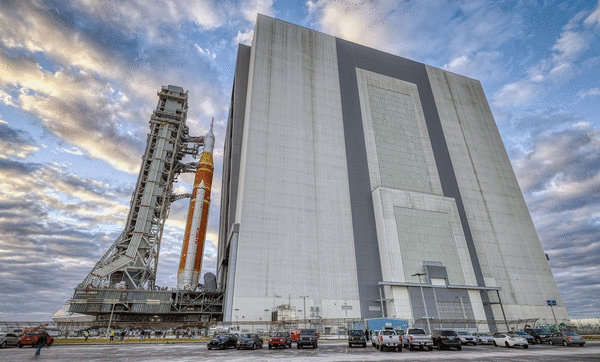
KENNEDY SPACE CENTER — NASA hopes it has only one more roll to the launch pad before it gets a shot to launch four astronauts around the moon on the Artemis II mission.
Teams are set to begin the 4.2 mile journey from the Vehicle Assembly Building to Launch Pad 39-B beginning at 8 p.m. Thursday for what would be around a 12-hour trip.
Winds at KSC have gusted to 40 mph throughout the day, though, and mission managers may delay its roll if they don’t die down.
The Space Launch System rocket topped with the Orion spacecraft sitting atop Mobile Launcher 1 will get piggybacked on NASA’s crawler-transporter-2 for the slog to the pad not exceeding 1 mph.
This is the second trip to the pad for the Artemis II hardware, which made its first foray back in January. NASA had originally been trying for an early February launch window for what would be the first crewed mission of the Artemis program. But during a first wet dress rehearsal attempt issues with liquid hydrogen leaks took February’s chances off the board. Then, despite completing a second wet dress rehearsal successfully, the March window was also pulled when a helium flow blockage in the inaccessible upper stage forced the decision to roll the rocket back to the Vehicle Assembly Building.
That issue was fixed and teams replaced batteries on several items, so now NASA will try to hit a launch opportunity that falls during an April 1-6 window.
Waiting for their shot to climb on board Orion are NASA astronauts Reid Wiseman, Victor Glover and Christina Koch as well as Canadian Space Agency astronaut Jeremy Glover.
The quartet entered quarantine on Wednesday evening in Houston with a two-week run-in before the first launch opportunity. They will fly into KSC about five days before launch, where they will remain at quarantine at crew quarters at the space center.
If they fly and Orion gets the OK after performing a trip around the planet to ensure it’s safe, they will punch their moonbound ticket and would be the first humans to leave low-Earth orbit since Apollo 17 in 1972.
The lunar fly-by seeks to prove Orion can safely transport crew. It comes nearly 3 1/2 years after the uncrewed Artemis I mission that flew in 2022. That mission saw major damage to the coating on the capsule’s heat shield that forced contractor Lockheed Martin and NASA to reassess how the spacecraft comes back in for reentry.
Orion will approach 25,000 mph and see temperatures near 5,000 degrees Fahrenheit coming back for a parachute-assisted splashdown in the Pacific Ocean.
Next up would be Artemis III, originally designed to be a lunar landing mission. It was recently retasked, though, to fly as early as mid-2027, and only on a near-Earth trip that will allow NASA to attempt docking with one or both of the two lunar landers being developed by SpaceX and Blue Origin.
It won’t be until Artemis IV, currently targeting early 2028, that NASA will go for a moon landing, while a second moon landing on Artemis V is also looking to fly by late 2028.
Those targets are part of NASA Administrator Jared Isaacman’s gauntlet thrown that killed, or at least left in limbo, some aspects of what had been the previous Artemis plan.
That includes NASA no longer supporting a larger version of the SLS rocket, which ended production of Boeing’s Exploration Upper Stage, and made expendable the $1 billion Mobile Launcher 2 that’s been under construction adjacent the VAB for the last two years. It also left any mention of the lunar space station Gateway out of any plans for now.
Instead, Isaacman wants to increase the flight rate for SLS, so as to not lose “muscle memory” by waiting so long between launches.
It also sets up a better chance to actually make the lunar landing before the end of President Trump’s second term by not combining so many mission facets into one trip. The previous plans for Artemis III were essentially the same as combining the Apollo 9, 10 and 11 missions into one.
But first up, the Artemis II rocket needs to get to the pad.
_____
©2026 Orlando Sentinel. Visit orlandosentinel.com. Distributed by Tribune Content Agency, LLC.






Comments