California used faulty DUI tests for nearly 10 years, state Justice Department says
Published in News & Features
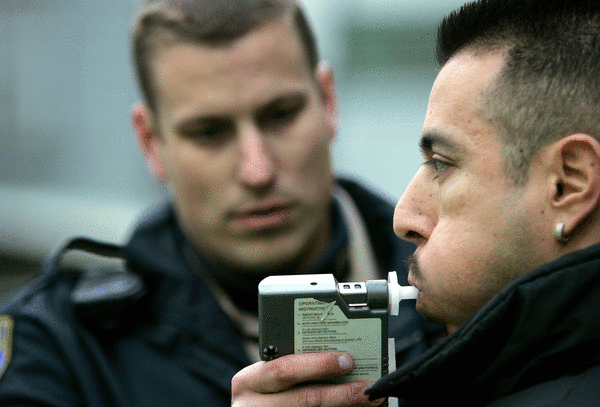
LOS ANGELES — Almost a decade ago, a Simi Valley-based medical supply company began providing the California Department of Justice urinalysis tests for law enforcement agencies around the state that didn't have local forensic labs to test for alcohol.
For most of that time, the test kits Andwin Scientific supplied were faulty, potentially inflating the results of DUI suspects in the heart of California's wine country and elsewhere, according to a letter state officials sent to Sonoma County prosecutors that was first reported by the San Francisco Chronicle.
As a result, an untold number of criminal cases across California were potentially up for review, with about 60 law enforcement agencies and seven district attorney's offices informed that cases in their jurisdictions could be affected, a state Justice Department spokesperson said. Generally, urinalysis tests are rarely used to prosecute DUIs.
Following an audit by the state, officials told The Times this week, the state Department of Justice determined that only a small number of California's DUI and other cases involving alcohol analyses — 0.07% — involved the faulty urinalysis tests and needed to be reviewed.
It's now up to local jurisdictions such as Sonoma County to do a deeper dive and see if anything was missed. Large counties, such as Los Angeles, San Francisco and Orange counties, which have their own labs, were not affected.
"We have alerted the impacted agencies so they can conduct their own review of the case information," state Justice Department officials told The Times in an email.
Authorities first learned that the tests were faulty last summer, according to the letter state officials sent Sonoma County.
For nearly 10 years up until then, the test kits Andwin Scientific supplied the state did not contain the necessary amount of the chemical compound sodium fluoride to prevent urine samples from fermenting, according to the state's letter. That meant that urine samples with high sugar content could have started fermenting and consequently generated alcohol that could have skewed the test result or created a false positive.
For that to happen, several different variables would have had to align, Katina Repp, director of the state's lab in Santa Rosa, told the Sonoma County district attorney's office in the Jan. 28 letter.
For the low levels of the fermentation-blocking compound to make a difference, the tested urine would need to contain a high concentration of sugar, which usually only happens for people with diabetes. For that sugar to then ferment and produce alcohol, the person giving the sample would also need to have a yeast infection, she wrote.
"It is possible, under these ideal conditions described above, that some fermentation may have occurred [in some tests]," Repp wrote. "However, this is still not likely as there was at least some sodium fluoride which would help preserve the sample."
After being notified of the issue, Andwin Scientific fixed the tests and the state launched an audit of all the criminal cases that it believed could have been affected. The audit ultimately flagged 97 tests that showed near or above 0.04% alcohol in a person's system — the maximum allowed for commercial drivers before they could be charged with a DUI. The department did not specify why it chose that threshold.
Out of the thousands of DUI cases Sonoma County has prosecuted since 2016, ultimately only six were flagged for a deeper review, Chief Deputy Dist. Atty. Matthew Henning said.
In each case, the office concluded there was enough other evidence of intoxication that nothing more needed to be done. In another three criminal cases, the people who gave urine samples were not the defendants, he said.
Attorneys in each of the cases were informed, including the public defender's office, according to a letter obtained by The Times from Sonoma County prosecutors to the public defender's office.
"Although we have attempted to identify all Sonoma County cases that were potentially impacted by what is described in the attached letter, please let us know if there are any other cases you are aware of that should be assessed, and we will promptly investigate those matters," Assistant Dist. Atty. Brian Staebell wrote.
In an email to The Times on Wednesday, the Sonoma County district attorney's office said they were "looking into these issues." The Sonoma County public defender's office did not immediately provide comment.
©2026 Los Angeles Times. Visit at latimes.com. Distributed by Tribune Content Agency, LLC.





Comments