Why Iran's choice of supreme leader signals defiance against the US and Israel
Published in News & Features
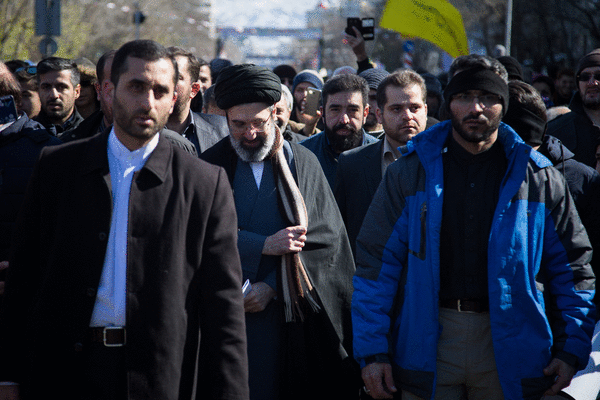
TEHRAN, Iran — The elevation of Mojtaba Khamenei to the mantle of supreme leader brings to Iran’s top job a hard-line figure who is most firmly his father’s son in charting a defiant path for the country.
“Mojtaba Khamenei’s elevation is not just a succession, it is a provocation — a blunt middle finger to Trump,” said Ali Vaez, who heads the Iran Project at the International Crisis Group think tank, adding that his selection was “a declaration that the Islamic Republic will answer pressure with defiance, not reform.”
Dismissed by U.S. President Donald Trump as a “loser” and an “unacceptable choice,” the 56-year-old Khamenei was chosen on Monday by Iran’s Assembly of Experts, an 88-member clerical body, to succeed his father, Ayatollah Ali Khamenei, who was killed in the first day of the U.S. and Israel’s assault.
World markets reacted with alarm to Khamenei’s ascension, interpreting it as a sign that the war is likely to continue beyond the “four or five weeks” Trump promised.
“It’s a final act of resistance by the late Khamenei from his grave,” said Ellie Geranmayeh, a senior fellow and Iran expert the European Council of Foreign Relations. “It also sends a strong message to Trump that his bombings and threats are not delivering the regime change he seemingly wants.”
“He will not only carry his father’s legacy of deep distrust for the U.S. and Israel,” she added, “but will also be clouded by personal vengeance given the killing of his mother, father, wife and child in the opening strikes of this war.”
Khamenei will preside over an exhausted populace battered by years-long sanctions and successive confrontations with Israel and the U.S. Many of the country’s 93 million people were deeply dissatisfied with the sclerotic and often corrupt rule that characterized the 36-plus-year reign of his father. In January, country-wide protests rocked the government, which deployed deadly force and killed anywhere thousands if not tens of thousands of protesters.
The appointment represented a closing of ranks among Iran’s leadership even as the war on the Islamic Republic continues into its second week. Iran’s U.N. ambassador said 1,332 civilians have been killed, including 200 children and 11 healthcare workers.
Top Iranian politicians — the president, foreign minister and parliament speaker — sent effusive congratulations to Khamenei. Ali Larijani, the head of Iran’s Supreme National Council and the country’s de facto leader during the war, said Khamenei was raised “in the school of thought of his great father” and would use those teachings to lead the nation.
The army pledged allegiance, while the Islamic Revolutionary Guard Corps, with whom Khamenei served during the Iran-Iraq war, hailed him as “a new dawn and the start of a new phase in the history of the Islamic Revolution and the Islamic Republic.”
From Moscow, Russian President Vladimir Putin also sent congratulations, adding, “Russia has been and will remain the Islamic Republic’s reliable partner.”
Despite word that his father opposed his candidacy for fear of turning the revolutionary Islamic system of government into a hereditary one, Khamenei was for years considered a possible — perhaps even likely — successor. Nevertheless, he kept a low profile, giving no interviews or public speeches and holding no official government position.
He studied in a seminary in Qom after his service with the Revolutionary Guard and wears the black turban of a sayyid, indicating that he traces his lineage back to the Prophet Mohammad.
Like his father before him, Khamenei ascends to the office without the necessary religious credentials to do so. He is not an ayatollah, the rank of the Islamic Republic’s founder and his father’s mentor, Ruhollah Khomeini.
Ali Khamenei also was not an ayatollah, as the constitution requires, when chosen as supreme leader, though he later assumed the title. Khamenei is a hojjat al-Islam, which is one rung below ayatollah.
The expectation, said Hamidreza Taraghi, an analyst considered close to Ali Khamenei, is that the son will espouse an even harder line than his father that will all but excise from government anyone who counsels rapprochement with the U.S. and the West.
“The leniency among the so-called reformers only made America bolder, so no putting those people in top positions, nor allowing policies that open up to the West,” Taraghi said. “He will remain as firm as his late father against the Zionist regime and will not budge under pressure, whether internal or external.”
Geranmayeh, the Iran expert, added that Ali Khamenei’s followers will expect his son to follow his father’s path “but potentially with more defiance to restore deterrence against the U.S. and Israel — something which Ali Khamenei lost in his final years.”
On Monday, Iranian state-affiliated TV channels broadcast rallies from all across the country, depicting masses of people gathering in main squares to express their fealty. In Tehran, thousands gathered in Enghelab Square, shouting “We sacrifice ourselves for you, O Khamenei!”
Others were less enthused.
“What can he do? Everything’s at a standstill. He doesn’t even have an office to work and run the country,” said Azizullah, a grocery shop owner in Tehran who refused to be identified to avoid reprisals.
“It doesn’t matter. They’ve chosen him, so he will be next target to be assassinated,” he said.
Azizullah referred to Israel’s repeated threat that it will kill whoever is appointed as the next supreme leader. On Sunday, Trump said any leader would have to be approved by the U.S.
“If he doesn’t get approval from us, he’s not going to last long. We want to make sure that we don’t have to go back every 10 years, when you don’t have a president like me that’s not going to do it,” Trump said in an interview with ABC.
Still, Trump said he would be amenable to figures tied to the old regime “in order to choose a good leader.”
“There are numerous people that could qualify,” he said.
Yet for some in Iran the supreme leader as irrelevant.
“His predecessor wasn’t important for me,” said Mehdi, an IT specialist working near Enghelab Square. “The new one won’t be helpful for me and my family either.”
_____
(Mostaghim is a Times special correspondent and Bulos is a Times staff writer.)
_____
©2026 Los Angeles Times. Visit at latimes.com. Distributed by Tribune Content Agency, LLC.



Comments