Rev. Jesse Jackson's family and closest friends offer one last goodbye
Published in News & Features
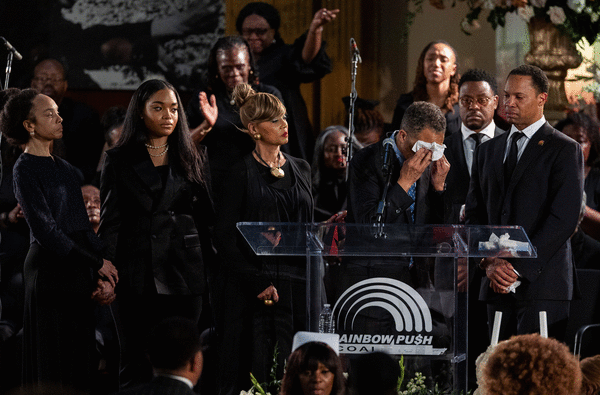
CHICAGO — They sent the Rev. Jesse Jackson home Saturday the only way it could have been done: with Gospel music, testimony that often brought people to their feet and story after story about a man who rose from humble beginnings to become one of America’s most influential Civil Rights leaders.
The final service in Jackson’s honor, in a packed chapel at the Rainbow PUSH Coalition, proved befitting of a human rights advocate who came to be known, simply, as the “country preacher.” Jackson earned that nickname in the years after leaving the Chicago Theological Seminary, while he marched from Selma to Montgomery and through streets in Chicago and far beyond.
Like any good country preacher, Jackson could move people to tears and move them to act. Speakers and performers at his funeral Saturday — a group that included his children, singer Stevie Wonder and South African President Cyril Ramaphosa — came to do both.
At times, it had the feel of a Sunday morning service at a Baptist church, the kind Jackson might have attended growing up in Greenville, South Carolina, in a country that did not welcome people who looked like him. During perhaps the most rousing eulogy of all on Saturday, Jackson’s second-oldest son, Jonathan, referenced his father’s journey from then to now, while a who’s-who of faith leaders, heads of state, dignitaries, power brokers and celebrities mourned before him.
“According to how things are supposed to work out in America,” said Jonathan Jackson, a Democratic Congressman representing Illinois’ 1st District, “Jesse Jackson was supposed to be a nobody.” And then he listed all the reasons why, from the poverty to the oppressive hand of Jim Crow, before Jonathan Jackson then referenced three of his father’s most famous words, ones that became something like a personal motto and defied everything that conspired to keep him down:
“I am somebody.”
“Look at what the Lord has done,” Jonathan Jackson said, referencing the hundreds of people who’d come to bid one final farewell. “Look at what the Lord has done,” he said again, referencing the lifetime of humanitarian work that defined his father’s legacy. He talked of the marches and protests, the freed hostages and the long fight to end apartheid in South Africa, as well as the battles that received far less publicity.
Jonathan Jackson’s voice rose while he spoke of American history and his father’s place in it.
“My father honored the words of the Declaration of Independence more than the men who signed it,” he said. “Jesse Jackson honored the ideals of the Constitution of America more than any of the 25 slave holders that signed and ratified it in their hypocrisy.”
He turned to his father’s casket in front of him and evoked the rallying cry — “run Jesse run” — that followed him when he twice ran for president in the 1980s. Only this time, Jonathan Jackson said, over and over again, the words growing louder:
“Rise Jesse, rise! Rise, Jesse, rise!”
The service Saturday represented the culmination of nine days of funerals and celebrations for Jackson, who died last month at age 84. The mourning began the moment his family announced his death on Feb. 17. On the first day of his public visitation, people lined up hours early to walk inside Rainbow PUSH and past Jackson’s casket at the front of the chapel.
Jackson founded the coalition in 1971, in the years after his role in the Civil Rights Movement propelled him into national politics and advocacy and made him a voice of the people — especially of Black people who’d long fought for equality and opportunity. While people gathered the morning of Feb. 26, the first day of his public visitation, some of Jackson’s most memorable speeches played on a loop.
There was Jackson at marches and rallies and protests, speaking and leading. There he was, talking with eloquent force in front of tens of thousands at the Los Angeles Coliseum in 1972, delivering the “I Am Somebody” speech that became an anthem for those who most needed to hear his words.
“I may be poor … but I am … somebody! I may be on welfare … but I am … somebody!”
Several speakers referenced those words Saturday during Jackson’s funeral. They reinforced one of his core messages throughout the past six decades: that people — no matter their background or challenges, and regardless of race or their wealth, or lack thereof — are people. And throughout the past week and a half, thousands of people joined Jackson during what was almost like his final march.
After lying in repose for two days at the Rainbow PUSH Coalition, where members of Jackson’s family formed a receiving line near his casket and hugged those who walked past, he returned to South Carolina, where he was born in Greenville in 1941. Jackson, afflicted with a stutter as a child, grew up in poverty and amid unenviable circumstances he often referenced in his speeches.
He often spoke of not knowing his true last name; of having three last names in his childhood because he was adopted. During his memorable speech at the 1988 Democratic National Convention, where Jackson ended his second and final run for president, he shared the story of waiting to eat Thanksgiving leftovers his mom brought home after working in someone else’s kitchen.
“At 3 o’clock on Thanksgiving Day, we couldn’t eat turkey because Mama was preparing somebody else’s turkey at 3 o’clock,” he said. “We had to play football to entertain ourselves. And then around 6 o’clock she would get off the Alta Vista bus and we would bring up the leftovers and eat our turkey — leftovers, the carcass, the cranberries — around 8 o’clock at night.
“I really do understand,” he said, of struggle — because he grew up struggling. His youngest child, Ashley, referenced that speech on Saturday and recalled the time, many years after Jackson delivered it in 1988, when he brought her to his childhood home to show her where he’d grown up.
“He wasn’t showing me a house,” she said. “He was teaching me something about beginnings.”
While Jackson lay in honor Monday at the South Carolina capitol in Columbia, mourners filled city blocks to wait their turn to view Jackson’s flag-draped casket on the statehouse floor. A horse-drawn carriage delivered his casket to the Capitol grounds, where members of Jackson’s family watched the procession from the statehouse steps.
Columbia is about an hour away from Jackson’s hometown of Greenville, where, in the summer of 1960, he led sit-ins at a public library that was available only to white people. Jackson was to be remembered in a service in Washington, D.C., later in the week, but his family postponed it.
His journey from South Carolina and back to Chicago, then, mirrored the path he traveled in life. Jackson arrived in the city in 1964, then 23, to attend the Chicago Theological Seminary.
“He brought enormous pride to the people of this city, and this state,” Gov. JB Pritzker said Friday, during a public funeral service for Jackson at the House of Hope, the 10,000-seat Baptist church deep on the city’s South Side, off of 114th Street. “And though we shared him with the whole world, Rev. Jackson belonged to Chicago, and Chicago belonged to him.”
Among the thousands who attended the service Friday were former Presidents Joe Biden, Barack Obama and Bill Clinton, all of whom delivered eulogies. So did former Vice President Kamala Harris, who sat in the first row alongside the former presidents in a group that also included former Secretary of State Hillary Clinton and former first lady Jill Biden. Obama, whose political rise began as a community organizer on the South Side, and who still owns his home in Kenwood, spoke for nearly 30 minutes.
“Jesse didn’t just speak to Black folks,” Obama said. “He spoke to white folks and Latinos and Asian Americans and the first Americans. He spoke to family farmers and environmentalists. He spoke to gay rights activists when nobody was talking to gay rights activists, and blue collar workers, and he gave them the same message — that they mattered.
“That their voices and their votes counted. He invited them to believe. He invited us to believe in our own power to change America for the better.”
Jackson’s family invited President Donald Trump to attend the Friday service but he did not. The president paid tribute to Jackson on social media following his death, describing Jackson as “a good man” who “could not stand” Obama.
Toward the end of his eulogy, meanwhile, Obama contrasted much of Jackson’s legacy, and his appeals to unity and helping people believe that they matter, with a divisive time today, in which “it can be hard to hope.”
“Each day, we’re told by those in high office to fear each other and to turn on each other, and that some Americans count more than others, and that some don’t even count at all,” Obama said. “And everywhere we see greed and bigotry being celebrated and bullying and mockery masquerading as strength. We see science and expertise denigrated while ignorance and dishonesty and cruelty and corruption are reaping untold rewards every single day.
“We see that, and it’s hard to hope in those moments. So it may be tempting to get discouraged, to give in to cynicism. … Rev. Jesse Louis Jackson inspires us to take a harder path. His voice calls on each of us to be heralds of change, to be messengers of hope.”
Several speakers on Saturday echoed that messaging, while those closest to Jackson — his children — shared tender memories of their father. Jacqueline Jackson, namesake of her mother, recalled caring for her father in his final months and the gentle way he taught her to read and write. Jesse Jackson, Jr., a former congressman who served time in federal prison for campaign fraud, recalled the time in his incarceration when “I had to ask my daddy if he was disappointed in me,” and how his father comforted him.
“He’s the one we turned to at our lowest hours,” he said, and there were many who could relate.
Jackson’s family described the service Saturday not as a funeral but as a homegoing. Stevie Wonder sang two of his songs — “They Won’t Go As I Go” and “As” — that served as bookends to a rendition of “We Shall Overcome” that inspired tears. Mr. T, a Chicago native who joined some of Jackson’s movements in the 1980s, arrived early wearing an American flag bandana.
Politicians sat next to preachers, who sat near family members and world leaders, and when the service ended, after four hours, a hearse sat outside, waiting. The procession moved up Drexel Street, west on 49th Street, and south on Cottage Grove Avenue to Oakwood Cemetery. It wove through the South Side streets, where in many ways Jackson got his start.
Several blocks away was the Fellowship Missionary Baptist Church, where Rev. Clay Evans ordained Jackson in 1968, in the months after the assassination of Rev. Martin Luther King Jr.
Jackson founded Operation Breadbasket in that church, and then Rainbow PUSH not long after. And on Saturday, his procession passed its headquarters one final time, on his way home.
©2026 Chicago Tribune. Visit chicagotribune.com. Distributed by Tribune Content Agency, LLC.






Comments